A Desk Sharing Adoption Case Study That Works

A desk sharing adoption case study rarely begins with a problem of furniture. The desks may be well specified, the booking system may work, and the office may look considered on opening day. Yet adoption can still stall when people arrive carrying a laptop, a charger, papers, a water bottle and the quiet expectation of having to rebuild their working environment from scratch.
The following illustrative case is based on a common workplace planning pattern: a professional services team moving to a shared-desk floor as part of a wider hybrid workplace strategy. It shows why the physical details of arrival, set-up and pack-down often decide whether desk sharing feels efficient or merely temporary.
The brief: more flexibility without less comfort
The organisation had redesigned one floor around bookable workpoints, project tables, focus rooms and meeting spaces. The intention was sound. Employees could choose a setting suited to the task rather than inherit a fixed desk by default.
In the first weeks, however, familiar behaviours returned. Some people booked the same position several days in advance. Others arrived early to secure preferred areas. Desks accumulated forgotten cables, notebooks and stationery, while lockers became a catch-all for equipment that did not travel well. The space was technically flexible, but the everyday experience did not yet feel personal or dependable.
The workplace team recognised the underlying tension. Desk sharing asks people to give up a permanent surface, but it cannot ask them to give up organisation, ergonomic comfort or a sense of readiness. A policy can set expectations. A booking platform can allocate a desk. Neither can make a bare table feel like a useful workstation in the first sixty seconds.
What the workplace team changed
Rather than adding more fixed storage or introducing stricter clear-desk reminders, the team focused on the handover between locations. They designed a simple personal workspace system around three moments: leaving a locker, arriving at a desk and moving on to the next setting.
Each participating employee received a portable organiser or desk-sharing bag for daily essentials. The intention was not to encourage people to carry their whole office. It was to establish a considered kit: laptop, power supply, mouse, notebook, headphones, small stationery and personal items needed for a typical day.
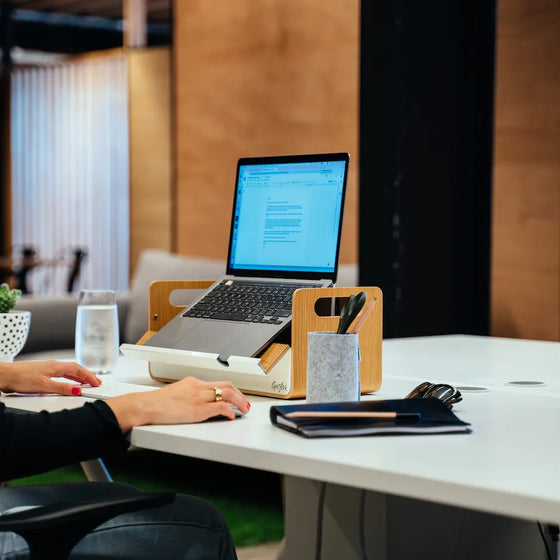
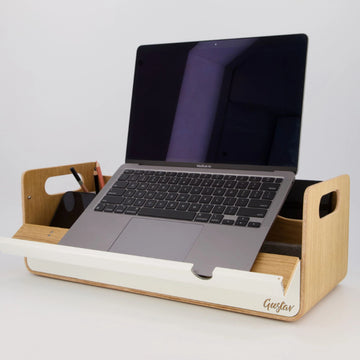
At the desk, the kit unfolded into a visible, orderly set-up. A laptop riser created a more comfortable screen height, while compartments gave small items a clear place rather than allowing them to spread across the worktop. On departure, everything returned to one portable home. The desk was ready for its next user without a separate clearing routine.
This is where products such as Gustav Original and DeskMate have a practical role. One provides an ergonomic, organised workstation on an otherwise standard table; the other helps carry the working day between locker, desk and meeting room. The design point is simple: mobility should not look or feel improvised.
Why the first approach had friction
The initial office design had assumed that shared desks would be accepted because they were attractive and available. In practice, employees assessed the model through smaller questions. Where do I put my charger? Can I raise my screen? Will I spend the first ten minutes searching for a free power point? What happens to my notes when I move to a meeting?
These are not minor complaints. Repeated daily, they create a feeling that the employee is serving the workplace system rather than the system supporting the employee.
The trial also showed that desk sharing is not one behaviour. A designer moving between project reviews has different needs from an analyst working with dual screens, and both differ from a manager spending much of the day in meetings. A uniform desk policy may be appropriate, but a uniform work kit is not always necessary. The team therefore offered a small range of portable organisers and allowed teams to define sensible essentials for their work.
Desk sharing adoption case study: the rollout
The change was introduced as a workplace service, not as a compliance exercise. The facilities and people teams presented the portable set-up as part of the new office experience: arrive, choose the right setting, create your workspace, then leave it ready for someone else.
Start with a pilot group
A pilot group from several functions used the system before the wider launch. Their feedback was specific and useful. Some wanted space for a notebook and pens; others prioritised a larger charger or a headset. One team needed materials that could move from desk to workshop table without being repacked.
That feedback shaped the final selection and, just as importantly, exposed practical constraints. If a locker is too small, a portable organiser becomes inconvenient. If desks lack accessible power, a tidy set-up still has a cable problem. If shared monitors are inconsistent, employees will protect favourite desks. Product choices work best when they support a complete workplace standard rather than compensate for gaps in it.
Make the desired behaviour visible
The team created a sample workstation near the entrance to the shared floor. It showed a clear desk, a raised laptop, a compact organiser and the amount of space still available for focused work. This helped employees see the difference between carrying loose items and carrying a prepared workspace.
Managers also used the shared settings themselves. That mattered more than an additional policy document. Desk sharing gains credibility when leaders demonstrate that a well-designed mobile set-up is suitable for concentrated work, not a second-best arrangement.
Give people a reason to pack down
A clear desk policy can sound like an instruction to remove evidence of work. Framed differently, it becomes a courtesy to the next person and a way to protect one’s own materials. The most effective message in the pilot was not “do not leave items behind”. It was “take your office with you”.
That language acknowledged a real need for continuity. Employees did not have to choose between a clean shared environment and access to their preferred tools. They could have both, provided their tools were designed to move.
What improved, and what did not
The workplace team noticed a calmer visual environment quickly. Fewer loose items remained at the end of the day, and desks were easier to reset between users. Employees who had previously arrived with a bag, a laptop and scattered accessories reported that their first minutes at a desk felt more deliberate.
The more meaningful change was behavioural. People began choosing spaces according to work mode because moving no longer meant starting over. A project table could be used for collaboration, followed by a focus desk for individual work, without leaving behind a trail of equipment.
Not every issue disappeared. Some roles still required fixed technical equipment, larger displays or secure paper storage. Desk sharing was not the right answer for every task or every team. The organisation retained dedicated provisions where the work required them, rather than forcing mobility for its own sake.
This distinction is central to good adoption. The goal is not maximum desk turnover. It is a workplace where shared settings are genuinely usable, and where dedicated settings remain available when the work calls for them.
Design principles to carry into your own rollout
First, treat the personal workstation as part of the office specification. A desk, chair and monitor define the shared infrastructure; portable organisation defines the user’s layer of comfort and continuity. Both need attention.
Second, design for a fast first minute. If employees can place their organiser, raise their laptop, connect power and begin without searching for small essentials, the workspace feels reliable. If setup is slow, even a beautifully planned office will feel less usable than a familiar fixed desk.
Third, specify durable materials that support everyday movement. Premium portable tools are handled repeatedly, placed on shared surfaces and carried through busy working days. Quality construction, recycled materials where appropriate and a calm visual language all contribute to an experience people are willing to adopt.
Finally, measure more than utilisation. Desk bookings show whether seats are being used, but not whether people feel supported. Observe end-of-day desk conditions, ask employees what they carry, and find out which work settings they avoid. These signals reveal where physical friction is holding the strategy back.
A successful shared desk is not an empty desk. It is a desk that can become someone’s well-organised, ergonomic place of work in moments - and return gracefully to a shared resource when they leave.