How to Specify Ergonomic Accessories at Work

A shared desk can look perfectly considered at 9am and become a compromised workstation by 9:15. A laptop sits too low, cables spread across the surface, and personal essentials have nowhere to go. Knowing how to specify ergonomic accessories is therefore not about adding more objects to a desk. It is about giving people a consistent, comfortable way to work wherever they sit.
For workplace strategists, designers and facilities teams, the best accessories make good habits easier. They support posture, reduce visual noise and allow a user to establish a personal work zone in moments. That matters in home offices, hot-desking environments and project spaces alike.
Start with the way people actually work
An ergonomic accessory specification should begin with observed work patterns, not a product category list. Ask where people work, how long they remain at a desk and what they carry between locations. A fixed workstation used for eight hours has different requirements from a touchdown desk used between meetings. A home worker with a dedicated desk needs something different again from an employee moving between lockers, collaboration spaces and quiet rooms.
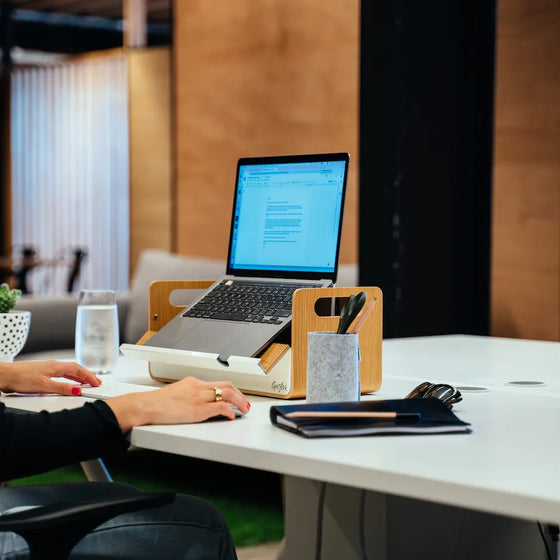
Look closely at the technology in use. Laptops create the most common ergonomic compromise because their screen and keyboard are connected. Raising the screen to a more comfortable height improves the viewing position, but it also makes the built-in keyboard unsuitable for sustained typing. Where laptop stands are specified for regular desk work, an external keyboard and mouse should normally form part of the same setup.
The physical setting matters too. Desk depth, monitor provision, storage, power access and cleaning routines all affect whether an accessory will be used. A beautifully made organiser that cannot be stored easily, or a stand that creates an awkward cable arrangement, will soon be left behind.
Define ergonomics as a complete desk condition
Ergonomics is not achieved by one elevated screen or one supportive chair. It is the relationship between the user, their equipment and the available work surface. Accessories should help people bring those elements into a sensible position without making the desk feel over-equipped.
For laptop work, screen height is a practical starting point. The display should be raised so the user is not continuously bending their neck towards the desk. The exact position varies with the individual, screen size and visual requirements, so avoid specifying a single, universal height as though it suits everyone. What matters is that the accessory creates a clearly better position for the intended use.
The keyboard and mouse need enough space to be used with relaxed shoulders and supported forearms. This is where shallow desks can expose a trade-off: a tall stand may improve the screen position but leave too little depth for an external keyboard. In these settings, consider a more compact laptop riser, a monitor-equipped desk, or a different workstation layout rather than forcing an unsuitable accessory into the space.
Accessories should also support order. A clear surface gives users room to position their tools correctly, while cable and stationery organisation reduces the small interruptions that make shared desks feel temporary. Good ergonomics is physical, but it is also about creating a calm, usable working environment.
Choose accessories as a coordinated system
The strongest specifications describe how products work together. They do not treat a laptop stand, organiser and carry solution as unrelated purchases.
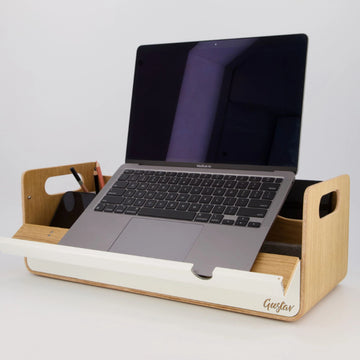
A portable laptop stand should be stable, quick to deploy and appropriate for the organisation's laptop sizes. Look for a working angle and height that improve screen placement without obstructing airflow or creating a precarious setup. It should feel dependable when typing patterns change or when the desk is lightly knocked.
An organiser should give everyday items a defined home: cables, chargers, pens, headphones and small personal equipment. In desk-sharing offices, this supports clear-desk policies without asking people to carry loose items from one workpoint to another. The form should be compact enough to sit comfortably on the desk, yet structured enough to prevent the surface becoming a holding area for clutter.
A mobile work bag or desk-sharing carrier has a different role. It needs to make transitions easier while protecting the equipment that moves with the employee. The best designs carry the essentials neatly, then help establish an organised desk on arrival. That continuity is particularly valuable when people alternate between the office, home and other work locations.
Gustav approaches this system through portable workspace tools, from the Original laptop stand and desk organiser to DeskMate, Loop and Echo. Together, these categories address the practical sequence of flexible work: carry, set up, focus and pack away.
How to specify ergonomic accessories for daily use
Write the specification around performance criteria before deciding on finishes or quantities. This keeps the brief focused on the employee experience and gives procurement teams a clear basis for comparing options.
For a flexible workplace, the specification should address four connected requirements:
- Ergonomic function: the accessory must support a more comfortable laptop, keyboard and mouse arrangement for the intended duration of work.
- Portability: it should be light and compact enough for users to move between work settings without reluctance.
- Organisation: it should contain or structure everyday tools, helping users arrive at a clear desk and leave one behind.
- Durability and material quality: it should withstand repeated movement, setup and storage while maintaining a professional appearance.
Materials deserve attention because accessories are handled more often than fixed furniture. Specify surfaces that feel considered and are suited to repeated everyday use. Recycled PET felt can bring softness and colour to a desktop while helping contain smaller items. Sustainably grown wood offers a warm, crafted counterpoint to the technical equipment it supports. The right choice depends on the interior, cleaning needs and expected intensity of use, not only visual preference.
Avoid over-specifying features that add complexity without a clear benefit. Multiple hinges, oversized compartments or a large footprint may look capable on paper but make an item slower to use and harder to store. In a desk-sharing environment, simplicity is a functional advantage.
Test the setup, not just the product
A sample review should replicate the real working day. Place the accessory on the desk types where it will be used. Ask people of different heights to work with it using their own laptop, keyboard, mouse and charger. Then ask them to pack it away, move to another desk and set up again.
Observe the details. Does the stand stay stable? Is there enough depth for comfortable keyboard and mouse placement? Can cables be managed without creating a tangle? Does the organiser genuinely reduce loose items? Does the whole setup fit the storage provision? These questions reveal far more than a catalogue image.
A short pilot with a representative group can also expose differences between teams. A design studio may need room for tablets and drawing tools, while a consultant-heavy workplace may place more value on fast pack-away and reliable carrying capacity. One universal accessory set can work well, but only when it reflects the most common work mode rather than an idealised one.
Build in adoption from the beginning
Even well-specified accessories need a simple introduction. Show employees how to raise a laptop, where to place an external keyboard and mouse, and how the organiser or carrier is intended to support a clean desk. A short setup guide at the point of use is often enough. The aim is not to prescribe a rigid desk ritual, but to make the better option obvious.
Consider replenishment and replacement at the same time. In high-use shared environments, accessories can be misplaced or separated from their companion tools. Clear ownership, accessible storage and a small reserve stock help maintain the intended experience over time.
The most effective ergonomic accessory is the one people choose without being prompted. Specify for the reality of movement, limited desk space and personal work preferences, and each desk can become a more comfortable place to do meaningful work.