Guide d'aménagement ergonomique de l'espace de travail pour le travail hybride

La différence entre un bureau fonctionnel et un bureau épuisant se mesure souvent en centimètres. Un écran légèrement trop bas, une chaise laissée sans réglage, un ordinateur portable utilisé à plat sur la table pendant des heures – de petits compromis s’accumulent rapidement. Ce guide d’aménagement ergonomique de l’espace de travail est conçu pour la manière dont les gens travaillent réellement aujourd’hui : entre bureaux à domicile, bureaux partagés et lieux de travail changeants.
Pour les équipes hybrides et les environnements de partage de bureaux, l’ergonomie ne peut pas dépendre d’un poste de travail fixe uniquement. L’aménagement doit être répétable, rapide à mettre en place et facile à maintenir. Cela change la conversation, qui ne porte plus sur l’achat d’une grande chaise ou d’un grand bureau, mais sur la création d’un système qui soutient la posture, le mouvement et la concentration où que le travail ait lieu.
Ce qu’un aménagement ergonomique doit vraiment accomplir
Un bon aménagement doit réduire la fatigue physique sans donner au bureau une impression clinique ou trop technique. Cela signifie soutenir une posture neutre, garder les outils essentiels à portée confortable et limiter les frictions de bas niveau causées par le désordre, un mauvais placement des câbles ou une hauteur d’écran inadaptée.
Il doit aussi refléter les véritables habitudes de travail. Quelqu’un qui passe huit heures à un bureau dédié à domicile a des besoins différents d’un consultant qui se déplace entre plusieurs sites clients ou d’un employé utilisant des bureaux partagés trois fois par semaine. Le principe reste le même, mais la combinaison de produits et le niveau de portabilité varient.
Les aménagements les plus efficaces équilibrent trois facteurs : l’ajustabilité, l’organisation et la constance. L’ajustabilité aide le corps. L’organisation facilite le flux de travail. La constance est importante car le corps remarque davantage une mauvaise position répétée que des imperfections occasionnelles.
Commencez par la posture, pas par les produits
La plupart des problèmes ergonomiques commencent par un problème fondamental : le corps qui s’adapte au bureau au lieu que le bureau s’adapte au corps. Avant d’ajouter des accessoires, il est utile de définir la géométrie de base du poste de travail.
La hauteur de la chaise vient en premier. Les pieds doivent reposer à plat sur le sol, ou sur un repose-pieds si nécessaire, avec les genoux à peu près au niveau ou légèrement en dessous des hanches. Le bas du dos doit être soutenu sans être rigidement maintenu droit. Si la chaise est trop basse, les épaules ont tendance à se relever et les poignets à s’effondrer vers le clavier. Si elle est trop haute, une pression s’exerce sous les cuisses.
La hauteur du bureau doit ensuite permettre aux avant-bras de reposer à un angle confortable, près du corps, sans hausser les épaules. Pour beaucoup, cela signifie des coudes proches d’un angle droit, mais la position exacte dépend des proportions du corps et du design de la chaise. L’ergonomie ne consiste pas souvent à atteindre une mesure précise, mais à réduire les tensions inutiles.
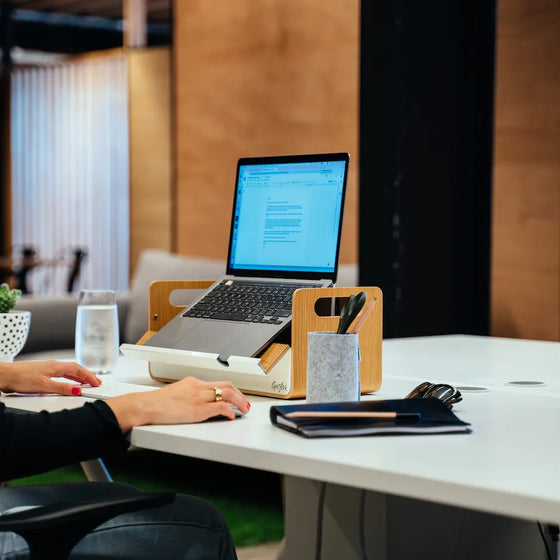
Le positionnement de l’écran est souvent là où de nombreux aménagements hybrides échouent. Un moniteur doit être placé assez haut pour que le haut de l’écran soit proche du niveau des yeux, à une distance de vision confortable. Si vous travaillez principalement sur un ordinateur portable, l’utiliser directement sur le bureau pendant de longues sessions force généralement la tête à se pencher en avant et vers le bas. Un support pour ordinateur portable est l’une des améliorations les plus simples car il rétablit la hauteur de l’écran sans nécessiter un aménagement permanent.
Le guide d’aménagement ergonomique pour le partage de bureaux
Le partage de bureaux crée un défi ergonomique spécifique : le poste de travail peut être techniquement bien conçu, mais mal configuré à chaque arrivée d’une nouvelle personne. En pratique, cela signifie que même des bureaux de haute qualité peuvent engendrer de mauvaises habitudes d’aménagement.
La solution est la rapidité et la simplicité. Si les utilisateurs ont besoin de dix minutes, de plusieurs câbles et d’un placard d’accessoires pour se sentir à l’aise, beaucoup ne prendront tout simplement pas la peine. Une meilleure approche consiste à rendre immédiates les actions ergonomiques clés : relever l’écran, positionner correctement le clavier et la souris, placer les documents pour pouvoir les lire sans se tordre, et garder les essentiels quotidiens organisés.
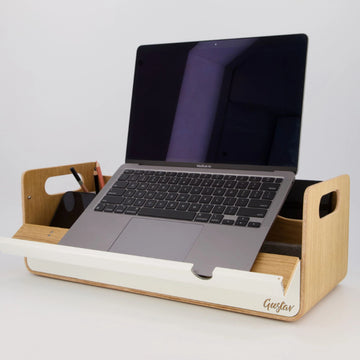
Les outils de bureau portables sont particulièrement utiles ici car ils transforment un bureau générique en un poste de travail familier en quelques secondes. Un support compact, un tapis de bureau qui délimite la zone de travail, et un organiseur ou une pochette qui contient le kit quotidien peuvent aider les utilisateurs à recréer la même configuration ergonomique sur différents bureaux. Cette constance est plus importante qu’elle n’y paraît. Le corps réagit bien à une bonne position répétée.
Pour les planificateurs d’espaces de travail et les équipes de gestion des installations, c’est aussi là que l’ergonomie rejoint la politique de bureau propre. Lorsque les accessoires sont mobiles, faciles à ranger et visuellement discrets, les employés sont plus enclins à les utiliser. L’aménagement paraît intentionnel plutôt qu’improvisé.
Placement de l’écran, du clavier et de la souris
Une fois le bureau et la chaise réglés, les dispositifs d’entrée doivent soutenir un haut du corps détendu. Le clavier doit être assez proche pour que les coudes restent près du torse. Tendre les bras vers l’avant pendant de longues périodes tend à tirer les épaules et le haut du dos en tension. Un clavier et une souris séparés sont généralement la meilleure option lorsqu’on utilise un support pour ordinateur portable, car ils permettent de positionner indépendamment l’écran et les mains.
La souris doit être placée près du clavier, pas sur un côté hors de portée facile. De petits ajustements font la différence ici. Si la souris est trop éloignée, le bras reste légèrement écarté pendant des heures, ce qui peut devenir fatigant même sans douleur évidente.
Il y a toujours une certaine variation selon la tâche. Les designers travaillant avec de grands écrans peuvent accepter une distance de vision légèrement plus grande. Quelqu’un qui écrit la majeure partie de la journée peut prioriser le placement du clavier avant tout. L’ergonomie est fonctionnelle, pas dogmatique.
Pourquoi travailler uniquement sur ordinateur portable est rarement idéal
Les ordinateurs portables sont excellents pour la mobilité mais pas pour une posture prolongée. L’écran et le clavier sont attachés, ce qui impose un compromis. Relever l’écran rend le clavier inutilisable. Abaisser le clavier fait pencher le cou vers le bas.
C’est pourquoi un aménagement modulaire fonctionne généralement mieux. Un support élève l’ordinateur portable à une meilleure hauteur, tandis que des dispositifs d’entrée séparés rétablissent une position plus naturelle des mains. Cette approche préserve la mobilité sans accepter la pénalité ergonomique habituelle.
Éclairage, confort visuel et calme sur le bureau
L’ergonomie ne se limite pas à la colonne vertébrale et aux poignets. La fatigue visuelle est tout aussi importante, surtout dans les bureaux à domicile où l’éclairage est souvent négligé. Une fenêtre lumineuse directement derrière l’écran peut créer des reflets, tandis qu’un éclairage uniquement au plafond peut laisser le bureau inégalement éclairé.
Idéalement, l’écran doit être perpendiculaire à la source principale de lumière plutôt que face à elle ou dos à elle. L’objectif n’est pas un éclairage parfait de studio, mais un confort visuel qui permet aux yeux de travailler sans adaptation constante.
L’organisation du bureau joue aussi un rôle ici. Une surface encombrée encourage des gestes maladroits, réduit l’espace de travail utilisable et crée du bruit visuel. En revanche, une disposition claire soutient à la fois la posture et la concentration. C’est là que les organiseurs haut de gamme et les accessoires de bureau trouvent leur place. Pas comme décoration, mais comme infrastructure pour un espace de travail plus calme et plus fonctionnel.
Privilégier le mouvement plutôt que l’immobilité parfaite
Une erreur courante en ergonomie est de supposer que la meilleure posture est une posture fixe. En réalité, le corps bénéficie de la variation. Même une chaise et un bureau bien réglés peuvent devenir inconfortables si la position ne change jamais.
Un meilleur objectif est le mouvement soutenu. Cela peut signifier alterner entre la saisie concentrée, la lecture et les appels vidéo tout au long de la journée, ajuster légèrement la chaise ou s’éloigner entre les tâches. Dans les environnements flexibles, cela peut aussi vouloir dire utiliser différentes zones pour différents types de travail plutôt que de forcer chaque activité dans une seule posture de bureau.
Cela importe autant pour les concepteurs de bureaux que pour les utilisateurs individuels. Un environnement ergonomique n’est pas seulement un poste de travail conforme. C’est un système de travail qui facilite les choix sains dans plusieurs contextes.
Un guide pratique d’aménagement ergonomique pour les bureaux à domicile
Les bureaux à domicile introduisent une autre couche de compromis car le mobilier domestique fait souvent office de mobilier de bureau. Les tables de cuisine, les petites pièces de rechange et les espaces de vie ne sont rarement conçus avec l’ergonomie en tête. Pourtant, un aménagement solide est possible sans encombrer la pièce d’équipements volumineux.
La priorité est d’établir une position de travail fiable qui peut être installée et rangée avec un minimum d’effort. Un support portable, une surface de travail définie et une solution de rangement pour câbles, chargeurs et dispositifs d’entrée peuvent transformer même un bureau temporaire en un poste de travail plus stable. Cela est particulièrement utile pour les professionnels qui ont besoin que l’espace soit résidentiel en fin de journée et très fonctionnel pendant les heures de travail.
Le choix des matériaux est aussi important. Les objets manipulés quotidiennement doivent être durables, raffinés et faciles à entretenir. De bons outils de bureau n’améliorent pas seulement la posture. Ils réduisent les frictions, soutiennent la routine et donnent au bureau une impression réfléchie plutôt que bricolée.
Quand la qualité du design rencontre la performance ergonomique
Les produits ergonomiques sont souvent jugés uniquement sur leur fonction technique, mais la qualité du design influence leur usage régulier. Si un accessoire est difficile à transporter, visuellement intrusif sur le bureau ou compliqué à ranger, il sera souvent laissé de côté. Dans le travail hybride, un équipement inutilisé n’a aucune valeur ergonomique.
C’est pourquoi les meilleures solutions allient fonction et sobriété. Elles facilitent une installation rapide, se transportent bien entre les lieux et s’intègrent harmonieusement dans les environnements professionnels et domestiques. Gustav réussit cela en considérant la portabilité, l’organisation et le soutien ergonomique comme un système d’espace de travail unique plutôt que comme des achats séparés.
Pour les employeurs et les prescripteurs, cette vision intégrée est utile. Elle aligne le confort des employés avec des bureaux plus propres, une meilleure utilisation de l’espace et une esthétique de lieu de travail plus cohérente. Pour les utilisateurs individuels, elle rend simplement le travail quotidien plus serein.
Un bureau bien réglé ne doit pas attirer l’attention toute la journée. Il doit être calme, soutenant et prêt en quelques instants – que vous travailliez depuis un bureau à domicile, une table de projet ou un bureau partagé à l’autre bout du bâtiment. C’est généralement le signe le plus clair que l’aménagement remplit sa fonction.
Créez dès aujourd’hui votre espace de travail ergonomique idéal.
Gustav conçoit des organiseurs de bureau portables primés, conçus pour soutenir une meilleure posture, réduire le désordre et vous accompagner partout où vous travaillez. Fabriqués de manière durable à partir de bouteilles d’eau 100 % recyclées.
⭐⭐⭐⭐⭐ Red Dot Design Award · Apprécié par plus de 5 000 travailleurs hybrides à travers l’Europe
Acheter des accessoires ergonomiques →Livraison gratuite en UE dès 90 € · Retours sous 30 jours