A Flexible Office Storage Case Study That Worked

A flexible office storage case study rarely begins with storage. It begins with a familiar 09:15 problem: a colleague arrives at a shared desk with a laptop, charger, notebook, water bottle and nowhere appropriate to place them. The desk is technically available, yet it does not feel ready for work.
For workplace teams, this is more than a question of tidiness. When personal equipment has no clear home, clean-desk policies become difficult to maintain, desk changeovers take longer, and employees lose the sense of ownership that makes a flexible office feel considered rather than temporary.
This illustrative case study follows a mid-sized professional services team moving from assigned desks to a desk-sharing model. Its experience shows why office storage works best when it is designed as part of the full user journey: arrival, setup, focused work, meetings and departure.
The brief: less fixed storage, better daily setup
The organisation had consolidated two floors into one flexible workplace for 120 people. The new space offered 84 bookable desks, project rooms, quiet areas and informal meeting settings. It was carefully planned, but the first weeks exposed a practical gap.
Each team member had previously relied on a pedestal unit, a drawer and the small collection of personal items that naturally accumulated around an assigned desk. In the new environment, those belongings had to travel. Lockers were available, but they were being used as long-term cupboards rather than efficient daily storage. Desks collected spare cables, notebooks and unclaimed accessories. Employees also carried loose items between lockers, desks and meeting rooms, creating clutter at every stage.
The facilities team did not want to solve the issue by adding more bulky furniture. That would reduce the very flexibility the new layout was intended to create. The brief was more precise: give people enough storage for a working day, support a fast and ergonomic setup, and keep shared spaces visibly calm.
That distinction matters. Flexible office storage is not simply about increasing capacity. It is about placing the right capacity in the right place, for the right length of time.
Mapping the storage journey
The project team began by observing how people actually moved through the office. This revealed that storage needs fell into three different categories.
The first was secure personal storage. Employees needed a reliable place for items they did not want to carry all day, such as spare footwear, confidential papers where permitted, or personal belongings. Lockers were the natural answer, but only when sized and managed for day-to-day use rather than treated as a permanent substitute for a desk drawer.
The second was mobile work storage. This included a laptop, charger, headset, notebook, pens, access pass and water bottle. These were the items employees needed at their desk, in a meeting room and sometimes at home. They needed to move as one organised kit, not as a handful of loose objects.
The third was shared team storage. Stationery, adapters, presentation materials and supplies still needed a home, but not on every desk. Locating these resources at clearly defined neighbourhood points kept desktop surfaces clear without making everyday essentials difficult to find.
This simple mapping prevented a common mistake: expecting one solution to serve every purpose. A locker is excellent for security, but inconvenient for carrying a charger to a project room. A desk organiser creates order at the workstation, but is not intended to store a winter coat. The strongest schemes combine fixed, mobile and shared storage deliberately.
The key design decision: make mobility visible
The team introduced a personal mobile-work kit for employees who regularly used shared desks. Rather than issuing a generic bag and hoping it would be used, the kit was designed around the actual setup sequence.
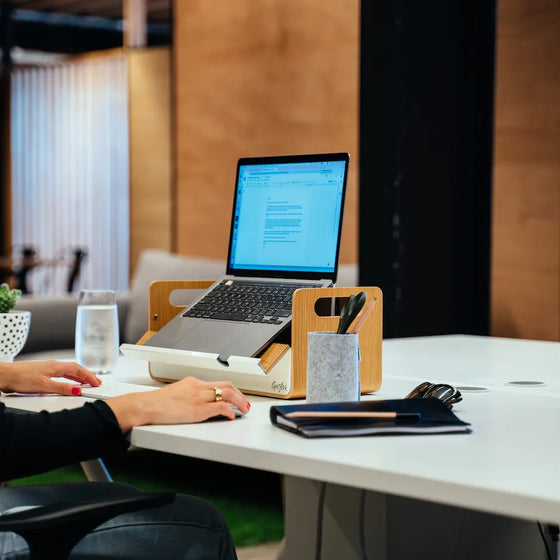
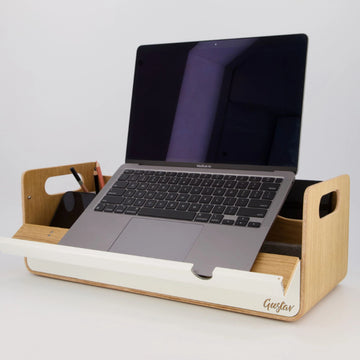
A portable desk-sharing bag held the daily essentials in defined compartments and created a clear transition between locker and desk. At the workstation, a compact organiser and laptop stand gave each person a place for cables, stationery and their device. The result was not a replica of an assigned desk. It was a consistent personal setup that could appear, function and disappear within minutes.
Gustav's DeskMate and Gustav Original are designed for precisely this kind of routine: carrying essential equipment, reducing visual noise and creating a more ergonomic workstation from almost any table. For a workplace project, the value lies in the system, not in adding accessories for their own sake.
A flexible office storage case study in practice
The rollout was piloted with a 24-person consulting team before the wider office adopted the approach. The pilot group had varied work patterns: some spent most of the day at a desk, while others moved frequently between client calls, project rooms and collaborative zones.
On arrival, each employee collected their mobile kit from a locker, selected a booked desk and set up. The workstation sequence was intentionally uncomplicated. Laptop, power and notebook came out first. Cables and smaller accessories remained contained until needed. At the end of the day, the kit returned to the locker or travelled home.
Shared supplies were removed from individual desks and placed in two visible resource points near the team area. This included spare charging leads, basic stationery, cleaning materials and equipment for ad-hoc meetings. Clear ownership was assigned for replenishment, avoiding the familiar problem of a communal cupboard that slowly becomes unusable.
The project team also established a small set of workplace conventions. Desks were for active work, not storage. Lockers were for personal items and daily kits. Shared resources belonged at resource points. These rules were displayed during onboarding and reinforced by the physical layout, rather than relying on reminders alone.
After several weeks, the pilot team reported fewer abandoned items at desks and less time spent searching for everyday equipment. More revealingly, employees described the office as easier to use. That response is significant. The objective was not only a cleaner photograph of the workplace. It was a more dependable experience from one workday to the next.
What made the approach work
The success of the pilot was not down to a single product or policy. It came from removing friction at the moments when people changed location.
First, the mobile kit gave employees a practical alternative to leaving items behind. Clean-desk behaviour is far more likely when there is an elegant place for belongings to go. Second, the setup tools made shared desks feel genuinely usable. A portable laptop stand and organiser can establish visual order and improve screen height without permanent equipment attached to every desk.
Third, the office separated personal and communal ownership. Employees knew what they were expected to carry, what was safely stored, and where shared equipment belonged. That clarity reduced duplication. It also helped the facilities team see which resources were being used and which were merely occupying space.
The premium details mattered as well. When mobile workspace tools are durable, well-organised and pleasant to use, they signal that desk sharing has been designed for people, not simply imposed on them. Materials, proportions and finish influence adoption because employees interact with these objects every day.
The trade-offs workplace teams should plan for
This model is not a reason to remove all storage. Some roles handle physical samples, specialist hardware or paper records that require additional provision. Teams with high volumes of confidential material may need secure cabinets, controlled access or different document processes. Storage planning should follow the work, not a fashionable floorplan.
There is also a balance between locker size and mobile-kit size. Oversized lockers can encourage long-term accumulation. Undersized lockers make the daily routine frustrating. The right dimensions depend on whether people commute with a laptop, cycle to work, visit clients, or split time between office and home.
A pilot is useful because it exposes these realities before a wider rollout. Observe where bags are put during meetings, whether people can find shared equipment, and what still lands on desks at the end of the day. These small behaviours reveal more than a static storage schedule.
Designing storage as part of employee experience
Flexible offices are often judged by their most visible features: meeting rooms, collaboration areas and desk technology. Yet storage quietly determines whether those spaces remain functional throughout the day. It shapes how quickly a person can settle in, how confidently they can move, and whether a shared desk feels anonymous or ready for purposeful work.
The lesson from this flexible office storage case study is straightforward: give every item a logical place, but do not force every item into fixed furniture. Secure what must stay. Share what belongs to the team. Make the daily workspace portable.
When people can carry a complete, organised setup from locker to desk to meeting room, the office stays calmer without asking employees to work with less. It simply gives them a better way to work wherever the day takes them.