Wood Desk Accessories vs Plastic: Which Works?

A desk organiser is rarely just a place for pens. In a home office, it shapes the surface you see for hours. In a desk-sharing workplace, it needs to travel well, settle quickly and leave a clear desk behind. That is why the choice between wood desk accessories vs plastic deserves more thought than a simple question of appearance.
Both materials can serve a purpose. Plastic can be light, wipe-clean and economical for high-volume use. Wood brings a warmer visual language, a more considered tactile quality and, when designed well, the sense that a workspace is a place for focused work rather than temporary storage. The right answer depends on how your people work, move and maintain their space.
Wood desk accessories vs plastic in flexible workplaces
Material choices become more visible when a desk is shared. A fixed personal office can accommodate almost any organiser, because it stays in one place and gathers its own familiar collection of objects. Hot-desking changes the brief. Accessories must support a quick arrival, an organised working day and an equally quick reset.
Plastic desk accessories are common for understandable reasons. They are often moulded into practical shapes, tolerate spills well and are easy to standardise across a large workplace. For stationery trays in a supply cupboard or simple cable clips, this can be entirely appropriate. Their light weight is useful when an item is moved often, although very light pieces can also slide, tip or feel insubstantial during daily use.
Wood is better suited to the moments where the desk needs to feel intentional. A well-made wooden organiser has visual presence without asking for attention. Its grain and natural variation soften the harder surfaces of screens, metal frames and laminate tables. In a workplace designed around calm, considered zones, that difference is not decorative excess. It helps create a setting people are more willing to maintain.
The distinction is not that wood is always premium and plastic is always practical. Poorly finished wood can mark or warp; well-engineered plastic can perform reliably for years. The useful question is whether the accessory has been designed for its task, its environment and its expected lifespan.
Appearance matters because behaviour follows
A clear-desk policy works best when people can see an obvious place for the items they use. Accessories that look temporary are more likely to be treated as temporary, becoming overfilled, moved aside or replaced without thought. A refined organiser gives everyday objects a defined home and makes a clean reset feel natural.
Wood has a particular advantage in hospitality-led office design, home workspaces and client-facing areas. It sits comfortably alongside felt, fabric, paper and other tactile finishes, bringing visual warmth without adding visual noise. For architects and workplace planners, it can also connect a workstation to a wider interior palette without turning each desk into a styled display.
Plastic offers broader colour freedom and can work well where colour coding supports wayfinding, team zones or storage systems. The risk is visual fragmentation. A collection of unrelated plastic trays, stands and holders can make an otherwise well-planned desk feel busy. If plastic is the preferred material, consistent colour, proportion and finish matter greatly.
Durability is about construction, not only material
The most useful desk accessory is one that still works properly after hundreds of setups. That means looking beyond the headline material. Are edges protected? Does the base remain stable? Will moving components keep their shape? Can the surface withstand the routine contact of a laptop, charger, water bottle or bag?
Plastic resists moisture well and is simple to clean, making it a sensible option for shared utility items and environments with frequent wipe-down routines. However, some plastics can scratch, discolour or become brittle over time, particularly where thin sections carry weight or receive constant friction. A scratched, glossy plastic surface can quickly look tired in a highly visible workspace.
Wood requires more care around standing water and harsh cleaners, but it can age with greater character when it is properly finished and treated with respect. Small marks are often less visually jarring on a matte wood surface than on a smooth synthetic one. More importantly, a solid, carefully designed wooden piece tends to invite repair-minded behaviour rather than immediate replacement.
For procurement teams, durability should be assessed in context. A stationery cup in a fixed office has different demands from a portable organiser that is packed, carried and placed on unfamiliar tables every day. Ask how the item performs in motion, not just how it looks in a product image.
Portability changes the material decision
Weight matters when people carry their workspace between lockers, desks, meeting rooms and home. Plastic has an obvious advantage for accessories that need to be exceptionally light. Yet low weight alone does not create portability. A useful mobile organiser must also hold its contents securely, protect equipment and create an orderly setup once opened.
Wood can work exceptionally well in portable products when it is used selectively and intelligently. Rather than making every part heavy, a wooden surface can provide structure, stability and a comfortable work plane, while other elements manage storage and carrying. This combination gives users a more grounded workstation without asking them to transport a permanent desk.
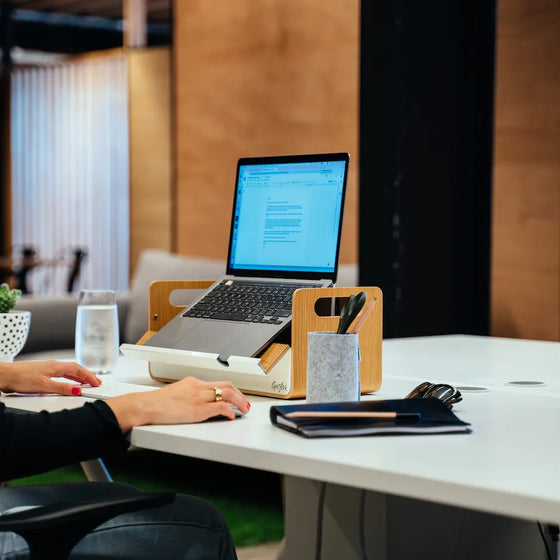
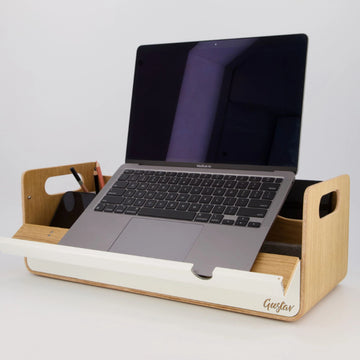
Gustav Original reflects this approach: a portable organiser and ergonomic laptop stand designed to turn an available table into a more comfortable workstation in seconds. Here, the material is part of the working experience. It supports a stable setup while helping users keep essential tools together, rather than treating organisation as an afterthought.
Ergonomics should lead the choice
Neither wood nor plastic automatically improves posture. Ergonomic value comes from dimensions, angles, stability and the ability to position a laptop or accessories where they support comfortable work. Material contributes when it helps the product remain steady, durable and pleasant to use throughout the day.
A laptop stand that flexes, slips or feels too light for its load creates friction at exactly the moment a user is trying to get settled. Conversely, an overly heavy item may be left in a locker or at home, defeating the point of mobile ergonomics. The best designs resolve this tension through balanced construction, not by relying on material alone.
Consider how the item behaves on different surfaces. Shared offices include meeting tables, touchdown counters and standard desks. Home workers may use dining tables or compact worktops. A quality accessory should sit confidently across these settings and protect the surface beneath it where appropriate.
Maintenance and hygiene need a realistic plan
Plastic is often chosen because it is straightforward to wipe down. In shared environments, that is a genuine operational advantage. Smooth, non-porous surfaces make routine cleaning simple, especially for accessories handled by many people.
Wood needs a more considered cleaning approach. A lightly damp cloth and suitable mild cleaning method are generally preferable to soaking or aggressive chemicals. That does not make wood unsuitable for shared workspaces. It means facilities teams should match their cleaning protocol to the materials they specify, just as they would with upholstery, felt or coated finishes.
The same principle applies to perceived hygiene. A visibly worn plastic tray may look harder to clean even when it is perfectly serviceable. A well-maintained wooden organiser can communicate care and quality. The material must be supported by an appropriate maintenance routine, not expected to solve it on its own.
A better specification question
Instead of asking whether wood or plastic is universally better, define what the accessory must achieve. Is it a lightweight communal storage item? Is it part of an employee's personal mobile setup? Will it be seen by clients? Does it need to support a laptop, contain cables or simply keep small stationery in one place?
Plastic is often the sensible choice for simple, high-turnover utility pieces where washability and minimal weight are the priority. Wood is often the stronger choice when the accessory is central to the workstation, needs to feel stable and enduring, or contributes to the visual quality of a shared environment. Hybrid material solutions can be especially effective, combining a structured wood element with softer recycled felt or durable technical fabrics.
A thoughtfully specified desk accessory does more than hold objects. It signals how a workplace expects to be used: with clarity, care and enough flexibility for people to make any available surface feel like a place to do their best work.