Clean Desk Policy: Template and How to Implement It in the Office

Friday, 5.40 pm. Half the desks in the open-plan office are empty – but not free. One has a stack of printouts with customer data on it, the next a Post-it with a password stuck to the monitor, the third has held the same coffee mug since Monday. If you plan to roll out desk sharing on Monday, you have a problem: without clear rules, shared desks quickly turn into arguments about occupied desks. That is what a clean desk policy is for. This article gives you a template you can adopt as it stands, and an honest view of where implementation fails in practice.
What a clean desk policy covers – and what it doesn't
A clean desk policy is a written guideline that sets out how a workstation is left when you walk away from it. It originally comes from data protection: no confidential documents, no unlocked screens, no written-down credentials on the desk. Since GDPR, that has become standard practice for most companies.
In recent years a second reason has been added: desk sharing. When desks are no longer assigned, every workstation has to look, at the end of the day, as if someone else could use it the next morning. A clean desk policy therefore regulates two things at once: data security and availability.
What it does not regulate is where your belongings should go instead. That is the point at which most policies quietly fail.
Clean desk policy: a template you can adopt
The template below covers the six areas that appear in practically every policy that works. Adjust the wording and the exceptions to your organisation.
- Scope. Who and which areas does the policy apply to? (For example all desk-sharing zones, meeting rooms, home-office workstations with company equipment.)
- Documents and storage media. Papers containing personal or confidential data are kept in lockable cabinets or lockers when you are away. USB sticks and external drives are not left in view. Printouts no longer needed go into the shredder, not the recycling bin.
- Screens and credentials. Devices are locked whenever you leave the desk. Passwords are not written down – not on Post-its, not in notebooks.
- End of the working day. The desk is cleared completely: no personal items, no crockery, no cables. Monitor, docking station and chair stay; everything else is taken home or stored in the locker.
- Exceptions. Which workstations remain assigned, and why (reception, lab, special ergonomic equipment)? Exceptions belong in the policy, not in corridor conversations.
- Responsibility and non-compliance. Who is the point of contact? What happens when a desk has not been cleared? A two-step approach works well: a friendly reminder, then a conversation with the line manager – no sanctions as a first step.
A note for Germany: as soon as the policy regulates employee conduct, the works council has co-determination rights under section 87 of the Works Constitution Act (BetrVG). Involve it from the start, not as the final step.
Implementation: three approaches compared
1. The policy alone
You write the policy, email it round and pin it up. Cost: close to zero. Success rate: low. Without storage and without a routine, everything either ends up back on the desk or in rucksacks left underneath it. After four weeks the office looks exactly as it did before.
2. Policy plus lockers
Everyone gets a lockable compartment. That solves the data-protection question. What it does not solve is the daily trip between locker and desk. Anyone who spends five minutes every morning fetching laptop, charger, mouse, notebook and pens one by one from the locker, and five minutes every evening putting them back, stops doing it fairly quickly – and leaves the desk half cleared.
3. Policy plus lockers plus a personal organiser
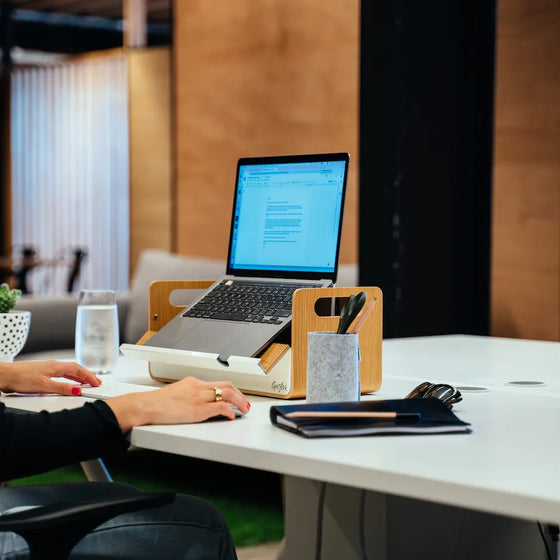
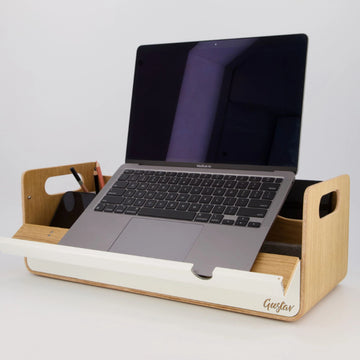
The difference is a single movement: all work tools live in one container that travels as a whole from locker to desk and back. The desk is set up in a minute and cleared in a minute. In our experience with companies of 50 to 5,000 employees, this is the approach that is still being followed six months later. It is also the most expensive – add €109 to €139 per person.
Which option suits you?
You are introducing desk sharing and people stay in the building. Then you need something that sits in a locker and keeps the desk tidy without looking like a removal box. The Loop Desk Caddy (€109) is exactly that: 42 × 20 × 13.5 cm, 900 g, made from 100% recycled PET felt with an oak-veneer centre section, with an organiser panel and pen holder. Laptop, keyboard and notebook fit inside, and nothing more – which is deliberate.
Your employees commute between office, home and client sites. Then the organiser also has to be a bag. The DeskMate Work Bag (€139) has a fold-out organiser panel, a padded compartment for laptops up to 17 inches, and stands up on its own. The material is REPREVE® fabric made from recycled plastic bottles, water-resistant, 1.2 kg. It does not replace the locker, but for commuters it often makes one unnecessary.
You want to solve this for a whole team or site. Then have a look at our desk-sharing solutions for businesses – including a pilot programme from 25 units.
Who should not buy this
To be frank: if your team has fewer than ten people, everyone keeps a fixed desk and no confidential paper documents are involved, you need neither a formal clean desk policy nor organisers to go with it. A team agreement is enough. And if there is no budget for lockers, a caddy on its own does not solve the data-protection problem – buy the cabinets first.
For businesses: pilot before rollout
We advise facility and workplace teams not to start with the whole site. A six-week pilot with 25 people in one desk-sharing zone shows whether policy, lockers and organisers work together – and gives you evidence for the works council. Gustav supports such pilots with specification, procurement and onboarding; framework agreements and leasing are available. Details are on the business page.
Frequently asked questions
Is a clean desk policy a legal requirement?
Not as such. GDPR does, however, require "appropriate technical and organisational measures" to protect personal data. A clean desk policy is one of the simplest organisational measures you can use to demonstrate that.
Does the works council have to agree?
In Germany, yes, where the policy regulates conduct in the workplace (section 87(1) no. 1 BetrVG). Austria and Switzerland have different rules, but there too, early involvement of staff is the difference between acceptance and resistance.
What may stay on the desk at the end of the day?
Only what belongs to the desk: monitor, docking station, keyboard and mouse if they are provided. Everything personal – including chargers and mugs – goes home or into the locker.
Does a clean desk policy work without desk sharing?
Yes. As a pure data-protection measure it makes sense for assigned desks too. The rules on documents, screen locking and credentials apply unchanged; the "clear the desk completely" point can be dropped.