Guide to Desk Hoteling Accessories That Work

A shared desk should not feel like a compromise. Yet when people arrive with a laptop, charger, notebook, headset and water bottle, an unplanned setup quickly becomes cluttered and uncomfortable. This guide to desk hoteling accessories focuses on the physical tools that help people claim a workspace with purpose, then leave it clear for the next colleague.
The goal is not to fill every desk with more objects. It is to give employees a small, considered system that travels easily, supports healthier posture and makes every workstation feel ready in minutes. For workplace teams, that means accessories need to work as part of the office experience, not as an afterthought.
Start with the desk hoteling experience
Desk hoteling succeeds when the practical details are easy. Employees should be able to find a desk, carry what they need, set up without searching for equipment and reset the space at the end of the day. If any stage creates friction, people bring too much from home, leave personal items behind or avoid certain workstations altogether.
Accessories bridge the gap between a standard desk and an individual’s working needs. They allow the desk itself to remain clean and shared, while the user brings the elements that make it comfortable and functional. This is particularly useful in activity-based offices, where a focus desk, touchdown table and meeting room may all form part of one working day.
Before selecting products, define the behaviour the workplace needs to support. A team that moves only between lockers and assigned neighbourhoods needs a different solution from consultants who travel between client sites, or designers who carry paper samples and larger devices. The best accessories are proportionate to the real journey, not an idealised one.
The essential desk hoteling accessories
A portable laptop stand
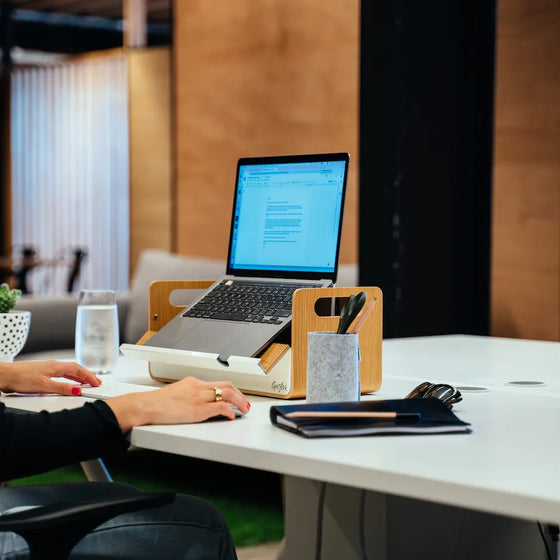
For many desk-sharing environments, a laptop stand is the most valuable starting point. It raises the screen closer to eye level, helping users avoid spending hours looking down at a low display. Paired with an external keyboard and mouse where appropriate, it creates a more comfortable workstation from almost any table.
Portability matters as much as height. A stand that stays in a drawer may be beautifully engineered but adds little value to a hoteling model. Look for a stable, compact design that opens quickly, packs flat or fits inside a mobile organiser, and feels appropriate in both the office and home workspace.
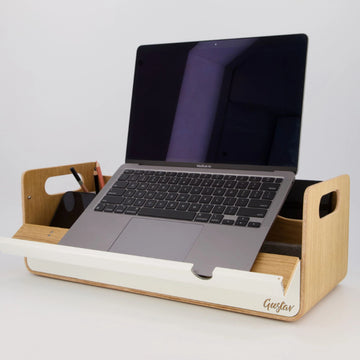
There is a trade-off. Ultra-light stands can be convenient for travelling but may offer less stability or fewer height options. For teams using larger laptops or working at shared desks all day, a sturdier portable organiser with an integrated ergonomic laptop stand can be the better choice.
A mobile desk organiser or work bag
The most effective desk hoteling accessory is often the one that gets everything else to the desk. A dedicated organiser or desk-sharing bag gives employees a place for their laptop, notebook, cables, headphones, stationery and everyday personal essentials. It replaces the improvised tote bag full of loose equipment with a clear, repeatable routine.
Choose a format based on the distance people travel. A compact organiser is ideal for colleagues who move within one office and want an orderly desktop on arrival. A larger carry solution is better for people walking from lockers to desks, meeting rooms and public transport, especially when they need documents, a bottle or a second device.
The interior should make access obvious. Separate sections reduce cable tangles and keep small items visible. On the desk, the product should create a defined personal zone rather than becoming another piece of clutter. That distinction matters: a portable system should help employees unpack less, not spread more across the tabletop.
A cable and charger organiser
Cables are small, but they are usually the first sign that a clean-desk policy has lost momentum. Chargers disappear into bags, adaptors are borrowed and returned late, and a shared workstation accumulates an untidy collection of leads. A compact tech organiser gives each item a consistent home before, during and after the working day.
For employees, it means fewer frantic searches before a meeting. For facilities teams, it reduces the visual noise that can make an otherwise well-designed office feel unmanaged. It also helps protect equipment from the wear that comes with being repeatedly thrown into a backpack or locker.
Avoid oversized cable cases unless the role genuinely requires several adaptors or specialist technology. Most people need a simple solution for a charging cable, power adaptor, mouse, earbuds and a few small essentials. The right organiser should be easy to bring everywhere, not another item left behind.
A desk mat or defined work surface
A desk mat is not essential for every workplace, but it can add real value where employees use varied tables or want a more consistent visual and tactile setup. It establishes a clear working area for a laptop, keyboard and mouse, while protecting the desk surface and softening the feel of hard communal tables.
It also supports a sense of ownership without making a desk permanent. When the day ends, the mat rolls, folds or packs away with the user, and the desk returns to a neutral state. For organisations focused on a calm, considered office aesthetic, this simple boundary can make desk sharing feel more intentional.
Material choice depends on the environment. A slim, wipeable surface may suit high-turnover touchdown spaces, while a more tactile material can work well for quieter home offices and studios. In either case, select colours and finishes that support the wider interior scheme rather than compete with it.
A compact stationery organiser
Shared offices often underestimate analogue work. Even highly digital teams still use pens, sticky notes, reading glasses, index cards and notebooks. Without a home for these items, they migrate into drawers, meeting rooms and communal surfaces.
A small desktop organiser keeps frequently used tools accessible without claiming too much space. It is particularly useful when a workstation has no personal pedestal storage or when desks are deliberately designed with minimal fixed furniture. Choose one that is light enough to move, refined enough to sit in an open-plan setting and sized for the tools people actually use.
How to build an accessory system, not a collection
The strongest approach combines a few pieces that work together. Start with the employee journey: carry, set up, work, pack down. At each stage, ask whether the accessory removes a task or creates one.
For example, a laptop stand solves posture but does not solve transport. A work bag solves transport but may not create an organised desktop. A cable pouch protects small technology but does not support screen height. Together, carefully chosen items create a complete mobile workstation.
Gustav approaches this as a coordinated workspace system: an organiser that supports laptop ergonomics, a desk-sharing bag for movement through the office, and compact organisers for the smaller tools that otherwise create friction. This kind of consistency helps employees understand how to use the space and helps workplace teams specify fewer, better products.
Avoid issuing a large assortment without guidance. Too many choices can lead to uneven experiences across teams and make storage harder to manage. A core kit for most employees, with additional options for roles that need them, is usually more effective. It also makes replacement, cleaning and onboarding simpler.
What workplace teams should specify
For architects, facility managers and workplace strategists, the specification should go beyond appearance. Assess durability, ease of cleaning, portability, storage footprint and how accessories perform across the desk types in the office. A product that looks excellent on a bench desk may be less useful on a small touchdown table or at a café-height work surface.
Consider where each item lives overnight. If employees use lockers, test whether the organiser, bag and laptop fit comfortably together. If the office relies on neighbourhood storage, make collection points obvious and close to the desks they serve. Storage that is inconvenient will undermine even the most thoughtful accessory programme.
Material choices deserve scrutiny too. Premium accessories should withstand regular movement and daily handling while maintaining a professional finish. Sustainably grown wood and recycled materials can add substance to the specification when they are paired with durable construction and a clear practical role.
Finally, test with a representative group before a wider roll-out. Include employees who work from home, move between floors, use different laptop sizes and rely on paper-based materials. Their feedback reveals whether the system supports real habits, rather than only looking well resolved in a presentation.
Make reset part of the design
A clear desk at the end of the day is not created by signage alone. It comes from giving people somewhere sensible to put their things. When accessories pack away quickly and naturally, reset becomes the easiest final step.
The best desk hoteling setup is quiet in the best sense: no loose cables, no improvised piles and no lengthy adjustment period before work can begin. Give people a portable place for the essentials, a better screen position and a defined surface for focus. The office remains shared, while every user can still make it their own for the day.