Felt Desk Organiser: Who It Suits (and Who Should Skip It)

Tuesday, 9:05, second floor. You have a different desk from yesterday – as you have every day since the office switched to desk sharing. Laptop in one hand, coffee in the other, notebook under your arm, and the charging cable dangling somewhere out of your jacket pocket. This is usually the point at which people start searching for a felt desk organiser. Soft, quiet, light, and closer in look to a living room than to an open-plan office – it sounds like the obvious answer. Often it is. Not always. This guide covers the types of felt organiser on the market, what to check before you buy, and who should not buy one at all.
Why felt – and what felt cannot do
Felt has three real strengths in an office. It is quiet: a felt organiser set down or slid across a desk makes no sound, which matters more in an open-plan space than it seems. It is light, usually well under a kilo, which makes it the natural material for anything carried every day. And it is gentle: neither your laptop nor the desktop picks up scratches.
The honest weaknesses: thin, soft felt loses its shape quickly, attracts dust and crumbs and is hard to clean. Cheap felt pills within months. And felt on its own holds nothing up – if you are after a laptop stand, you are in the wrong place. Whether a felt organiser lasts years or sags after a quarter comes down almost entirely to one question: how was the felt constructed?
The three constructions compared
1. Stitched soft felt
The cheapest and most common type: sheets of felt cut and sewn together, often as a hanging organiser or a fabric basket. Pros: price, colour choice, low weight. Cons: little inherent stiffness, compartments collapse as soon as anything heavy goes in, and the seams are the usual point of failure. Perfectly fine for pens and sticky notes at a fixed desk. Not ideal for carrying between desks every day.
2. Thermo-moulded PET felt
Here, felt made from recycled PET bottles is pressed into a rigid shape under heat and pressure. The result feels like felt but behaves like a box: holds its form, no seams, clearly defined compartments. This is the construction built for desk sharing, because the caddy keeps its shape with a charger, mouse and water bottle inside. Downsides: more expensive than stitched felt, and deep dents from rough handling stay visible. Gustav Loop and Loop XL fall into this category.
3. Felt as a lining in wood or metal
The body is wood or aluminium; felt serves as padding and divider inside. You get the rigidity of the body and the protection of the felt – and the weight of the body too. For a fixed workstation this is often the longest-lasting option; for commuters it becomes a question of how strong your back is. Gustav Dot, for example, pairs oak veneer with an organiser panel in recycled PET felt.
What really matters when you buy
- Rigidity. Press the side wall in. Does it spring back or stay dented? An organiser that only looks good when empty will not help you on a Tuesday.
- Weight and handles. If it is carried daily, every gram counts – as do handles that work one-handed, because the other hand is holding the coffee. Under a kilo is a good benchmark.
- Compartments that match your things. Pens need something tall, chargers and headphones something wide, notebooks something flat. A single large compartment turns into a lucky dip.
- Where the material comes from. "Felt" says nothing about sustainability. Recycled PET felt made from bottles is a different thing from virgin polyester. Ask about the recycled content, not whether "eco" appears in the product name.
- Cleaning. Rigid felt can be vacuumed and wiped with a damp cloth. Soft felt attracts fluff and tends to stay looking the way it did after the first coffee incident.
Who should not buy a felt organiser
Candidly: if you need to store A4 binders, stacks of paper or a 15-inch laptop, do not buy a felt organiser. If you have allergies and work in a dusty environment, you will be happier with a smooth surface. If your desk is fixed and you want something that reads as furniture, a wooden organiser is the better choice. And if you want to spend under 30 euros, you will be buying stitched soft felt – fine at a fixed desk, just do not expect it to survive desk sharing.
Which option suits you?
You change desks daily and carry a laptop, charger, mouse, pens and a notebook. You need thermo-moulded felt with handles. Gustav Loop (€92) weighs 0.9 kg, is made from 100% recycled PET felt with an oak-veneer centre panel, and comes with a pen holder and organiser panel. Six colours – handy when several colleagues use the same caddy.
You carry more – two chargers, over-ear headphones, a water bottle. Loop XL (€101) is the larger version with the same construction.
You want felt inside but wood outside. Gustav Dot (€118) is an oak-veneer organiser with a recycled PET felt panel – heavier than Loop, but made in Europe and visually closer to furniture than to office supplies. The full range is in the desk organiser collection.
For businesses: felt caddies in desk sharing
Introducing desk sharing takes the personal desk away from employees – and, done well, hands back a personal caddy. Felt has two advantages here: it is quiet in an open-plan office and it protects desktops that are now shared by many people. Loop comes in a box of 8 and Loop XL in a box of 4, each in several colours to distinguish teams or floors. Volume pricing and options are on our business page.
Frequently asked questions
How do I clean a felt organiser?
Vacuum rigid PET felt or wipe it with a slightly damp cloth. No washing machine, no harsh cleaners. Blot spills immediately rather than rubbing.
Is recycled PET felt actually more sustainable?
It uses existing material instead of new petroleum – a real advantage. It is still plastic, though. The bigger lever is longevity: a caddy that lasts five years beats any materials debate.
Will a felt organiser hold my laptop?
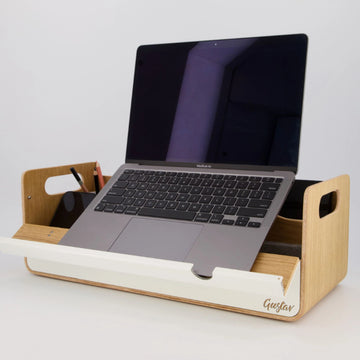
No. Felt caddies are built for accessories, not as laptop stands. For an organiser with an integrated stand, look at Gustav Original.
Loop or Loop XL?
If you only carry pens, a charger, a mouse and a notebook: Loop. If headphones, a bottle or a second charger come along: XL. When in doubt, go smaller – a full caddy is tidier than a half-empty one.