A Guide to Specifying Workspace Accessories

A desk-sharing strategy can look excellent on a floor plan and still fail at the point of use. The missing detail is often the personal layer: where a laptop sits, how cables travel, where daily tools live, and how someone makes a shared desk feel ready in minutes. This guide to specifying workspace accessories focuses on those practical decisions - and on choosing pieces that support people, workplace standards and the character of the space.
Start with the workday, not the product
Workspace accessories should be specified around behaviours rather than a generic desk layout. A consultant moving between focus desks, client rooms and home needs a different system from an employee with a regular shared neighbourhood. A creative team may need easy access to pens, paper and chargers, while a laptop-led team may place more value on a raised screen and a simple way to carry equipment between settings.
Map the journey before choosing accessories. Consider what people carry in the morning, where they store belongings, how far they move during the day, and whether they must clear their desk at the end of a session. This reveals whether the priority is a portable workstation, a compact organiser, protected cable storage or a combination of all three.
The goal is consistency without rigidity. People should be able to create a familiar, comfortable setup at any desk, while the workplace retains a calm and orderly appearance.
Define the accessory roles
A considered specification usually brings together four roles. Each solves a different friction point, and treating them as interchangeable often leads to clutter or duplication.
Ergonomic support
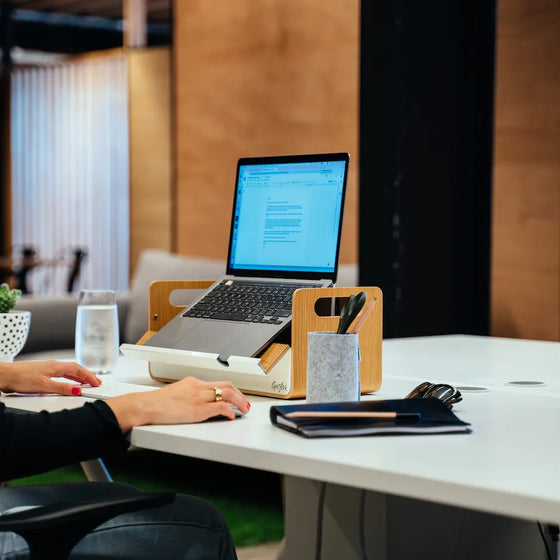
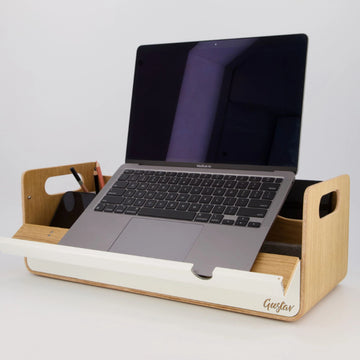
Laptop users need a workable screen height, especially when they spend long periods reading, writing or joining video calls. A portable laptop stand can improve posture without permanently filling the desk. The trade-off is that a raised laptop works best with a separate keyboard and mouse, so confirm whether these are provided, carried by users or stored locally.
Look for stable construction, an intuitive opening mechanism and a footprint that suits the desk dimensions. A stand that is elegant but awkward to adjust will be left in a drawer. Equally, a large desktop riser may be right for a fixed home office but unsuitable for a busy hot-desking zone.
Personal organisation
Small items create disproportionate visual noise. Chargers, adapters, pens, notebooks and headphones quickly spread across a shared desk when they have no defined home. Desktop organisers and compact tech pouches make these objects easier to find, easier to carry and quicker to put away.
Specify the organiser according to the objects it must contain. A felt desk organiser suits stationery and visible everyday tools; a zipped or structured pouch is better for cables, power supplies and smaller tech. In open-plan offices, choose forms that look composed from every angle, not only from the seated user’s view.
Mobility between work settings
Desk sharing only feels effortless when employees can move their essentials without juggling loose items. A purpose-designed work bag can combine laptop protection, document storage, bottle space and desk organisation in one object. More importantly, it reduces the time between arriving and being ready to work.
Capacity requires judgement. An oversized bag can encourage people to carry too much and become cumbersome in circulation areas. A smaller solution may be perfect for laptop-first work but insufficient for teams handling paper files or equipment. Specify for the typical day, then account for exceptions through lockers, shared storage or bookable project space.
Surface definition and protection
Desk mats and organisers do more than decorate a workstation. They establish a clear working zone, help protect shared furniture and provide a visual cue for where devices and tools belong. In a clean-desk environment, this can make resetting a desk more intuitive.
Choose materials that suit the maintenance routine and expected level of use. Premium finishes add warmth and tactility, but they should also tolerate daily handling. For high-use workspaces, durability and straightforward cleaning matter as much as appearance.
A guide to specifying workspace accessories by environment
The same accessory can perform differently depending on where it is used. Specify systems, not isolated objects.
Shared offices and activity-based workplaces
In desk-sharing environments, portability and reset speed are the primary measures. Employees should be able to collect their work kit, choose a desk and establish a functional setup with minimal effort. A mobile organiser or work bag, paired with a lightweight laptop stand and a compact tech organiser, creates a clear personal system without claiming permanent desk territory.
Visual coherence matters here. Accessories in considered colours and materials help shared spaces feel intentional rather than temporary. However, avoid treating every desk as a display surface. The best specification supports individual comfort while allowing the architecture, furniture and circulation to remain visually calm.
Home offices
At home, accessories often remain in place for longer, so ergonomics and material quality carry greater weight. A laptop stand should support a more sustained setup, while organisers can prevent work tools from overtaking the dining table or living space.
This does not always mean specifying larger products. Many professionals need to pack their workstation away at the end of the day. Compact, refined accessories are particularly valuable where one table serves several purposes.
Mobile and client-facing work
For employees who move through offices, campuses or client locations, every item must earn its place. Prioritise protection, quick access and a polished appearance. Loose cables and improvised carriers undermine the experience of flexible work, particularly when a meeting room becomes a temporary workstation.
A portable desk organiser that unfolds into a work surface can be especially effective in this setting. It turns arrival into a repeatable setup ritual: place, open, connect, begin.
Assess materials, longevity and maintenance
Accessories are handled more often than most workplace furniture. They are lifted, packed, opened, wiped down and occasionally dropped. Specification should therefore look beyond first impressions.
Assess joinery, edges, fastenings, zips, surfaces and the way different materials age. Sustainably grown wood can bring a warm, residential quality to a workplace, while recycled PET felt offers soft structure, colour and a practical home for everyday objects. Both can work well, but their role should match the environment and cleaning requirements.
Longevity is also a financial and environmental consideration. A well-made accessory that remains useful through office reconfigurations, role changes and hybrid schedules is preferable to a disposable solution designed for one layout. Gustav’s products are designed around this principle, combining portable function with durable materials and a two-year warranty.
Specify for adoption, not just distribution
Even well-designed accessories need a clear place in the workplace system. Decide how they are issued, stored, cleaned and replaced. A personal work bag may be assigned to each employee; desk organisers may belong to specific collaboration areas; laptop stands may sit in an equipment library or be included in an onboarding kit.
Before committing at scale, run a focused trial with users who represent different work patterns. Observe what they carry, what remains unused and what causes delay at the desk. Ask practical questions: Does the organiser fit in a locker? Can the stand be set up without instruction? Does the bag work on public transport as well as within the office? Is there enough room for a charger, notebook and water bottle?
Use the findings to refine the specification rather than simply adding more accessories. A smaller, coherent kit is often more successful than a generous collection of disconnected items.
Create a clear specification brief
A strong brief gives procurement teams and design partners something more useful than a product list. It should state the intended user groups, work settings, required carrying capacity, ergonomic function, material preferences, colour approach and maintenance expectations. Include desk dimensions and locker sizes where relevant, as these details quickly expose compatibility issues.
Also define what success looks like after installation. It may be faster desk setup, fewer abandoned cables, more consistent clean-desk behaviour or improved comfort for laptop users. These outcomes make it easier to evaluate whether the accessories are supporting the wider workplace strategy.
The right workspace accessories should feel almost invisible once they are in use: each item has a purpose, each desk is ready for work, and every employee can create a composed personal workspace wherever the day takes them.