Laptop Stand Benefits for Flexible Workspaces

A laptop on a shared desk can turn a well-planned workspace into a compromised one within minutes. The screen sits too low, cables spread across the surface and the person using it adapts their posture to the furniture rather than the other way around. The most useful laptop stand benefits address this daily reality: a more comfortable viewing height, a clearer work surface and a faster route to a workstation that feels personal and prepared.
For hybrid professionals, the value is not simply owning another accessory. It is having a reliable foundation for focused work whether the day starts at home, at a hot desk or between meetings.
Laptop Stand Benefits That Matter at Work
A more natural screen height
Laptops are designed for portability, not necessarily for prolonged desk work. Placed directly on a table, the screen commonly sits below a comfortable line of sight. That encourages users to lower their head and round their shoulders towards the display, particularly during concentrated tasks such as writing, analysing documents or joining video calls.
A laptop stand raises the screen towards eye level, helping create a more upright, relaxed working position. It does not replace an individual ergonomic assessment, and the correct height will vary with a person's stature, chair and desk. Yet it gives the user a practical adjustment that a fixed laptop position cannot provide.
The benefit becomes more pronounced when paired with an external keyboard and mouse. Once the screen is raised, typing directly on the laptop keyboard for long periods can place the arms too high. A separate keyboard and mouse allow the display and hands to be positioned independently, bringing the whole workstation into better balance.
Less visual clutter, more usable desk space
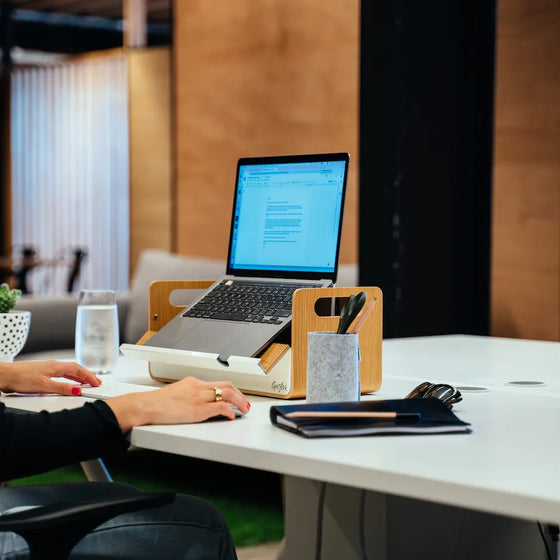
A stand creates physical space beneath the laptop and visual order above it. This can be a modest change, but it has a noticeable effect on smaller desks, kitchen tables and shared workstations where every centimetre matters. Notes, a keyboard or a charging cable can be kept in a deliberate place rather than pushed to the desk edge.
Clear surfaces also support the rhythm of desk sharing. A desk should be easy to arrive at, work from and leave ready for the next person. When a few essential tools have defined positions, packing away is simpler and the workspace retains its intended character.
Faster setup across changing locations
Flexible work is often disrupted by small setup frictions. Finding a comfortable position, arranging cables and creating enough room for a notebook can take longer than it should. A portable laptop stand provides a repeatable starting point. Open it, place the laptop, connect the essentials and the desk becomes recognisably yours without becoming permanently occupied.
This consistency matters for knowledge workers moving between home, office and client spaces. It also matters to workplace teams responsible for making hot-desking feel considered rather than temporary. The aim is not to recreate a fixed desk in every location. It is to make a good working position possible in seconds.
Better conditions for video calls
Raising a laptop also improves the practical quality of video conversations. A camera positioned closer to eye level tends to produce a more direct, professional angle than one looking upwards from the desk. Users are less likely to hunch towards the screen to stay engaged, and the frame is often less dominated by the desk surface.
There are limits. A stand cannot solve poor lighting, distracting backgrounds or an unsuitable meeting space. But it can make the primary tool for a video call feel more intentional, which is especially valuable when meetings happen from more than one location.
Why These Benefits Extend Beyond Individual Comfort
A laptop stand is often viewed as a personal ergonomic item. In a flexible workplace, it can also be part of the wider workplace system. The quality of a desk-sharing environment depends on how easily people can set up their equipment, keep shared surfaces orderly and work comfortably without claiming a permanent footprint.
For facility managers and workplace strategists, that means considering accessories alongside desks and chairs. A beautifully designed office can still underperform if users arrive with loose chargers, laptops and notebooks but no effective way to organise them. Small, mobile tools help bridge the gap between a shared environment and an individual's daily requirements.
For architects and interior designers, portability can protect the visual calm of a space. Instead of adding permanent desktop equipment to every workstation, organisations can provide well-designed personal tools that travel with employees. This keeps desks adaptable while allowing people to create a dependable setup when they need one.
There is an employee-experience dimension too. A stand signals that flexibility does not mean settling for an improvised work position. It acknowledges that people work in different places while maintaining the expectation of comfort, order and professional presentation.
Choosing a Laptop Stand for Real Working Days
Not all stands serve the same purpose. A stand that stays permanently on a large desk can prioritise adjustment range and weight. One intended for hybrid work needs to earn its place in a bag and remain simple to use on arrival. The right choice depends on where, how often and for how long it will be used.
Look first at stability. The stand should hold the laptop securely without wobbling while typing or touching the screen. Its contact points should be designed to protect the device and allow airflow, especially during intensive work. A compact footprint is useful, but not if it makes the setup feel precarious on a typical office table.
Then consider setup and pack-down. Complicated mechanisms can be acceptable in a dedicated home office, but they are less appealing when a user changes desks several times a week. A stand should open intuitively, fit into a working routine and pack away without demanding extra attention.
Material choice also affects the experience. Durable, considered materials feel appropriate in client-facing spaces and can withstand regular movement. For organisations with design standards and clean desk policies, the stand should look as resolved as the furniture around it rather than as an afterthought.
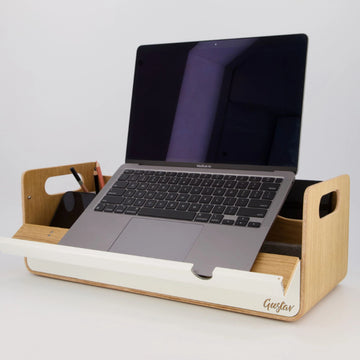
Finally, assess how it works with the rest of the mobile workspace. A laptop stand is most effective when cables, keyboard, mouse, notebook and smaller accessories have a clear home. Gustav Original, for example, combines a portable organiser with an ergonomic laptop stand, helping users carry their essentials and establish a clear workspace from the same compact object.
The Trade-Offs Worth Considering
A raised screen is not automatically the right answer for every task. If someone relies on the laptop keyboard for brief, occasional work, a lower profile may be more convenient. For long sessions, however, raising the laptop without adding an external keyboard and mouse can introduce a new compromise at wrist and shoulder level.
Desk height matters as well. A stand that feels comfortable on a standard office desk may sit differently on a high kitchen counter or a compact meeting table. Users should be able to adjust their chair where possible, keep their feet supported and avoid treating any single accessory as a complete ergonomic solution.
Portability also involves a choice. The lightest stand may be easiest to carry, while a heavier construction may offer greater stability and a more premium feel. For daily commuting, the best option is usually the one that balances these qualities without making setup feel burdensome.
A Small Tool With a Clear Workplace Role
The strongest workspaces make good habits easy. They do not require employees to search for a comfortable screen position, clear a patch of desk or accept an untidy temporary setup as the cost of flexibility. They provide simple tools that support the way people actually move through their week.
A well-chosen laptop stand does exactly that. It brings the screen closer to a comfortable height, creates order on limited surfaces and gives each user a repeatable setup across locations. When the desk is ready for focused work in moments, mobility feels less like compromise and more like considered design.