How to Create a Mobile Workstation

You notice the difference within minutes. A shared desk with the wrong setup feels temporary, cluttered and slightly off. Your shoulders rise, cables spread, and the tools you need are never where they should be. Knowing how to create a mobile workstation changes that. It turns any desk into a calm, functional place to work - without carrying half an office on your shoulder.
For hybrid professionals, designers, consultants and workplace teams, mobility is no longer a side requirement. It is part of the brief. The challenge is building a setup that travels well, supports good posture and still looks considered in a home office, project room or desk-sharing environment. The best mobile workstations are not improvised. They are edited.
What a mobile workstation actually needs
A mobile workstation is not just a laptop in a bag. It is a compact system that lets you arrive, set up quickly and work comfortably for several hours without visual or physical friction. That system usually includes three things: core technology, ergonomic support and organised storage.
The technology is straightforward. Most people start with a laptop, charger, mouse and headphones. Depending on your role, you might also need a compact keyboard, portable monitor or notebook. What matters is not the number of items but whether each one earns its place.
Ergonomic support is where many mobile setups fail. Working directly on a laptop for long periods pulls the screen too low and the body forward. A proper mobile workstation raises the screen, creates space for a better hand position and reduces the tendency to hunch over the desk. Even in flexible environments, posture should not be treated as optional.
Storage is the third part, and often the most underestimated. If your cables, adapters, pens and daily tools are loose in a bag, your setup will always feel scattered. Good organisation shortens setup time, reduces forgotten items and supports clean desk policies without effort.
How to create a mobile workstation with less, not more
The instinct is often to add equipment until every possible scenario is covered. In practice, that makes the workstation heavier, slower and harder to maintain. A better approach is to build around your non-negotiables.
Start by asking where you actually work in a typical week. If you move between home and a central office, your setup can be more refined because transport is predictable. If you work across client sites, campuses or public sector buildings, weight and packing speed matter more. If you regularly hot-desk, visual order becomes just as important as functionality.
From there, define your essential kit. For most professionals, that means a laptop, a stand, a mouse, charging equipment, earphones or headphones, and a small set of work tools such as a notebook or stylus. If you rely on a separate keyboard, choose one that is slim enough to carry every day, not one that stays in the drawer because it is too bulky.
This is the point where restraint pays off. Every extra item adds complexity. A mobile workstation should feel complete, but never crowded.
Build around ergonomics first
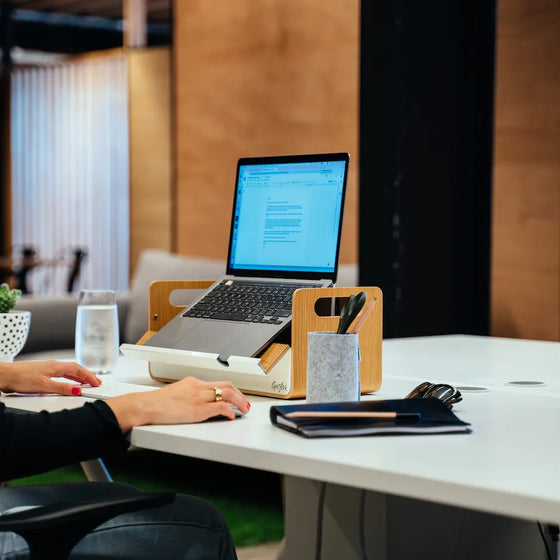
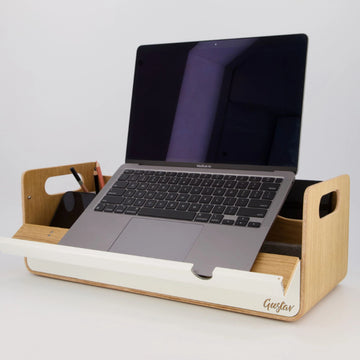
If there is one decision that improves daily use most, it is elevating the laptop screen. A laptop stand creates a more natural viewing height and immediately makes temporary desks feel more deliberate. Paired with an external mouse and, if needed, a keyboard, it gives your body a more sustainable working position.
There is some nuance here. If your mobile sessions are short, a very light stand may be enough. If you spend full days at different desks, stability matters more than saving a few grams. The same trade-off applies to keyboards and mice. Ultra-compact accessories are easier to carry, but they are not always the most comfortable over a long day.
Desk surface also matters more than people expect. Shared workstations can feel inconsistent from one location to the next. A desk mat helps define your space, improves comfort and creates a cleaner visual zone for your core tools. In design-led workplaces, it also helps a temporary setup feel intentional rather than improvised.
Keep setup time under two minutes
A strong mobile workstation should be ready almost as soon as you sit down. If setup takes ten minutes, involves untangling cables or requires several decisions, it will eventually break down.
The easiest way to avoid that is to group items by function. Store chargers and adapters together. Keep writing tools in one place. Separate daily essentials from occasional extras. A dedicated organiser or tech pouch is useful not because it holds more, but because it removes repetition and guesswork.
This matters at scale as well as individually. In desk-sharing offices, fast setup supports smoother transitions between users and keeps the workspace visually clear. For facility managers and workplace strategists, that consistency improves the experience of flexible working without adding complexity to the environment.
One useful rule is this: if an item does not have a fixed place in your carry system, it will become friction. Mobile work benefits from defined compartments, repeatable packing and a setup order that soon becomes automatic.
Choose a bag that supports the system
People often build the workstation first and think about the bag later. It should be the other way round. The bag determines how the system moves, how protected it is, and whether carrying it daily feels practical.
A good work bag should fit your laptop and accessories without compressing them into a single compartment. It should allow quick access to the tools you use first and protect more delicate items without creating excess bulk. Structure matters. So does weight.
There is also an aesthetic consideration. In many modern workplaces, your bag arrives at the desk with you and becomes part of the overall impression. A considered, well-made carry solution supports a more professional setup and aligns better with design-conscious environments than an overstuffed backpack full of loose accessories.
That does not mean choosing style over function. It means recognising that the best mobile products do both.
Design for consistency across locations
The real value of a mobile workstation is consistency. You are not just carrying objects. You are carrying a familiar way of working.
That consistency has practical benefits. When your screen height, input tools and organisation stay largely the same, your body and workflow need less adjustment from one location to another. Home office on Monday, shared desk on Wednesday, client site on Thursday - the working experience remains recognisable.
It also has cultural value in organisations adopting flexible workplace models. Employees are more likely to embrace desk sharing when they can create a personal, comfortable setup quickly. Portable desk systems help bridge the gap between shared infrastructure and individual comfort.
This is where product quality matters. Lightweight materials, durable construction and thoughtful details are not luxuries in mobile work. They are what allow a setup to function day after day without looking tired or becoming annoying to use. Gustav has built much of its approach around that idea: portable workspace tools should perform well, travel well and still feel refined on the desk.
Avoid the common mistakes
The first mistake is treating mobility as an afterthought. If your daily work requires movement, your setup should be designed for movement from the start.
The second is overpacking. A workstation that feels too heavy or too fiddly will be abandoned piece by piece until you are back to working directly from a laptop.
The third is ignoring ergonomics in the name of convenience. Portable should still support proper use. There is little value in a beautiful setup that leaves you uncomfortable by mid-afternoon.
The fourth is poor organisation. Loose items create visual noise, slow down setup and make even premium equipment feel chaotic. Order is part of function.
How to create a mobile workstation that lasts
The most effective mobile workstations are not built around novelty. They are built around repeat use. That means choosing fewer, better tools, using materials that hold up to daily carrying, and creating a setup you can maintain without effort.
It also means accepting that the perfect setup depends on context. A workplace consultant travelling between meetings may prioritise portability above all else. An architect working across studio and home may want stronger ergonomic support and room for sketch tools. A company rolling out desk sharing may focus on standardised accessories that help teams settle quickly and keep desks clear.
The principle stays the same. Good mobile work is structured, ergonomic and easy to carry.
When you get it right, something subtle happens. The desk in front of you no longer feels borrowed, temporary or compromised. It feels ready. And that is usually the clearest sign that your workstation is working as it should.