How to Organise a Small Workspace Properly

A small workspace becomes difficult long before it becomes full. One charger left out becomes three. Papers settle beside the keyboard. Your laptop sits too low because there is nowhere else for it to go. Learning how to organise a small workspace is less about fitting more into it and more about deciding what deserves a place.
For hybrid workers, home-office users and teams sharing desks, that decision needs to work repeatedly. The best setup is not one that looks tidy for a photograph. It is one that can be set up quickly, support comfortable work and return to order at the end of the day.
Start with the work, not the storage
Before buying organisers or moving furniture, look at what happens at the desk. A workstation used mainly for focused laptop work needs a different arrangement from one used for sketching, calls, client meetings or hot desking. Small spaces fail when every task is expected to happen in the same square metre at once.
Separate your essentials into three groups: items used throughout the day, items used occasionally, and items that simply live at the desk out of habit. The first group should remain immediately accessible. The second can be stored nearby. The third should leave the surface altogether.
For most knowledge workers, the daily essentials are surprisingly few: laptop, power, notebook, pen, headphones and perhaps a water bottle. Once these have a defined position, the desk begins to feel larger without changing its dimensions.
Create clear zones on a small desk
A compact desk needs boundaries. Without them, objects drift towards the centre and compete with your working area. Give each part of the surface a job.
The central zone should be reserved for the task in front of you. If you use a laptop, that means a stable, comfortable viewing position and enough clear space for your hands. Keep the immediate side zone for the tools you reach for often, such as a notebook, pen or phone. The back edge is useful for objects that can remain present but should not interrupt your work, including a lamp, a small plant or a charging point.
Avoid treating every spare corner as storage. A crowded perimeter makes even an orderly desk feel constrained. Leaving a little visible surface is not wasted space. It gives the workstation visual calm and makes it easier to reset between tasks.
Put ergonomics before aesthetics
A beautifully organised desk can still be uncomfortable to use. In a small workspace, ergonomics and organisation should support each other.
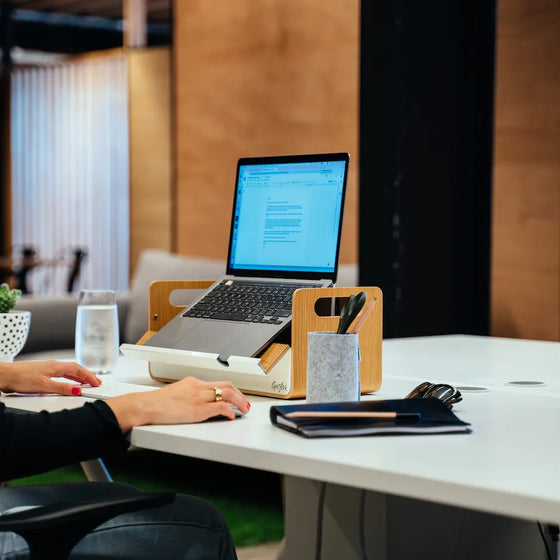
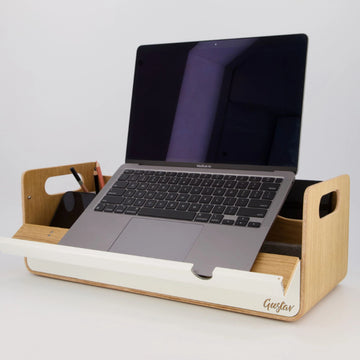
Raising a laptop to a more suitable screen height can free useful space beneath or around it, while encouraging a more upright posture. Pairing it with a separate keyboard and mouse may require a little more surface area, but it often improves comfort for longer work sessions. If the desk is too narrow for this arrangement, a portable laptop stand that also stores your essentials can be a more practical choice than adding several separate accessories.
The right solution depends on how long you work there. A dining table used for an hour of email needs flexibility. A compact home office used all day needs greater attention to screen position, chair height and input devices.
Choose organisers that earn their footprint
On a small desk, every object must justify the space it occupies. Large trays can make clutter look contained while taking up the area needed to work. Choose organisers that group small essentials vertically, move easily or perform more than one role.
A slim desk organiser can keep pens, adapters, notes and headphones together rather than scattered across the surface. A compact tech pouch gives chargers, cables and small accessories a home when they are not in use. This is especially useful for people moving between home, office and client sites, where loose technology tends to accumulate in bags and then spread onto the nearest desk.
Materials matter as well. A premium felt organiser, for example, can soften the visual feel of a workstation while keeping small objects distinct. Wooden elements bring structure and durability. The aim is not to fill the desk with accessories, but to select a few considered pieces that make the space easier to use.
Gustav approaches this through portable organisers designed to create an orderly workstation wherever work happens, rather than tying organisation to one fixed desk.
Make cables part of the plan
Cables are often the first sign that a compact workspace has lost its order. They collect dust, catch on bags and make cleaning around the desk unnecessarily awkward. More importantly, they create visual noise around the very tools meant to support focused work.
Begin by reducing what stays connected. Keep only the cables you use every day on the desk, then give each one a defined route. A single power source positioned at the rear or side of the workspace is usually easier to manage than several chargers spread across the surface.
For mobile work, store spare charging leads, adapters and dongles together in a dedicated pouch. This stops them disappearing into different drawers or bags, and means your desk can be cleared without dismantling your setup. If you share desks, this distinction is essential: personal technology should travel with the person, not remain behind as desk clutter.
Use vertical space carefully
When the desk itself is small, the wall and the space beneath the table become more valuable. A shallow shelf above the desk can hold reference books, files or a docking station, provided it does not make the area feel enclosed. A hook beneath the worktop can keep a bag off the floor and immediately reclaim legroom.
Vertical storage works best for items you do not need constantly. Frequently used objects should not require standing up, opening doors or reaching over your screen. The goal is to reduce interruptions, not create a miniature storage system that adds friction to every task.
Be selective with wall-mounted boards and shelving. They are useful in a permanent home office, but less relevant at a shared desk or a temporary setup. In those settings, portable storage is usually the more flexible answer.
Build a reset routine for desk sharing
Organisation is not a one-time activity. It is a short routine that keeps a workspace ready for the next person, the next task or the next location.
At the end of a work session, return loose items to their organiser or pouch, pack away personal tools and leave the surface clear. This takes only a few minutes when every item has a home. It takes far longer when documents, cables and stationery have no defined destination.
For workplace teams, this habit supports clean-desk policies without making them feel restrictive. A well-designed desk-sharing system lets employees carry their essential equipment, establish a familiar work zone in seconds and clear it just as quickly. The desk remains available, while the individual retains a sense of control and comfort.
A portable desk bag can be particularly effective here. It keeps a laptop, documents, bottle and daily equipment together during the move between locker, desk and meeting room, then unfolds into an organised setup when needed. The value is not simply carrying capacity. It is reducing the number of decisions required to begin work.
Avoid the common small-workspace mistakes
The most common mistake is storing too much on the desk because there is nowhere else to put it. If an item has not been used in the past week, consider whether it belongs in a drawer, cabinet or bag instead. A small workspace needs a low visual baseline.
Another is using a single catch-all tray. These can be helpful for a few small items, but they quickly become a place where cables, receipts, spare pens and adapters disappear together. Give technology, stationery and paperwork separate homes where possible.
Finally, do not solve every problem by adding more storage. More containers can make a desk feel fragmented and busy. Often the better move is to reduce duplicates, consolidate supplies and choose one portable system that keeps your daily tools together.
Let the workspace support the way you move
The strongest small workspace is not necessarily permanent. It can be a focused corner at home in the morning, a shared office desk in the afternoon and a meeting table later that day. What matters is that the essential elements move with you and return to the same logical arrangement each time.
Keep the surface clear enough to think, the tools close enough to use and the setup simple enough to repeat. When a small workspace has that kind of order, it stops feeling like a compromise and starts performing like a considered place to work.