Alternatives to the Under-Desk Pedestal: What Actually Works for Desk Sharing

Monday, 8.40 am. You arrive at the office, last week's desk is taken, and your under-desk pedestal is still parked over there – with your charger, notebook, keyboard and tea mug inside. So: unlock the pedestal, gather everything up, carry it to a free desk, in two trips. This is the moment most companies realise the classic pedestal was never built for desk sharing. It is a piece of furniture for a fixed seat. When the seat changes every day, you need something else.
Why the pedestal stops working in a desk-sharing office
A pedestal has three jobs: store things, lock things away, keep things at your seat. In desk sharing the third job disappears – there is no "your seat" any more – and lockers do the first two better. What remains is 20 to 30 kilos of furniture that eats floor space, that nobody actually wheels anywhere, and that raises the same question every morning: where is my stuff, and how does it get to the desk?
There is a side effect facility teams tend to underestimate, too: a half-used pedestal quickly becomes a small landfill. Old printouts, three pens, a power supply with no device. If you take a clean desk policy seriously, that is exactly what you do not want.
The four alternatives compared
In practice four models have established themselves. None is right for everyone – so here are the strengths and weaknesses, openly.
1. Locker
The locker is the new pedestal: central, lockable, often bookable via an app. It reliably solves security for laptops, documents and valuables. What it does not solve is the journey from locker to desk. Everything you need daily still has to be carried somehow. That is why the locker is almost always the foundation – but rarely the whole solution.
2. Desk-sharing box or caddy
An open box or caddy that sits on the desk, keeps your working essentials in order and goes into the locker in the evening. The advantage: you do not pack and unpack, you carry your complete workstation. Keyboard, mouse, notebook, pens and cables stay where they are inside the box. The disadvantage: a box is not lockable and needs a place to live overnight. Without a locker or a shelf, this model does not work.
The Gustav Loop is our caddy for exactly this case: 42 × 20 × 13.5 cm (XL: 48 × 20 × 14.5 cm), around 0.9 kg, recycled PET felt with an oak veneer element, €109. It is deliberately light and soft, so it does not jam in a locker and does not clatter on the desk.
3. Work bag with a built-in organiser
For anyone who commutes regularly between home office and office, a box is often too awkward. Here a bag that unfolds into an organiser on the desk takes over. You carry it like a normal laptop bag, stand it on the desk, and the contents are within reach without unpacking. The limit: it does not replace a locker, and it is not for people who carry a lot of paper.
Our DeskMate work bag is built this way: laptops up to 17 inches, 47 × 18 × 30 cm, REPREVE® recycled performance fabric, water-repellent, €139. For an honest picture: the DeskMate is not made in Europe – our wooden products are, our textile products are not.
4. Organiser with laptop stand
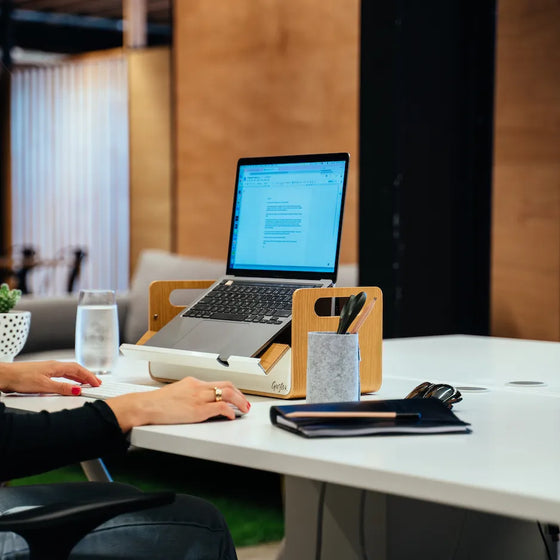
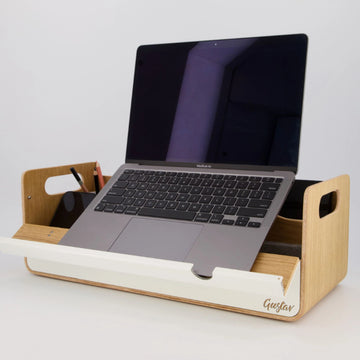
The premium model for teams where ergonomics and appearance matter. A solid wooden organiser that holds your essentials and lifts the laptop to eye level at the same time. The Gustav Original (oak, powder-coated steel, handmade in Greece, €245) is made for this. It is heavier and more expensive than a box or a bag, though – daily commuters will tend to leave it at the office rather than carry it.
What really matters when you buy
- Does it fit the locker? Measure the compartment before you order boxes or caddies. Many standard lockers are 30 to 45 cm wide. A caddy that does not fit stays on the desk – and at that point desk sharing has failed.
- Weight when loaded. An empty box weighs little; with a keyboard, power supply and bottle it is quickly three kilos. Handles and a soft rim make the difference day to day.
- Open or closed? Open caddies are faster to use, closed bags protect better when commuting. Decide by the journey, not the look.
- Material and noise. Hard plastic rattles, metal scratches the desk. Felt and wood are quieter – an underrated factor in an open-plan office.
- Recognisability. If 40 people have the same caddy, you need colours or a label. Otherwise the wrong caddy walks off.
Who these alternatives are not for
Frankly: if you have a fixed desk, no box solves a problem you do not have – a pedestal or a drawer is simply cheaper. If you work with a lot of sensitive paper files, you need lockable storage, and that is neither a caddy nor a bag. And if your office has no lockers yet, solve that first – a caddy with nowhere to sleep only creates a new tidiness problem.
Which option suits you?
You are in the same building three to five days a week and only change desks: take a caddy like the Loop and combine it with the existing locker. You commute between home office and office and do not want to repack every day: the DeskMate is the better fit. You want an overview of all the options for your team – from caddy to organiser with laptop stand: have a look at our desk-sharing collection.
For companies: a roll-out, not a one-off purchase
If you are introducing desk sharing for 50 or more employees, the caddy or bag is usually the element that decides acceptance – not the booking software. We support companies with pilot programmes from 25 units, volume pricing and procurement via framework agreement or leasing. Details are on our page for businesses.
Frequently asked questions
Can I just keep using the pedestal?
Yes, but as shared furniture at the desk – not as personal storage. Many companies leave one empty pedestal per desk and move personal items to a locker plus caddy.
Is a desk-sharing box lockable?
Open caddies like the Loop are not. Security comes from the locker the caddy goes into at the end of the day. If you want individually lockable boxes, you pay for it in weight and price.
How big should a caddy be?
Big enough for a keyboard, mouse, notebook, cables and a bottle – and small enough to fit the locker. For most offices that means 40 to 48 cm long and no more than 20 cm deep.
What does the switch cost per workstation?
A caddy is around €109, an organiser bag €139, a wooden organiser with laptop stand €245. Lockers come on top – they are usually the larger item.