A Home Office That Works Wherever You Work

A kitchen table at 8am. A dedicated study after lunch. A shared desk on the office floor tomorrow. For many professionals, a home office is no longer one fixed room with one permanent setup. It is a working environment that needs to perform across changing locations, tasks and routines.
The best setups do not rely on more furniture or more equipment. They rely on a clear system: the essentials are easy to carry, quick to arrange and comfortable to use. When every item has a purpose, work begins with less friction and ends with less clutter.
What a home office needs to do
A well-designed home office should support three things at once: physical comfort, visual order and an efficient start to the day. These are connected. A laptop positioned too low can create unnecessary strain. Cables, notebooks and chargers spread across a surface make it harder to settle into focused work. A setup that takes ten minutes to assemble will rarely feel practical when the day is already full.
The solution is not necessarily a larger desk. In compact homes, a large permanent workstation may not be realistic or desirable. Even in a dedicated room, a fixed arrangement can become limiting when work moves between video calls, individual concentration, sketching, reading and meetings.
Instead, think of the workspace as a kit that creates a consistent experience wherever it is placed. The desk may change. Your working position, essential tools and sense of order should not.
Start with ergonomic height, not desk size
Laptop work is convenient, but a laptop alone rarely provides a comfortable all-day position. When the screen sits below eye level, the neck and shoulders tend to follow it down. Over time, that small compromise can make a home office feel less sustainable to use.
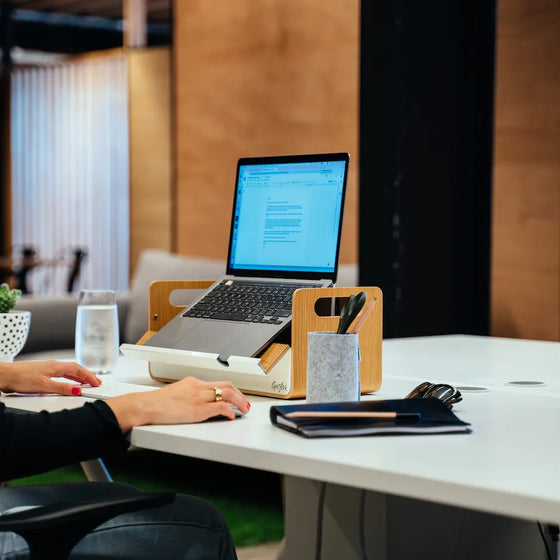
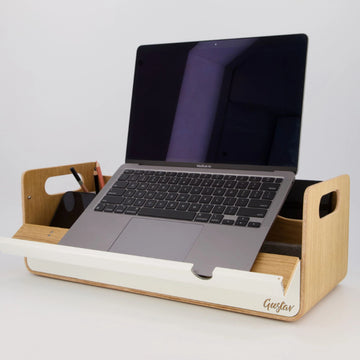
Raising the screen is often the most meaningful first adjustment. An elevated laptop stand brings the display closer to a natural viewing height and creates a more deliberate work zone. For longer sessions, pairing it with an external keyboard and mouse allows the screen and hands to sit at more appropriate heights.
There is a trade-off. A large monitor and fixed arm can be excellent in a permanent study, particularly for detailed visual work or multiple documents. But for hybrid professionals, it can tie the setup to a single location. A portable stand offers a different advantage: it makes good posture easier to reproduce at the dining table, a project room or a shared office desk.
The aim is not to create a showroom-perfect workstation. It is to reduce the small physical compromises that accumulate across a working week.
Make the sitting position adjustable
Chair height, screen height and table height work together. Sit back in the chair with feet supported and shoulders relaxed, then adjust the screen rather than bending towards it. If the table is higher than ideal, a supportive footrest or stable box beneath the feet can help create a more balanced position.
Natural light is valuable, but screen glare is not. Position the display at an angle to the window where possible, rather than directly in front of or behind it. This simple move can improve comfort on calls and reduce the urge to lean closer to the screen.
Give every work essential a home
Visual calm is practical, not decorative. A clear surface makes it easier to find what is needed, easier to clean at the end of the day and easier to share when the desk is part of a living space.
Begin by separating genuine daily essentials from items that have simply remained on the desk. Most people need a laptop, power supply, writing tools, notebook, headphones and a few small personal items. Everything else should earn its place.
A compact organiser can hold the items that otherwise drift across the workspace: cables, adapters, pens, sticky notes and reading glasses. Keeping these objects together also makes transition simpler. At the end of the day, there is no need to collect loose pieces from around the room.
Cable management deserves the same attention. One charging cable trailing across the desk is manageable. Several cables, power supplies and unused adapters quickly make a workspace feel temporary and disordered. Use only the leads needed for the task at hand, keep the remainder in a tech organiser and route active cables from one side of the desk where possible.
This is particularly useful in homes where the desk becomes a dining table, console or family surface after work. A clean-desk reset should take moments, not a full packing exercise.
Build a portable home office system
Portability does not mean working with less care. It means making a considered setup easier to take with you. This matters for people who divide their time between home, office, client locations and meeting rooms, but it also matters inside the home. A portable system lets a spare bedroom become a focused workspace in the morning and a guest room again in the evening.
The most effective systems keep setup components together. A laptop stand and desk organiser establish the work zone. A tech pouch protects and contains smaller accessories. A work bag carries the full set between locations without turning into a mixed collection of cables, papers and loose stationery.
Gustav designs this principle into products such as the Original, which combines desk organisation with an ergonomic laptop stand, and DeskMate, a mobile workstation bag for desk-sharing environments. The point is not to carry more. It is to arrive with what is needed, set up with intention and leave the surface as clear as it was found.
For workplace teams, the same approach supports a consistent employee experience. A shared desk should not require staff to search for an adapter, work from a low laptop screen or spread belongings across a communal surface. Portable personal work tools help individuals establish a familiar, functional workstation while respecting clean-desk policies.
Choose materials that suit daily use
A home office is part of the home, so materials and finishes influence how it feels. Plastic containers and promotional pouches may solve an immediate storage problem, but they can quickly look out of place in a carefully considered interior. They may also fail to protect the tools used every day.
Choose pieces that are durable enough for repeated movement and restrained enough to work with different rooms. Wood, recycled felt and considered textiles can add warmth without adding distraction. Neutral tones create a quieter base, while a small amount of colour in an organiser can help define a personal workspace in a shared environment.
There is no universal aesthetic rule. A creative studio may benefit from visible materials, sketches and tools, while a consultant working from a living room may prefer a setup that packs away completely. The common requirement is that the workspace should feel intentional rather than improvised.
Design the end of the working day
A home office works best when it has a clear closing routine. Not a productivity ritual, simply a physical reset. Close the laptop, return cables and accessories to their organiser, clear the desk and place the portable setup where it belongs.
That reset protects the workspace for tomorrow and protects the home from becoming permanently occupied by work. It is especially useful when the desk shares space with daily life.
A good workspace should never demand a room of its own to feel professional. Give your essential tools a place, raise the screen, reduce the visual noise and make the setup easy to move. Then wherever work happens next, your office is ready to meet you there.