9 Best Portable Office Setup Ideas for Hybrid Work

A shared desk should not mean starting from zero each morning. The best portable office setup ideas create a familiar, comfortable place to work in minutes, whether the day begins at home, in a project room or at a desk booked for the afternoon. The goal is not to carry an entire office. It is to bring the few tools that make any surface feel considered, organised and ready for focused work.
For employees, this means less visual clutter and a more reliable ergonomic position. For workplace teams, it supports clean-desk standards without making people feel temporary at their own workstation. The strongest portable setups are designed as systems: easy to carry, quick to arrange and simple to pack away.
What makes a portable office setup work?
Portability is often mistaken for smallness. A compact pouch can be useful, but it does not automatically create a better place to work. A portable office should protect essential equipment, establish a clear working zone and support the body through a full day of laptop work.
That requires a sensible balance. Carry too little and users still borrow cables, work from a low screen and scatter belongings across the desk. Carry too much and the system becomes inconvenient enough to stay at home. The right solution depends on the workday: a consultant moving between client sites needs a lighter kit than an employee using desk-sharing spaces several days each week.
1. Start with a mobile desk organiser
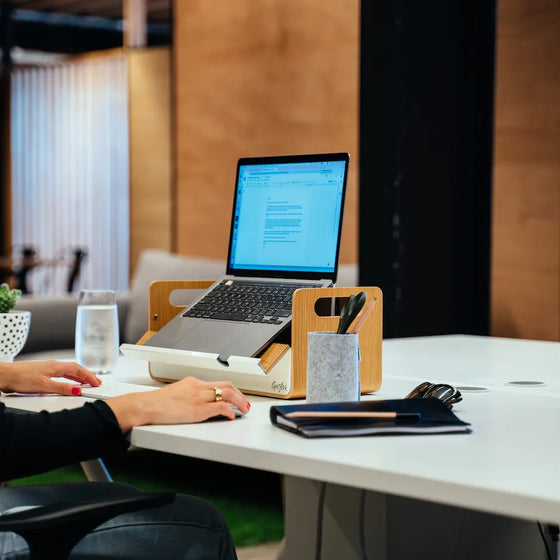
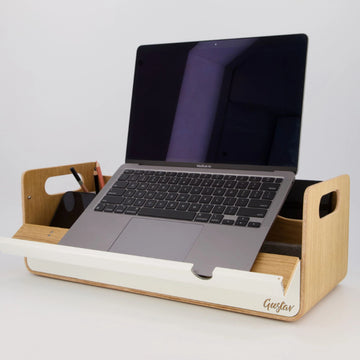
A structured desk organiser is the foundation of a portable setup. It gives a laptop, charger, notebook, mouse and smaller accessories a defined home while travelling, then becomes the first element placed on the desk. This removes the familiar ritual of emptying a bag across every available surface.
Choose an organiser with considered compartments rather than one large cavity. Separating cables from pens and technology from paperwork helps users find what they need without creating a second layer of disorder. In shared offices, it also makes packing down more dependable: the desk can be cleared quickly because every item already has a place.
2. Raise the laptop, not the shoulders
Laptop screens encourage a downward gaze, particularly when working for several hours. A portable laptop stand is one of the most valuable additions to a mobile office because it brings the screen closer to eye level and creates a more open, comfortable posture.
A stand works best with a separate keyboard and mouse. Without them, the raised screen can put the hands in an awkward position. For shorter sessions, a lower and lighter stand may be enough. For regular desk-sharing or home working, prioritise stable elevation and a design that folds flat without adding unnecessary bulk.
3. Treat the desk mat as a working boundary
An unfamiliar desk can feel visually noisy before a laptop is even opened. A desk mat creates an immediate working zone, giving the keyboard, mouse and notebook a consistent surface while protecting the table beneath from everyday wear.
This is especially useful in activity-based workplaces where desks may vary in finish, size and condition. The mat signals where work begins and keeps smaller items from drifting across the desk. A restrained material and colour palette helps the setup look professional in a client-facing environment, while a wipeable, durable surface is more practical than something precious that users hesitate to carry.
4. Build a cable kit that stays closed
Cables are small, essential and unusually effective at making a desk look unfinished. A dedicated tech pouch keeps a charger, charging cable, display adaptor, headphones and spare battery in one place. It also prevents loose leads from tangling with documents or catching when the setup is packed away.
Keep the kit deliberately lean. Include only the connections used often and check them against the places people actually work. A designer who frequently presents may need display adaptors; someone using a standard office docking point may not. One short charging cable can be more useful than three redundant ones, provided it is compatible with the devices in use.
5. Create a two-minute arrival routine
The most effective portable office setup is one people can use without thinking. Establish an order that is the same at home, in the office and on the move: place the organiser, set out the mat, raise the screen, connect power, then position keyboard and mouse.
This routine has practical value beyond speed. It reduces missed items, makes ergonomic checks habitual and helps employees settle into a changing environment with less friction. Workplace managers can support the habit by making power access, storage and shared desk equipment easy to locate. A beautifully designed portable kit cannot compensate for a desk with no accessible sockets or no room for a laptop stand.
6. Keep paper purposeful
Flexible work has reduced some paper use, but notebooks, sketches, marked-up briefs and confidential notes still matter. The answer is not to remove paper from the setup. It is to give it a defined, limited role.
A slim notebook or document sleeve is usually enough for a day away from a fixed desk. It keeps loose sheets from becoming a separate carrying problem and gives handwriting a place alongside digital work. If paper regularly expands beyond that, consider whether the workflow needs a dedicated project case rather than asking a daily portable kit to carry everything.
7. Use one bag for the complete system
A portable office only works if it travels as a complete unit. The work bag should fit the organiser, laptop and daily essentials without forcing users to stack items loosely or carry a second bag for cables. Good internal structure matters as much as external appearance: equipment should remain protected and easy to access at security checks, on public transport and in busy office entrances.
Avoid choosing a bag solely on capacity. An oversized bag invites surplus items and makes mobility less comfortable. Instead, select a format around the actual core kit, with enough room for a water bottle or light layer when travelling, but not so much that the system loses its discipline.
8. Separate personal items from shared-desk tools
Desk-sharing works better when the line between personal belongings and workplace equipment is clear. The portable kit should contain the things that make a workstation personal and functional: technology, stationery, ergonomic accessories and work materials. Shared resources such as monitors, docking points and desk lamps should remain easy to access at the workplace.
This division avoids duplication while giving employees ownership over their daily setup. It also makes facilities planning clearer. If every employee arrives with a laptop stand, a workplace may need generous desk depth but fewer permanently installed risers. If a company provides shared screens, it should make sure the connection process is consistent across zones.
9. Choose materials built for repeat use
A portable office is handled more often than stationary desk equipment. It is lifted, opened, moved between rooms and packed at the end of the day. Materials should therefore feel good in daily use but also be selected for resilience.
Sustainably grown wood, recycled materials and durable textile finishes can bring warmth and character to mobile work without making the kit feel domestic or fragile. For organisations specifying accessories at scale, longevity is a practical sustainability decision as well as a design choice. A well-made system that employees want to keep using is less likely to become clutter in a storage cupboard.
Best portable office setup ideas for workplace teams
For workplace strategists and office planners, individual accessories should connect to the wider environment. A portable setup supports flexibility best when desks offer enough clear surface area, nearby power and a straightforward way to connect to shared technology. Small inconsistencies can undermine a good employee experience: a stand that blocks a monitor, a mat that leaves no room for a mouse, or a cable kit that cannot reach the socket.
A useful approach is to test the complete setup at several desk types before rolling it out. Include a compact touchdown space, a standard shared desk and a meeting room table. Ask users to arrive, work for an hour, take a video call and pack down. The details revealed in that test are often more useful than a generic equipment checklist.
Gustav approaches this as a complete workspace system rather than a collection of isolated accessories. The principle is simple: every piece should earn its place in the bag and on the desk.
A portable office should never ask people to compromise between mobility and a workspace that feels properly theirs. When the essentials are organised, elevated and ready to travel, a new desk becomes a place to begin good work, not another thing to manage.