Can Shared Desks Feel Personal Without Clutter?

A desk can be shared without feeling anonymous. The question is not whether can shared desks feel personal, but whether the workplace gives people the means to make a desk their own for the hours they use it. When someone arrives with a laptop, a charger and nowhere to place either comfortably, desk sharing feels like compromise. When they can set up a familiar, organised workstation in moments, it feels intentional.
For workplace teams, this distinction matters. A clean desk policy may keep an office visually calm, but an empty surface alone does not create a good employee experience. People still need physical cues of ownership, comfort and readiness. The most effective shared spaces balance collective order with individual control.
Can Shared Desks Feel Personal? Yes, With a Better Setup
Personal does not have to mean permanent. In a desk-sharing environment, it should mean that each person can create a consistent working position, access their essential tools and establish a small sense of familiarity wherever they sit.
This is especially relevant in offices designed around activity-based work. An employee may move from a focus desk to a project table, a meeting room and a home office during the same week. The room changes, but the basic needs do not: a clear surface, useful storage, a comfortable screen height and a place for the items that support their work.
A personal workspace is therefore less about decorating a desk and more about reducing friction. It is the feeling of knowing where your cables are, placing your laptop at a comfortable height and having a defined area for notes, headphones and a water bottle. These small rituals help people settle more quickly.
The Problem With Bare Desks
Minimalism can be useful, but there is a point where a blank desk becomes unwelcoming. If every useful item is locked away, scattered across several locations or carried loose through the office, employees spend the first minutes of their day searching and rearranging rather than working.
The result is often visual clutter of a different kind. Chargers trail across shared surfaces. Personal bags occupy chairs or walkways. Notebooks and accessories are spread out because there is no clear place to contain them. A workspace can comply with a clean desk policy while still feeling disorganised in use.
There is also an ergonomic consideration. Desk sharing works best when the physical setup supports different people, not just different schedules. A laptop placed flat on a table may be acceptable for a short task, but it is rarely a comfortable position for sustained screen work. The ability to improve posture without relying on a fixed assigned desk makes a material difference to everyday comfort.
Make Familiarity Portable
The strongest desk-sharing strategies give employees a compact personal workstation rather than asking them to recreate one from scratch each day. This does not require a large kit. It requires the right objects, designed to travel well and earn their place on the desk.
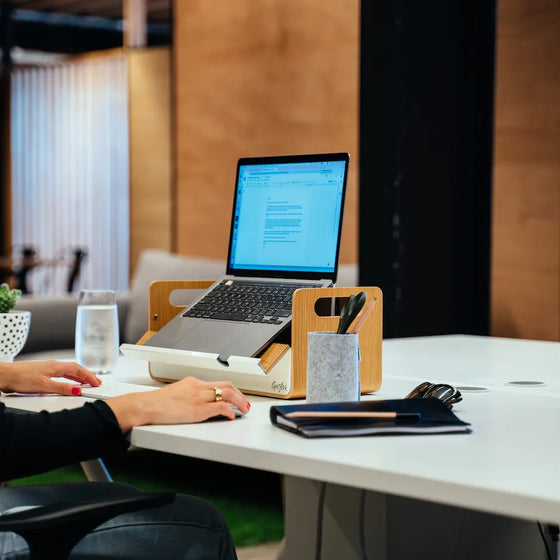
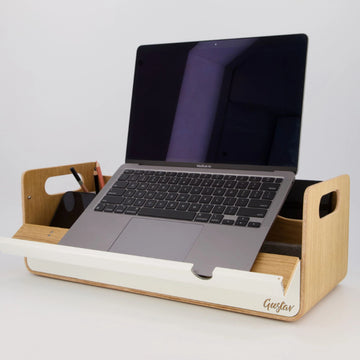
A portable organiser can establish order as soon as it is placed down. It gives everyday essentials a consistent home and creates a visual boundary between an active workspace and the rest of the shared table. A laptop stand adds another familiar element: a better screen position, achieved in seconds rather than through an adjustment request or a hunt for spare equipment.
For workers moving between lockers, desks and meeting rooms, a desk-sharing bag can make the transition more composed. Instead of carrying separate items under one arm, the employee has a single place for technology, documents and daily essentials. When it opens into an organised setup, the bag becomes part of the workstation rather than something that needs to be hidden under the desk.
Gustav designs this kind of continuity into mobile workspace tools: purposeful objects that help a standard table feel ready for focused work.
Consistency is more valuable than sameness
Not every desk needs identical accessories arranged in identical positions. In fact, excessive uniformity can make an office feel impersonal. The goal is to provide a dependable framework while allowing people to choose what they need for the task at hand.
One employee may use a compact organiser for cables, pens and headphones. Another may value space for sketches, reference documents or a tablet. Some will work primarily from a laptop stand; others may use an external monitor at selected desks. A well-planned shared environment supports these differences without leaving the office looking untidy.
Portable accessories are particularly useful here because they shift ownership to the individual while keeping the furniture and surfaces shared. The office remains adaptable, and employees retain agency over how they work.
Design the Reset, Not Only the Setup
The best shared desks are easy to leave as well as easy to occupy. If packing away feels inconvenient, items stay behind. If people do not know where peripherals belong, shared equipment gradually disappears into drawers, meeting rooms or personal lockers.
A good reset takes little thought. Tools should fold, nest or pack away quickly. Storage should be close enough to use, but not so limited that people have to choose between carrying essentials and keeping the desk clear. Clear workplace conventions also help: shared screens are returned to a neutral position, surfaces are cleared, and personal equipment travels with its owner.
This is where product choice and workplace policy need to work together. A beautifully organised desk is not sustainable if employees have nowhere practical to put their setup at the end of the day. Equally, generous storage will not solve the issue if it encourages people to build permanent territories in a space intended to remain flexible.
The right balance is personal mobility. Employees should be able to arrive, establish their preferred working conditions and leave no trace beyond a well-used desk.
Give People a Sense of Place
Workplace planners sometimes focus on desk utilisation as the primary measure of a successful flexible office. It is a useful measure, but it cannot tell the whole story. A desk may be available and technically functional while still offering a poor experience. If people avoid it because it lacks privacy, comfort, power access or room for their work, utilisation figures will not explain why.
A more useful question is whether the space helps people feel capable when they sit down. Does it support concentration? Can they organise their work without claiming extra surfaces? Can they adjust their screen position? Do they have a place for the objects that move with them through the day?
Small, high-quality details answer these questions quietly. A desk mat can define a calm working zone and protect a shared surface. A felt organiser can soften the visual character of a desk while containing loose items. A compact pouch can prevent cables and adapters from becoming a daily source of disorder. None of these objects needs to be permanent to make the experience feel considered.
The Trade-Off: Personalisation Versus Flexibility
There is a limit to what a shared desk should accommodate. Large personal displays, extensive paper archives and permanent decorative items can undermine the flexibility that desk sharing is meant to create. They also make resets slower and create unequal access to space.
That does not mean workplaces should remove personality altogether. It means personalisation should be portable, useful and proportionate to the setting. A few well-designed tools will usually do more for comfort and identity than a desk full of possessions.
For organisations, this approach has another advantage. Portable workspace systems are easier to introduce across different office zones and home-working routines than fixed, desk-specific additions. They support a consistent experience without forcing every employee into the same pattern of work.
A Shared Desk Should Feel Ready, Not Generic
The most successful desk-sharing environments do not ask people to choose between flexibility and belonging. They recognise that a desk can be communal while the work performed there remains deeply individual.
Start with the practical details: a clear surface, accessible power, sensible storage and tools that travel easily. Then consider the experience of arrival. When someone can open their organiser, raise their laptop, place their essentials in order and begin, the desk stops feeling borrowed. It simply becomes their office for the day.