How to Create Portable Workstations That Work

A shared desk at 9am, a project room before lunch, and a kitchen table in the afternoon should not require three different ways of working. Learning how to create portable workstations gives people a consistent place to focus, wherever the workday happens. The aim is not to carry an entire office. It is to carry the few considered tools that make any suitable surface feel organised, comfortable and ready for work.
For workplace teams, this matters beyond individual convenience. A portable setup supports clean desk policies, makes desk sharing easier to adopt, and helps an office feel intentional rather than temporary. For individuals, it removes the daily friction of searching for a cable, working at the wrong screen height, or spreading essentials across an unfamiliar table.
Start with the work, not the bag
The best portable workstation begins with an honest view of how it will be used. A consultant moving between client sites has different needs from an employee booking desks in a busy office. A designer may need a notebook, charger and input devices close to hand, while someone working primarily from a laptop may value a lighter setup and a clearer surface.
Look at the recurring moments in the working week. Where do people set up? How far do they carry their equipment? Do they use lockers, commute by public transport, move between meeting rooms, or work from home two days a week? The answers establish the right balance between capacity and portability.
A workstation should travel easily enough to be used every day. If it is too heavy, too complicated or too dependent on a particular desk, people will leave it behind. If it carries too little, it simply relocates clutter rather than solving it.
Build the portable workstation around four essentials
A useful portable setup creates a repeatable sequence: arrive, unpack, adjust, begin. That requires four distinct functions working together:
- Ergonomic support to raise the laptop screen and encourage a more comfortable working position.
- Organisation for the small items that otherwise disappear into a bag: chargers, cables, pens, adapters and headphones.
- A defined work surface that gives the user a visual boundary and keeps the desk clear.
- Protected carry for moving a laptop, documents and everyday equipment safely between locations.
This is where material and construction matter. Thin, flexible accessories may save space, but they can feel unstable when used as working tools. Heavier pieces often feel more substantial, but may be impractical for a daily commute. Seek a considered middle ground: durable materials, reliable structure and enough lightness to make mobility realistic.
How to create portable workstations for better ergonomics
Ergonomics is often treated as a fixed-desk issue. In flexible workplaces, it is more useful to think of it as a fast adjustment process. The workstation should help the user adapt an ordinary table into a more comfortable setup within seconds.
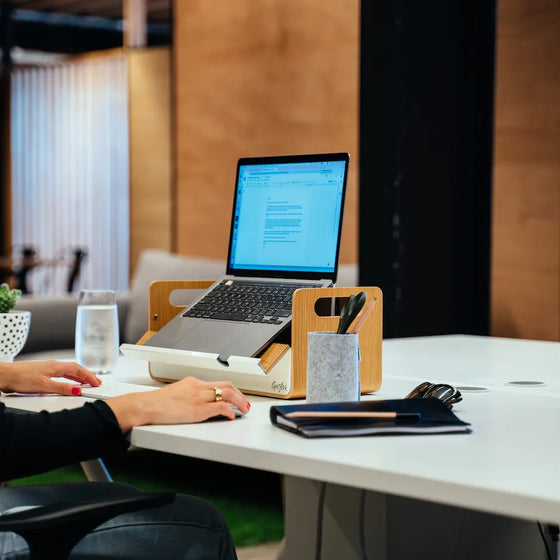
Begin with screen height. Laptop screens naturally sit low, which can encourage users to bend their necks towards the display for long periods. A portable laptop stand raises the screen closer to eye level and creates a more deliberate working posture. The ideal height varies by person, chair and table, so adjustability or a well-considered fixed angle can both work depending on the setting.
There is a trade-off. Once a laptop is raised, typing directly on its keyboard for extended work may be less comfortable. For regular desk-based days, a compact external keyboard and mouse can make the setup more suitable for longer sessions. For short tasks between meetings, the laptop stand alone may be the more practical choice. Portable workstations should accommodate both modes rather than insist on one perfect configuration.
Also consider the desk itself. In desk-sharing environments, table dimensions and chair quality can vary. A portable workstation cannot solve every limitation of poor furniture, but it can give users a familiar ergonomic starting point. That consistency is valuable. People know where their essentials are, how their screen will sit, and how to establish a clear workspace without rearranging an entire desk.
Make organisation visible and contained
Clutter is rarely caused by having too many things. More often, it comes from everyday essentials having no assigned place. A charging cable, badge, notebook and pen are all reasonable objects to bring to work. When they land randomly on a shared desk, however, the surface quickly feels crowded.
Create clear zones within the portable workstation. Frequently used items should be accessible without emptying the whole bag. Cables and adapters should have a dedicated compartment. Documents should stay flat and protected. Less-used accessories can sit deeper in the carry system, where they are available but not in the way.
This organisation has a practical workplace benefit: it shortens the reset at the end of the day. Users can pack their desk quickly, check that nothing has been left behind, and return the shared surface in good order. Facilities and workplace teams gain a more reliable clean desk culture without relying on constant reminders.
A desk organiser made from quality, tactile materials can also create a small sense of ownership at a non-assigned desk. It signals that this is a place for focused work while maintaining the order expected in a shared environment. Colour can be useful here too, particularly where organisations want a workplace to feel considered and welcoming without adding permanent personal items to every desk.
Design a setup routine people will actually use
The difference between a portable workstation and a collection of accessories is routine. Every item should have a logical place and a clear role at setup.
A simple sequence works well: place the organiser or desk mat, position the laptop stand, connect power, then take out only the tools needed for the task. This preserves visual calm and prevents the familiar situation where a bag is emptied onto the desk just to find one adapter.
For organisations introducing desk sharing, it helps to define a standard personal setup rather than leaving every employee to improvise. That does not mean prescribing identical working habits. It means providing a considered framework that supports different roles while establishing a consistent quality of experience across the office.
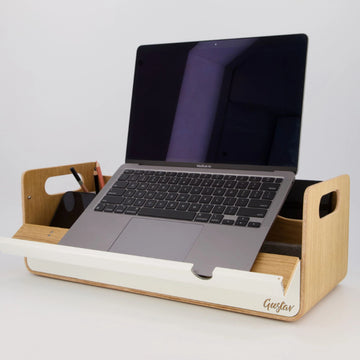
Gustav’s workspace system reflects this approach: the Original combines desk organisation with an ergonomic laptop position; DeskMate carries everyday work essentials and unfolds into a mobile desk setup; Loop keeps small items ordered at the workstation; and Echo contains cables, chargers and accessories. Together, these tools show how portability works best when carrying, organisation and setup are designed as one experience.
Choose materials that suit daily movement
Portable tools are handled more than fixed office furniture. They are packed, placed on café tables, carried through stations, stored in lockers and used on different surfaces every week. Good materials should feel appropriate to that reality.
Look for finishes that are durable without feeling purely utilitarian. Sustainably grown wood brings warmth and structure to a mobile setup, while recycled PET felt can provide lightweight organisation and a softer, quieter presence on the desk. These materials also help a workstation feel at home in both a domestic setting and a professionally designed office.
The visual standard matters. Flexible work does not need to look improvised. When accessories are well made and visually restrained, they complement architecture, interiors and shared workspaces rather than competing with them. This is especially relevant for architects, office planners and workplace managers balancing operational needs with a coherent interior concept.
Plan for different levels of mobility
Not every portable workstation needs to fit under an aeroplane seat. A person moving between a locker and several office zones may choose a more complete desk-sharing bag. Someone commuting across a city may prioritise compactness. A home worker who occasionally uses a project room may keep certain accessories in a pouch and use a larger organiser only on office days.
Think in layers. The daily core should include the equipment required to work effectively anywhere: laptop support, power, essential tools and a method of keeping them together. Add role-specific accessories only when they create a clear benefit. This prevents overpacking while allowing people to tailor their setup to the work ahead.
For a workplace rollout, offering one or two carefully selected configurations is often more effective than creating a large catalogue of optional items. The goal is consistency without excess. A smaller set of high-quality tools is easier to specify, store, maintain and use.
A portable workstation earns its value in the first few minutes of every work session. When a user can arrive, create order, raise their screen and begin without searching or rearranging, flexible work feels less temporary. The table may change, but the quality of the work setting does not have to.