How to Organise Desk Cables Neatly at Work

A desk can look perfectly considered until one charging cable slips from behind the screen. Add a laptop lead, monitor power cable, phone charger and headset, and the work surface quickly starts to feel temporary rather than intentional. Knowing how to organise desk cables neatly is less about hiding every wire and more about creating a setup that is easy to use, easy to clean and easy to reset.
For hybrid workers and desk-sharing teams, the best cable arrangement is rarely a permanent installation. It should support movement between home, office and meeting room without creating a new packing task at the end of every day. The aim is a calm workstation with only the connections you need, placed where they can work without taking over the desk.
Start with the desk you actually use
Before buying cable accessories, look at the equipment that stays on your desk and the equipment that travels with you. A fixed home office with a monitor, dock and desktop lamp needs a different approach from a shared desk used for a laptop and charger for a few hours.
Separate cables into two groups. Fixed cables power equipment that remains in one place. Mobile cables belong to your laptop, phone, headphones and other everyday tools. This simple distinction prevents a common mistake: securing every cable to the desk, then having to unclip half the setup whenever you leave.
Also consider the desk itself. A sit-stand desk needs enough slack to move through its full height range. A table in a shared office may not allow adhesive trays or drilled fittings. In both cases, a compact and reversible system is usually more useful than a heavily installed one.
Reduce the cable count before you organise it
The neatest cable is the one you do not need. Start by removing duplicates, outdated charging leads and adapters that no longer serve your current devices. Then identify whether one charging connection can cover more than one task through a suitable dock or power source.
This is not an argument for stripping a workspace back to the point of inconvenience. A monitor, external keyboard and reliable charging can make a significant difference to comfort and performance. It is about choosing a clear cable route for each essential item, rather than allowing old accessories to accumulate at the edge of the desk.
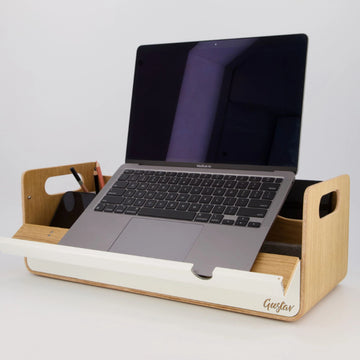
Keep a small reserve of specialist leads away from the work surface. Presentation adapters, spare chargers and rarely used connectors are useful, but they do not need to live beside your keyboard. A compact organiser such as Gustav Echo keeps these smaller essentials protected and ready to travel without turning them into visual clutter.
Create three clear cable zones
A tidy desk is easier to maintain when cables have a defined destination. Think in three zones: power, working connections and personal charging.
The power zone sits below or behind the desk. Place the extension lead close to the wall outlet, with enough access to switch it off or unplug it when needed. Keeping power bricks and excess cable length in this zone prevents the familiar tangle beneath the feet.
The working-connections zone is the shortest route between laptop, monitor, dock and peripherals. These cables should travel along the rear edge of the desk wherever possible. A cable sleeve, rear-mounted channel or discreet clips can hold them together, but do not bind cables so tightly that individual items are difficult to replace.
The personal-charging zone belongs within reach, but out of sight. Position a phone or headphone lead at one side of the desk, ideally beside a tray or organiser that gives the device a deliberate resting place. It avoids the habit of pulling a cable across the keyboard whenever a battery runs low.
How to organise desk cables neatly without over-fixing them
Cable clips are useful, but they work best as guides rather than restraints. Use them to keep a lead from falling behind the desk, to direct one charging cable to a chosen side, or to separate power cables from finer data cables. Choose clips that are easy to release, particularly on a desk that is shared or used for different tasks during the week.
For longer leads, coil the excess loosely and secure it with a reusable cable tie. Avoid tight winding around a power brick or sharp bends at the connector. Aside from looking untidy, excessive tension can shorten the life of the cable and make it harder to pack.
Where several cables travel in the same direction, group them in a sleeve or channel. Keep only compatible cables together. A monitor lead and power cable may share a route beneath the desk, while a delicate headset cable is often better left separate so it can be removed quickly.
Do not aim for total invisibility at the expense of access. A cable system that looks immaculate but makes it difficult to connect a guest device, move a laptop or replace a charger will not stay neat for long. Good organisation should make the next action obvious.
Give moving equipment a landing place
Hybrid work creates a particular challenge: the desk may be reset every morning and cleared every evening. In this setting, avoid treating mobile cables as permanent desk infrastructure. Instead, give them a consistent home in a portable organiser or tech pouch.
Pack the charger in the same compartment after each use, and keep the cable loosely looped rather than wrapped around the power adapter. When you arrive at a desk, place the organiser in the same position, connect only what is required, and return each lead once work is finished. This creates a repeatable setup without making the desk feel personalised or cluttered.
For workplace teams, this principle supports a clean desk policy without making employees carry a collection of loose accessories between lockers and workstations. The equipment becomes easier to find, easier to protect and quicker to set up.
Make cable routes work with ergonomics
Cable management should support the way you work, not dictate it. Start with the screen and laptop position, then route cables around that layout. If a laptop is raised on a stand, make sure its charging cable reaches without pulling at the port or hanging across the front edge of the desk.
Keep cables away from the space where your chair, feet and legs move. A lead that catches on a castor or runs across a footwell is not merely untidy. It can disconnect equipment, damage a connector or create an unnecessary trip risk.
On a sit-stand desk, test every connection at seated and standing heights before securing anything. Leave a gentle service loop - a small amount of spare length - near moving equipment. The cable should move freely, but never droop into the chair area.
Choose accessories with restraint
A few well-chosen accessories are normally enough. The most useful options are reusable cable ties, low-profile clips, a cable sleeve for a fixed bundle and an under-desk tray where the desk permits it. A small desktop organiser or tech pouch completes the system by containing the mobile items that do not belong in the fixed route.
Material and visual finish matter too, particularly in client-facing offices, studios and considered home interiors. Choose accessories that match the desk environment instead of adding more plastic shapes and visual noise. The goal is not to turn cable management into a feature. It is to let the workspace feel composed.
Be cautious with permanent adhesive solutions on shared furniture, rented spaces or finely finished desks. They can leave marks and often outlive the setup they were designed for. Removable clips and portable organisers offer more flexibility when teams, technology or office layouts change.
Build a five-minute reset routine
Neat cables are maintained through a simple closing routine, not a major monthly clear-out. At the end of the working day, disconnect mobile devices, place their leads back in the organiser, and check that the fixed routes remain behind the screen or beneath the desk. A quick visual check is usually enough to stop cable clutter building up.
For shared workspaces, make this reset part of the workstation standard. The desk should be ready for its next user without abandoned chargers, loose adapters or cables crossing the surface. For home offices, the same routine makes it easier to shift from focused work to the rest of the day.
A well-organised cable setup is not static. It should adapt as your devices, desk and working pattern change. When every cable has a purpose, a route and a place to return to, the desk feels less like a collection of equipment and more like a workspace designed to support good work.