Office Caddy Review: What Makes One Worth Carrying?

A good office caddy review should begin where the working day begins: at a shared desk, kitchen table or project room with a laptop in one hand and essentials scattered across a bag. The real test is not how much an organiser holds when it is full. It is whether it helps someone create a clear, comfortable place to work in a matter of seconds - then leave no trace when it is time to move on.
For hybrid teams and desk-sharing workplaces, an office caddy is no longer a simple stationery tray. It is part personal storage, part mobile workstation and part expression of how considered a workplace feels. The best designs reduce visual noise while making everyday tools easier to reach.
What an Office Caddy Needs to Do
Traditional desk organisers are designed to stay put. They suit assigned desks, where monitors, drawers and personal accessories have a permanent home. A mobile office caddy has a different brief. It needs to travel well, protect essentials, arrive looking composed and support the way a person actually works.
That means capacity alone is a poor measure of quality. A deep compartment may hold plenty of cables, pens and chargers, yet become frustrating when users have to empty it to find one adapter. Equally, a beautifully minimal tray can look right on a desk but offer little value if it does not carry the tools needed between work settings.
The strongest option creates order through thoughtful zones. Small items should be contained without becoming inaccessible. Frequently used tools should remain visible or intuitive to locate. The overall form should stay compact enough for lockers, shelving and a daily commute.
Office Caddy Review Criteria for Flexible Work
A useful review considers the product in motion as well as on the desk. These are the points that matter most when assessing an office caddy for a modern workplace.
Portability without unnecessary bulk
Portability is more than adding a handle. Consider the journey from locker to desk, from desk to meeting room and from office to home. A caddy should be comfortable to carry and proportioned for the items employees genuinely move: a notebook, charger, headset, stationery, access card and perhaps a water bottle or documents.
There is a trade-off here. Larger products can replace a work bag for some users, but they take up more locker space and may feel excessive for a short move across the office. Compact organisers are easier to store but demand more discipline about what goes inside. The right choice depends on whether the caddy is intended as a desk companion, a daily carry solution or both.
Setup that supports better posture
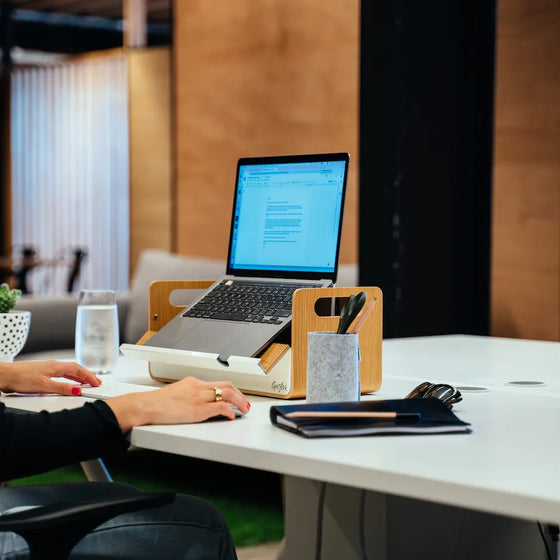
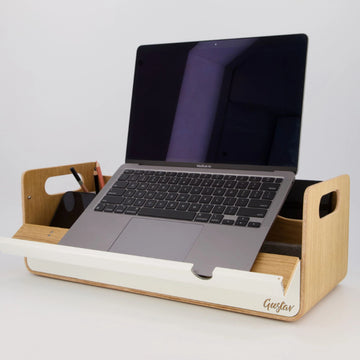
Organisation matters, but ergonomics often separates a pleasant portable accessory from a genuinely useful workspace tool. Laptop-only work at a shared desk can quickly lead to a lowered screen and a compromised working position. A caddy that also supports a raised laptop setup brings practical value to every location it reaches.
Look closely at how quickly the product changes from carry mode to work mode. Complex adjustments are rarely used during busy office days. A well-resolved design should make the intended setup obvious, stable and quick, allowing people to settle into a more comfortable position without filling the desk with separate parts.
Not every user needs an integrated laptop stand. Employees with fixed monitors or docking stations may prioritise compact storage instead. However, for home offices, touchdown spaces and meeting rooms, a raised screen can make an organiser substantially more useful.
Storage that reflects real equipment
The most convincing caddies are designed around the objects of contemporary work rather than a generic collection of office supplies. Cables need to be separated enough not to tangle. Chargers need a secure place. Pens should not roll across the desk. A phone, earbuds and notebook should be accessible without turning the caddy into a display case for clutter.
It is also worth considering what happens at the end of the day. In a clean-desk environment, a caddy should make clearing a workstation almost automatic. Users should be able to return their essentials to defined places, lift the organiser and leave the desk ready for its next occupant.
This simple routine supports more than tidiness. It reduces the small friction points that make desk sharing feel temporary or inconvenient. When people can recreate a familiar setup quickly, a flexible workplace feels more personal without becoming less shared.
Materials, finish and long-term use
An office caddy is handled repeatedly, often in public settings. Its material quality affects both durability and the atmosphere of the workspace. Hardwearing surfaces, clean edges and considered details help an object retain its appearance through daily movement. They also communicate that flexible work has been planned for, rather than treated as an afterthought.
Material choice is also a practical question. Soft recycled PET felt can bring warmth, colour and quiet organisation to a desk, while structured wood creates a more architectural feel and can provide the rigidity needed for a stand or stable workstation. Neither is automatically better. The decision should match the working environment, desired level of protection and intended use.
For organisations specifying products at scale, consistency matters. A coherent material palette can support an interior concept across shared neighbourhoods, home-working provisions and client-facing areas. It should still be easy for employees to use without instruction.
A footprint suited to shared desks
Desk-sharing systems only work when each desk can be reset quickly. An oversized caddy that occupies the central work zone may simply replace one form of clutter with another. A refined design keeps the essentials contained while leaving space for a keyboard, notebook and natural movement.
Assess the product opened as well as closed. Does it create a calm arrangement, or does it spread contents across the work surface? Is there a defined place for the caddy during focused work? Can the desk still accommodate collaboration? These questions are particularly relevant for office planners designing compact benching layouts.
When a Portable Organiser Is the Right Investment
An office caddy makes most sense when people regularly change work settings and need to bring more than a laptop. It is particularly effective in hot-desking offices where personal storage is limited, in project-based teams moving between rooms, and for professionals who want their home and office setups to feel consistent.
For workplace leaders, the value is partly operational. Clear personal storage can make clean-desk standards easier to maintain and reduce the number of loose accessories left behind. It can also improve the arrival experience for employees who do not have a dedicated workstation.
For individual users, the value is more immediate. A considered organiser removes the daily search for a charger, pen or adapter, while creating a work surface that feels intentional rather than improvised.
Gustav Original illustrates the broader principle well: an organiser becomes more useful when it combines orderly storage with an ergonomic laptop position, allowing one object to establish a more complete workstation wherever work happens.
Questions to Ask Before Choosing
Before specifying or buying an office caddy, consider the movement pattern it needs to support. Will it travel between home and office, or only between lockers and desks? Does the user need a laptop stand, document storage or space for a headset? Is the workplace aiming for discreet neutral organisation, or a visible accent of colour and material?
Also consider who will use it. Designers and consultants may carry cables, sketchbooks and adapters. Office-based employees may require simpler storage for a charger, notebook and personal items. A single standard product can work well, but only if its capacity and function match the majority of real use cases.
The best choice is rarely the one with the most pockets or the largest capacity. It is the one that makes moving, setting up and packing away feel effortless enough to become part of the working day. When that happens, an office caddy does more than contain equipment. It gives every desk a clearer starting point.