Best Desk Mats for Designers

A desk mat is often treated as a finishing touch. For designers, it is a working surface: the place where a mouse moves, sketches begin, devices land and visual clutter either builds up or disappears. The best desk mats for designers do more than protect a desktop. They establish a clear, composed zone for focused work, whether that work happens in a dedicated studio, at home or at a shared office desk.
Choosing well means looking beyond colour and texture. A mat should support the way you use tools, suit the desk it sits on and earn its place in a workspace that may need to reset at the end of every day.
What the best desk mats for designers need to do
Design work moves between digital and physical tasks. One moment calls for precise mouse control; the next might involve reviewing print samples, annotating a layout or arranging a tablet, notebook and cable. A useful desk mat gives those activities a defined surface without making the desk feel crowded.
The first job is practical protection. Desks in shared workplaces take constant wear from laptops, monitors, cups and equipment moved between users. A mat reduces scratches and minor marks while creating a more consistent surface for daily work. That consistency matters when the desk itself changes from one day to the next.
The second job is visual. Designers tend to notice competing textures, messy cable routes and objects without a clear home. A calm mat creates a visual foundation beneath essential equipment. It can make a standard desk feel considered without turning it into a display.
Finally, the mat needs to work with movement. For a permanent home-office setup, weight and thickness may be welcome. In a desk-sharing environment, those same qualities can become a burden. The right choice depends on whether the desk mat stays put or travels with its user.
Choose the material for the way you work
Material shapes almost every part of the experience: visual character, mouse performance, cleanability, portability and how the mat ages. There is no universally best option, but there are clear trade-offs.
Felt for warmth and everyday organisation
Felt desk mats bring softness to hard work surfaces and help reduce the slight noise of accessories being placed on a desk. They suit creative studios and shared offices particularly well because their matte finish keeps reflections low and makes a workstation feel less clinical.
A high-quality recycled PET felt can also hold its shape while remaining light enough to move easily. It is a natural fit for a portable workstation or a clean-desk policy, where the mat may be rolled, carried or stored between uses. The compromise is that felt requires more care around spills and is not always the ideal surface for every mouse sensor. If your work relies on fast, highly precise pointer movements, test compatibility before committing.
Smooth, wipeable surfaces for intensive digital work
A smooth desk mat is usually the simplest choice for designers who spend long periods moving between design software, prototypes and presentations. It provides a predictable mouse surface and is generally easy to wipe clean after coffee, ink or the residue of a busy working day.
This category includes a wide range of finishes, from refined synthetic materials to more structured coated surfaces. Look for a non-slip backing and edges that remain flat. A mat that curls at the corners quickly loses the polished effect it was chosen for, particularly in client-facing spaces.
The trade-off is visual and tactile. Highly smooth finishes can feel colder than felt or natural materials, and glossy options may show fingerprints. Choose a low-sheen finish if the desk sits near a window or under strong office lighting.
Natural materials for a more permanent desk
Cork, linoleum-like finishes and leather-style mats can add depth and character to a fixed workstation. They often feel premium, wear in distinct ways and pair well with timber, metal and neutral office furnishings. For designers specifying a home office or a leadership workspace, these materials can make the desk feel more architectural.
However, a natural-looking surface is not automatically the most practical one. Some can mark easily, react poorly to moisture or need more deliberate maintenance. Consider them when the desk has a stable owner and a stable location, rather than when it serves several people across a week.
Get the size right before choosing the colour
An oversized mat can bring order to a large desk, but it can also swallow valuable working space. A mat that is too small, meanwhile, leaves the mouse, laptop or notebook hovering outside the zone it was meant to create. Begin with your working layout, not the dimensions on a product page.
For a laptop-first setup, allow enough width for the laptop or stand, mouse and a notebook placed alongside it. If you use an external keyboard and monitor, the mat should accommodate the keyboard and mouse without forcing either to the edge. Designers who regularly sketch by hand may prefer a mat wide enough to support a notebook, but not so deep that it sits under the elbows all day.
Depth deserves the same attention. A shallow desk mat can look neat yet offer little benefit if it only covers the area beneath a keyboard. A deeper surface supports a more complete setup, but it may conflict with monitor arms, cable grommets or desk edges. Measure the clear area after monitors and laptop stands are in place.
In shared offices, a medium-format mat is often the more versatile decision. It defines a personal work zone while leaving enough open desk space for documents, collaboration and the next person who uses the desk.
Consider the desk mat as part of an ergonomic setup
A desk mat cannot replace ergonomic equipment, but it should support it. If a laptop is raised on a stand, the mat can act as the visual base for the keyboard, mouse and small accessories that remain below. This helps separate active tools from cables and items that do not need to be within reach.
Avoid a surface that adds excessive height beneath an external keyboard, especially if you already work at a compact desk. Thickness may feel luxurious, but even small changes can affect wrist position over a full day. Flat edges are equally useful, as they prevent a noticeable ridge where hands rest while typing or drawing.
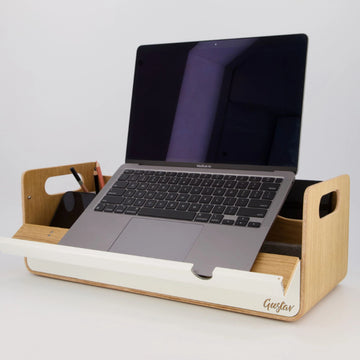
For mobile work, think in systems rather than single products. A desk mat works best alongside a compact organiser that keeps cables, chargers, pens and adapters contained. Gustav’s workspace accessories are designed around this principle: a portable setup should arrive organised, establish itself quickly and leave the desk as clear as it found it.
Details that separate a considered mat from a decorative one
The best designs solve small frustrations quietly. A non-slip base prevents the mat moving during mouse work. A surface that lies flat from day one avoids a desk that looks unfinished. Rounded corners are less likely to catch on sleeves or bags, while a restrained colour keeps the focus on screens, samples and work in progress.
For shared and client-facing spaces, cleanability should be part of the brief. Choose a material suited to regular light cleaning, and avoid finishes that make every mark look permanent. In a studio where materials and tools change constantly, a forgiving mid-tone often performs better than very pale or very dark shades.
Also consider how the mat behaves once work is finished. Can it be lifted without disturbing the entire desk? Does it fit inside a work bag or locker? Does it stack neatly with a laptop, organiser or documents? These questions matter more in hybrid workplaces than they do in a fixed office, and they often determine whether a mat remains useful after the first few weeks.
A desk mat should make the desk easier to use
The strongest choice is rarely the loudest or largest. It is the desk mat that gives your essential tools a clear place, supports the movement your work requires and makes an unfamiliar desk feel ready within minutes. Choose the material and format around the reality of your working day, then let colour and finish do what good design does best: bring calm without demanding attention.