11 Home Office Organisation Ideas That Work

The problem with most home office organisation ideas is not ambition. It is friction. A system looks good on day one, then cables drift, papers stack up and the dining table quietly becomes a second workstation. If your workspace has to support focused work, video calls and occasional movement between home and office, organisation needs to do more than look tidy. It needs to make setup, use and reset feel effortless.
That is where better structure matters. A well-organised home office is not about filling the room with storage. It is about reducing decision-making, protecting concentration and making the tools you use every day easier to reach, carry and put away. For hybrid professionals, the best setups are calm, ergonomic and ready to adapt.
Home office organisation ideas that improve daily work
Start with the surface. Most workspace issues begin on the desk itself, where every extra item competes for attention. If your desk holds chargers, notebooks, pens, headphones, sticky notes and a coffee cup at once, it stops functioning as a work surface and becomes storage. The fix is not necessarily a bigger desk. It is a more deliberate one.
A useful principle is to keep only active tools within arm's reach. Your laptop, screen riser, notebook and one or two writing tools may need to stay visible. Everything else should have a defined home nearby. This distinction between active and passive items is simple, but it changes how the entire setup feels. The desk becomes clearer, and that clarity tends to improve focus.
1. Create zones, even in a small room
Organisation works better when the space has boundaries. In a dedicated room, that might mean separate zones for focused work, storage and video calls. In a bedroom or living area, the zoning is smaller but still useful. One section of the desk can be your primary work area, while a tray, organiser or side shelf holds support items.
This matters because searching for tools interrupts concentration more than most people realise. A zoned setup reduces visual noise and speeds up routine tasks. It also makes it easier to reset at the end of the day, which is essential if the workspace sits inside a shared home environment.
2. Store vertically before you expand sideways
When desks feel crowded, the instinct is often to spread out. A second side table appears, then a floor basket, then a loose pile of folders. Very quickly, the room starts working against you. Vertical storage is usually the cleaner answer.
A monitor riser, a compact shelf, a wall-mounted rail or a slim cabinet can free valuable desk space without making the room feel heavy. The key is restraint. Too many stacked accessories create a different kind of clutter. The goal is to lift essential items off the desk while keeping the overall look quiet and intentional.
3. Give every cable a route
Cables are small, but they have an outsized effect on how organised a workspace feels. One charging lead across the desk is manageable. Five leads, two power adapters and a trailing extension block can make even a premium setup look improvised.
Good cable management starts with routing, not hiding. Decide where power enters the workspace, where devices charge and which cables need daily access. Then secure the rest so they stay in place. Clips, sleeves and under-desk mounts all help, but the real improvement comes from reducing surplus cables in the first place. If a device is rarely used, unplug it and store it away.
4. Use portable organisers for flexible work
For hybrid workers, home office organisation is rarely limited to one location. The same tools move between a home desk, an office touchdown space and sometimes a kitchen table or client site. In that context, fixed storage solves only part of the problem.
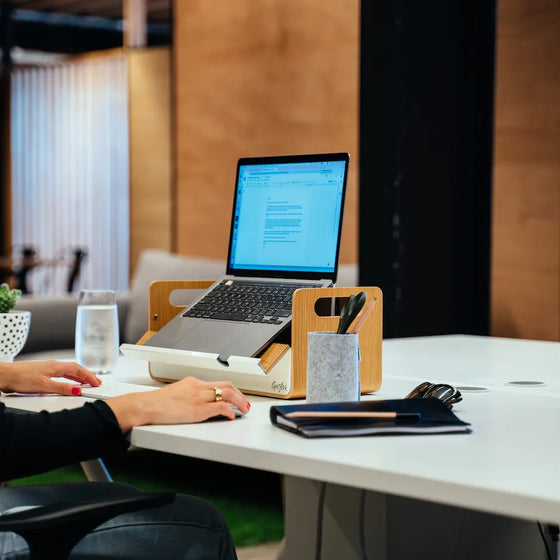
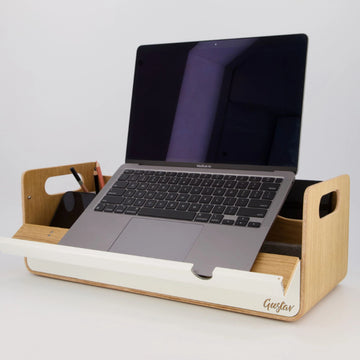
Portable organisers are particularly effective because they turn loose essentials into a single working kit. Laptop accessories, pens, chargers, notebooks and small tech items stay grouped together, which shortens setup time and supports a clean desk policy at home as well as in the office. This is where design quality makes a difference. A portable organiser should not feel like a temporary workaround. It should function as part of a considered workspace system.
5. Separate paperwork by action, not by type
Paper tends to linger because traditional filing is too abstract for daily work. If everything is sorted into broad categories, people still end up with a working pile on the desk. A more practical method is to organise paperwork by action.
Keep one place for items that need attention, one for documents to keep, and one for papers ready to leave the workspace entirely. That might sound basic, but it mirrors how work actually moves. You are less likely to create paper clutter when the next step for each document is obvious.
Home office organisation ideas for ergonomics and flow
A tidy workspace that leaves you hunched over a laptop is not well organised. Ergonomics and organisation are closely linked because both shape how easily the space supports sustained work.
6. Lift the screen and define the working posture
Laptop-based setups often create the biggest tension between minimalism and comfort. On one hand, a laptop keeps the desk visually clean. On the other, it encourages a poor working angle over time. A laptop stand or screen riser solves more than posture. It also creates structure.
Once the screen is elevated, you naturally define where the keyboard, mouse and notebook belong. The workspace gains a more stable rhythm, and the desk often feels more spacious because the vertical plane is being used properly. For people moving between locations, a portable ergonomic setup is particularly valuable because it creates consistency across changing environments.
7. Keep daily tools together, not scattered by category
Many people organise office tools according to product type: pens in one drawer, chargers in another, headphones on a hook, notebook on a shelf. It sounds rational, but it can be inefficient if those items are always used together.
A better approach is to group tools by task. If you regularly join calls, keep your earbuds, webcam accessory, notebook and charger in one compact unit. If your work involves sketching or reviewing plans, keep the relevant materials together rather than distributed across the room. Organisation should follow behaviour, not theory.
8. Build in a reset point at the end of the day
Some of the most effective home office organisation ideas have nothing to do with storage capacity. They depend on routine. A five-minute reset point can keep a workspace under control far more effectively than another drawer unit.
That reset might include returning accessories to an organiser, clearing cups, plugging in key devices and moving paperwork into its action tray. If your desk is part of a shared room, this ritual is even more useful. It helps the workspace disappear visually once work is finished, which supports a healthier boundary between professional and domestic life.
Design choices that make organisation easier to maintain
Not all organisation systems last, and usually the reason is obvious in hindsight. They ask too much. Too many compartments, too many steps, too many pieces that need constant adjustment. The best systems are easy to maintain because they align with normal behaviour.
9. Choose fewer, better storage pieces
A premium workspace does not need dozens of accessories. In fact, too many containers often create a fragmented setup where every object feels over-managed. It is usually more effective to choose a small number of well-designed pieces that work hard.
A desk organiser, a stand, a tech pouch and one storage unit may be enough for most home offices. The benefit is practical as well as aesthetic. Fewer objects mean fewer surfaces collecting dust, fewer places to misplace essentials and a calmer visual field during focused work.
10. Match materials to the rest of the room
This may sound like a styling detail, but it affects long-term organisation. If the workspace feels visually disconnected from the room around it, clutter becomes more noticeable and the entire setup can feel temporary. Materials matter here.
Wood, textiles and muted finishes tend to integrate more naturally into domestic interiors than cold plastic storage boxes or brightly coloured office furniture. When the workspace belongs in the room, people are more likely to maintain it. Good organisation is partly behavioural, and behaviour is influenced by how a space feels.
11. Plan for movement, not permanence
The old idea of the home office assumed one desk, one chair and one permanent setup. That still suits some people, but many professionals now work across multiple settings. The more flexible your week is, the more your organisation strategy should support movement.
That means choosing accessories that carry easily, store compactly and set up quickly. It may also mean avoiding bulky solutions that lock all your tools into one location. Gustav approaches this challenge with the belief that a workspace should travel as well as it performs. For hybrid professionals, that is increasingly the difference between a desk that looks organised and one that stays organised.
The most useful home office organisation ideas are rarely dramatic. They remove friction, support posture, reduce clutter and respect the fact that modern work moves. If your setup feels calm, quick to use and easy to reset, you are not just organising a desk. You are designing better working days.