Arbeitsplatzsysteme für flexible Büros

By 9.15, the best desk in the office is already taken. By 10.00, someone is hunting for a charger. By lunchtime, three people have rebuilt the same workstation in three different ways. That is the daily reality of hybrid work, and it is exactly why arbeitsplatzsysteme für flexible büros matter. In a desk-sharing environment, the workspace cannot rely on permanence. It has to rely on systems.
A flexible office only works when people can arrive, settle quickly and work well without friction. That sounds simple, but many offices still treat flexibility as a floorplan choice rather than a workplace experience. Removing assigned desks is easy. Creating a setup that feels organised, ergonomic and consistent from one day to the next is harder.
Why arbeitsplatzsysteme für flexible Büros are now essential
The shift to hybrid work changed what a workstation needs to do. In a traditional office, the desk carried the burden. People left their monitor at the same height, kept their notebook in a drawer and arranged their tools once. In a flexible office, the burden moves to the system around the user.
That system includes storage, portability, desk organisation, device support and the small details that reduce setup time. If those pieces are missing, flexible working starts to feel improvised. The office may look clean, but the user experience becomes messy.
This is where workplace leaders often face a trade-off. They want a clean desk policy, shared spaces and efficient real estate use. Employees want comfort, familiarity and control over how they work. A well-designed workplace system resolves that tension. It gives people enough structure to personalise their setup without turning every desk into a permanent camp.
What makes a good workplace system
The best workplace systems are not bulky furniture programmes with complicated rules. They are clear, portable and easy to use. They help people move between settings without sacrificing focus or ergonomics.
At a practical level, that usually means combining a few essentials. Users need a way to carry and store their daily tools, a simple method for organising cables and accessories, and support for healthy screen height and posture. The office also needs a consistent logic so that each shared desk works in roughly the same way.
Good systems feel calm because they remove minor decisions. Where does the laptop stand go? Where are the pens, charger and headset stored? How quickly can someone clear the desk for the next person? If the answer takes thought, the system is too loose.
There is also a material question. In premium workplaces, accessories should not feel disposable. Cheap plastic trays and temporary-looking add-ons can undermine an otherwise well-considered office. For architects, designers and workplace strategists, the visual and tactile quality of a workstation matters because it shapes how people perceive the whole environment.
The core elements of arbeitsplatzsysteme für flexible Büros
A flexible workstation does not need more components. It needs the right ones.
Portable organisation
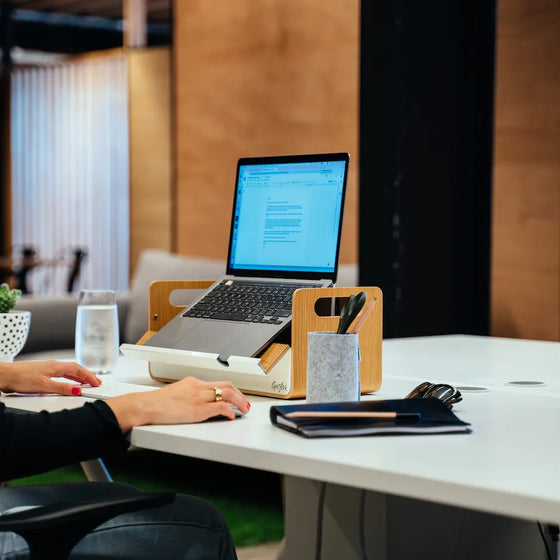
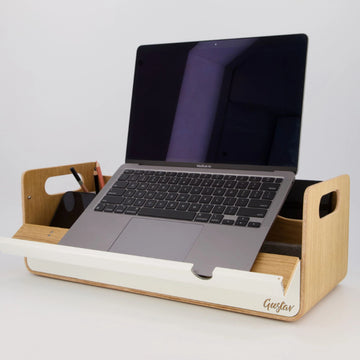
In desk-sharing offices, personal storage must move with the user. A portable organiser, work bag or structured pouch gives employees a single place for their essentials - laptop accessories, notebook, charger, mouse, pens and smaller personal items. This reduces desk clutter and shortens setup time.
Portable organisation is also one of the simplest ways to support clean desk policies without making the office feel sterile. People can keep what they need close at hand, then clear the space in seconds when they leave.
Ergonomic support
Hybrid work has made one issue impossible to ignore: many people switch between poor setups all week. Kitchen table one day, meeting room the next, shared desk after that. A workplace system should bring consistency back into that pattern.
Laptop stands, desk mats and accessories that define a stable working zone can make a substantial difference. The goal is not to turn every hot desk into a fully bespoke ergonomic station. It is to create a dependable baseline that supports posture, reduces visual clutter and helps users work comfortably for longer.
Fast setup and reset
Speed matters more than many office plans acknowledge. If employees spend the first ten minutes of the day finding accessories, adjusting devices and untangling cables, the office creates friction before work has even started.
The strongest systems are intuitive. Users should be able to unpack, position their tools and begin within moments. Just as importantly, they should be able to reset the desk just as fast. This protects shared environments from the slow drift into disorder.
Design consistency
Flexible offices often involve multiple zones - touchdown desks, focus areas, project tables and meeting settings. Without a coherent workstation language, these spaces can feel fragmented.
Consistent accessories help create continuity across the office. They signal how a desk should be used, support a tidier visual rhythm and reinforce the quality of the workplace. For brands and organisations investing in employee experience, that consistency is not superficial. It is part of how the environment earns trust.
Where many flexible offices go wrong
The most common mistake is assuming that shared desks require less support because no one owns them. In practice, shared desks need more thoughtful support because they serve more people, more working styles and more changing needs.
Another mistake is overengineering the solution. Lockers, booking systems and furniture standards all have their place, but they do not replace the need for personal portability. If the employee still has to carry loose items in their arms from locker to desk, the system is unfinished.
There is also a temptation to solve flexibility with standard IT equipment alone. A monitor and docking point are useful, but they are only part of the picture. Organisation, comfort and visual order come from the layer of tools around the technology, not the screen itself.
Choosing systems for people, not just for floorplans
For facility managers and workplace planners, the right choice depends on how the office is actually used. A consultancy with daily client meetings has different demands from a public sector team that splits time between home and headquarters. A creative studio may care deeply about aesthetic coherence, while a larger corporate rollout may prioritise speed, durability and ease of procurement.
That is why workplace systems should be judged by behaviour rather than product category alone. Look at how people arrive, what they carry, how long they stay and what slows them down. The answers usually reveal the gaps.
If users spend their day moving between zones, portability becomes critical. If desks are visually messy by midday, organisation is the weak point. If people avoid certain workstations, ergonomics may be inconsistent. Useful systems solve observed problems with as little complexity as possible.
This is also where premium accessories can justify their place. Better materials, thoughtful detailing and long-life construction do more than look good. They tend to perform better under repeated daily use, support a stronger workplace identity and reduce the cycle of replacing low-cost items that were never designed for intensive shared environments.
A design-led approach to flexibility
The strongest flexible offices do not feel temporary. They feel deliberate.
That comes from treating the workstation as part of the wider workplace strategy rather than as an afterthought. Desk-sharing only succeeds when employees can recreate a sense of order and readiness wherever they sit. That requires products and systems designed for mobility, not just furniture arranged for efficiency.
For organisations investing in better hybrid work, this is often the difference between policy and adoption. You can announce a flexible office model, but people will only embrace it if the physical experience supports them. When the setup is quick, tidy and comfortable, flexibility feels like freedom. When it is awkward, flexibility feels like compromise.
Brands such as Gustav have recognised that gap by designing workspace tools specifically for mobile, shared and hybrid use. The value is not in adding more objects to the desk. It is in giving users a clear, well-made system that helps them work with less friction.
The real measure of success
A good workplace system is almost invisible in use. People are not talking about where to find a cable or how to raise a screen. They are simply getting on with their day.
That is the standard worth aiming for with arbeitsplatzsysteme für flexible büros. Not novelty. Not complexity. Just a workspace that sets up fast, stays organised and supports professional work wherever it happens.
If your office strategy depends on people being more mobile, your workstation strategy has to make that mobility feel effortless.