Desk Sharing Accessories that actually help

If your morning starts by searching for a free desk, then pulling a charger, mouse, and headset out of your bag, and finally stacking books under your laptop, you already know the real issue behind desk sharing accessories.
It is not about extras. It is about whether a shared workstation becomes productive in two minutes — or creates ten minutes of friction.
In well-planned shared-desk environments, that exact moment often defines the quality of the working day. Employees want to arrive, set up, and begin. Workplace teams want clean surfaces, less cable clutter, and an environment that feels professional. Good accessories create the bridge between flexibility and reliability.
What desk sharing accessories need to deliver
A traditional personal workstation can grow over time. In desk sharing, that does not work. Every object needs to be mobile, instantly understandable, and ready to use immediately. If something looks attractive but only works on a permanent desk, it misses the point.
Desk sharing accessories therefore need to solve three tasks at once:
- Create order
- Improve ergonomics
- Simplify movement between locations
Only when these three layers come together does a setup stop feeling improvised.
For companies, this is more than a comfort issue. If employees lose time every day setting up and packing down, efficiency drops. So does acceptance of flexible spaces. That is one of the most common mistakes in hybrid offices: floorplans and booking systems are planned carefully, but the personal workstation moment is ignored.
The most important desk sharing accessories in daily work
Portable organisers instead of loose items
Often the biggest improvement is the simplest one: accessories that are not carried loose.
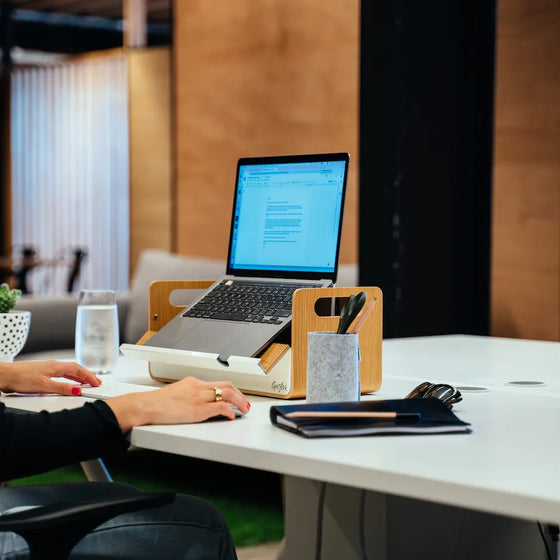
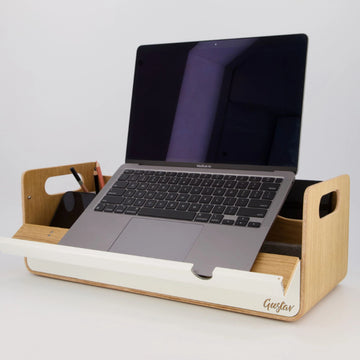
A portable organiser keeps work essentials in one place and noticeably reduces search time. Laptop, charger, mouse, notebook, pens, and small tech tools stay organised and instantly accessible.
For users, this is mainly about routine. For companies, it is about workspace quality. If personal tools do not end up scattered across the desk, the workstation stays cleaner, clearer, and ready for the next user faster.
This is also where quality becomes visible. Cheap organisers solve transport problems, but not setup problems. High-quality systems work both in the bag and on the desk. They are not just containers — they become part of the workstation.
Laptop stands for ergonomics without a fixed desk
A shared desk is rarely ergonomically ideal if it consists only of a table and chair.
Anyone working mobile several days a week notices that quickly in the neck and shoulders. A portable laptop stand is therefore one of the most valuable accessories available.
It raises the screen to a better height, improves posture, and makes temporary workstations far more suitable for longer focus sessions. This matters especially in hybrid environments where employees do not use the same external monitor every day.
The trade-off is portability. A stand needs to stay light and compact or it will simply remain at home. At the same time, it must not feel unstable. Good products solve exactly that balance between stability and mobility.
Desk mats as a clear work zone
In open offices, the value of a defined work surface is often underestimated.
A desk mat creates immediate structure. It marks a personal work zone, visually organises devices, and protects the surface.
Especially in desk-sharing concepts, this has a practical advantage: the workstation looks prepared and tidy within seconds. That helps not only the person working there, but also the overall aesthetics of the office.
Design is not secondary here. A calm, premium-looking surface communicates care and professionalism.
However, not every desk mat is suitable for mobile use. Many are too heavy, too large, or too delicate. For flexible work, materials need to be durable, easy to transport, and convincing in everyday use.
Tech pouches and cable management
Cables are almost always the first source of friction at a shared desk.
Not because they are complicated — but because they multiply. Laptop charger, phone cable, adapters, mouse, headphones: once these items are transported without structure, disorder appears quickly.
A well-organised tech pouch solves exactly that. It keeps small items together, protects accessories, and makes setup predictable.
This is especially valuable in offices with clean-desk policies, where everything should disappear neatly at the end of the day without chaos in bags and drawers.
For workplace managers, this matters because small objects create disproportionate friction in flexible offices. Large furniture gets planned. Small tools decide whether the workspace functions daily.
What really matters when choosing accessories
Many companies buy desk sharing accessories too late — or too randomly.
Accessories are often treated as optional add-ons, even though they are effectively part of workplace infrastructure. The better question is not: What can we add? It is: What does a flexible workplace need to function reliably every day?
A strong setup starts with mobility.
Products need to be:
- Easy to carry
- Intuitive to use
- Quick to store away
If an accessory requires its own setup process every time, it loses relevance quickly.
Then comes material quality.
In shared-desk environments, accessories are moved, packed, placed down, and repositioned more often than in fixed setups. Materials need to withstand that. Premium surfaces, precise craftsmanship, and durable construction are not luxuries — they are economical decisions.
Sustainability also plays a real role, especially for European companies with clear procurement and ESG standards. Long-lasting products made from responsible materials fit modern workplace strategies far better than short-lived plastic solutions that need replacing after months.
And finally, visual calm matters.
Accessories are part of the spatial concept. In well-designed offices, flexibility should not look temporary. Products with clean lines, restrained materials, and high build quality support exactly that goal.
Which solution suits whom?
Not every desk-sharing model needs the same setup.
Knowledge workers
Employees working mainly with laptop and headset benefit most from:
- Mobile organiser
- Laptop stand
- Compact tech pouch
This creates a fast, lightweight setup without overload.
Executives, consultants, creative roles
People changing locations frequently often benefit from a more integrated system.
When transport, storage, and desk organisation work together, moving between home office, office, and meeting rooms becomes significantly easier.
Workplace planners
For office planning, the focus is less on one product and more on standards.
Facility management, HR, and interior design teams should define the minimum level of mobile workplace quality available everywhere. Otherwise, the hybrid work experience becomes inconsistent.
Desk sharing accessories as part of workplace strategy
This is where the topic becomes truly interesting.
Accessories are not just personal tools. They are a quiet lever for the quality of the entire workplace concept.
They influence:
- How fast employees begin work
- How tidy spaces remain
- How premium flexible work feels
Especially during new desk-sharing rollouts, discussions often focus on occupancy rates, utilisation, and square metres. Far less attention is given to how people emotionally experience a temporary desk.
A workstation that feels structured, ergonomic, and valuable within seconds is more likely to be accepted than a bare desk with a standard chair.
That is why accessories should not be purchased individually, but thought of as a system.
When portable organisation, ergonomics, and material quality work together, a consistent experience emerges across locations. That is the difference between flexible work and constant improvisation.
Brands like Gustav demonstrate how this system logic can look in practice: mobile, design-led tools that combine transport, organisation, and workplace quality in one approach.
What is often overlooked
The best accessory is not always the one with the most features.
In shared-desk environments, the winning solution is usually the one that works daily without explanation.
Fewer parts. Clear actions. Precise details.
That is often more valuable than technical overengineering.
Acceptance matters just as much. Employees only use accessories consistently when those products visibly improve daily work.
A laptop stand that relieves neck strain stays in use.
An organiser that saves two steps every morning stays in use.
A product that only sounds good often disappears into a cupboard.
For B2B decision-makers, that means:
Choose a smaller, well-matched assortment rather than a large collection of random gadgets.
Quality, consistency, and ease of use create stronger long-term value than reactive purchasing.
Final thought
Desk sharing accessories are not extras.
They are the tools that turn an empty desk into a functioning workplace — quickly, neatly, and with the standard modern work should have today.
If flexible offices are meant to feel truly professional, it does not begin with the grand concept.
It begins with the tools people touch every single day.