Making hybrid working more productive

Monday morning at the kitchen table, Tuesday in the project area, Thursday at the shared desk. If you want to make hybrid working more productive, you must not only have meetings and tools under control, but above all the working environment. Productivity rarely fails in the hybrid everyday because of a lack of motivation. More often it is frictional losses — a poor screen angle, a lack of storage, an unsettled workspace or the daily restart without a clear setup.
Especially in knowledge work: good work requires less improvisation and more repeatability. This applies to individuals as well as organisations that want to make hybrid models sustainable in the long term. A flexible working model works well when employees can work in different locations with consistent quality — focused, ergonomic and without unnecessary effort.
Making hybrid working more productive means reducing friction
Many organisations view hybrid working primarily as a question of presence rules. Who is in the office when, which days count as team days, how often should in-person collaboration take place? That is relevant, but it is too narrow. Between policy and the actual workday lies the real experience of employees.
If every work environment has to be set up anew, an invisible productivity loss occurs. Ten minutes for power, charger and documents. Five minutes for a usable seating position. More time lost because headphones or a mouse were left in the other backpack. These small interruptions add up.
Hybrid working does not become more productive through more activity, but through fewer disruptions. Those who reduce the number of micro-decisions create space for focus. It starts with a clear basic question: what must be constant in every work environment so that performance does not depend on location?
What actually affects productivity in hybrid working
In the hybrid model productivity is often measured too narrowly. Many think first of output, responsiveness or meeting density. In everyday working life, however, other factors are decisive: how quickly can someone switch into work mode? How easily can order be maintained? How physically taxing is a workday? And how well does the environment support concentrated thinking?
A workspace in the home office can be technically adequate and still feel unproductive if cables, notes and devices are constantly in the way. A desk-sharing area can be well planned and still create friction if personal work items have no fixed place. Productivity is therefore not only a question of digital infrastructure. It is also a question of ergonomics, organisation and spatial clarity.
For facility managers, workplace strategists and planners this is an important point. Those who want to improve hybrid work should not only allocate space and introduce booking systems. What matters is how quickly and reliably a workstation can be activated.
Standards beat improvisation
The strongest hybrid setups have one thing in common: they are standardised without being rigid. Employees do not need identical desks in every location. They need a consistent logic. That means that the most important work tools are always equally accessible, transportable and intuitive to use.
A mobile working day benefits from clearly defined essentials. Laptop, charger, mouse, writing materials, headphones and personal work documents should not be loose between bags, drawers and kitchen tables. The better these things are bundled and organised, the quicker the start to the day.
Ergonomics is not optional even in a flexible model
Hybrid working is often associated with freedom. However, this freedom quickly turns sour when employees regularly work in poor postures. Those who switch between locations daily need not less ergonomic support, but more.
A laptop alone is rarely ideal for extended work. Screen height, viewing angle and arm position directly affect concentration and strain. The consequence of poor ergonomics is not only physical discomfort. It also shows in reduced attention, more frequent interruptions and shorter focus phases.
Therefore every hybrid working strategy should define a simple ergonomic baseline. Not maximally equipped, but sensible. A good seating position, a raised screen, organised work tools and enough clear space are not extras. They are the basis for consistent performance.
Making hybrid working more productive in the office and at home
A common mistake is to think of the home office and the office separately. In practice employees experience both as a connected system. If the quality of the work environment fluctuates greatly, overall performance falls.
At home it is mostly about making limited space usable professionally. Not everyone has a separate study. Precisely for that reason compact, mobile and visually calm solutions are crucial. Those who can quickly tidy or stow away their workspace at the end of the day keep the room functional and reduce mental unrest.
In the office the challenge is often different. Desk sharing, changing team sizes and open-plan spaces demand setups that work in seconds. Employees should not have to search for accessories, storage or a usable viewing angle. A well-planned shared desk feels ready to work at once.
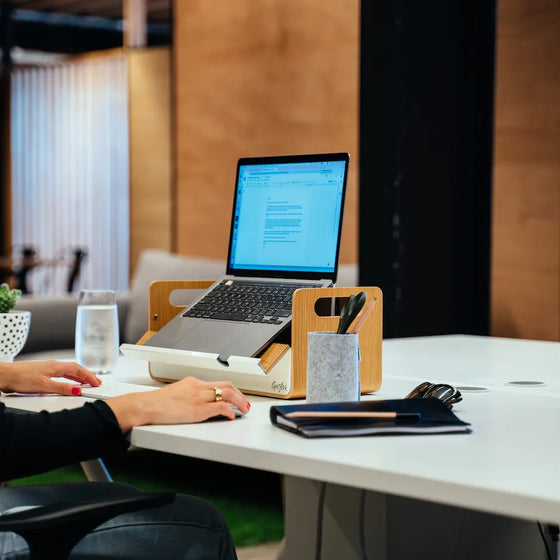
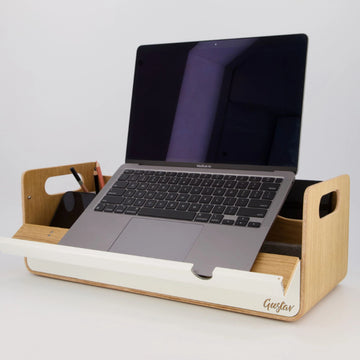
Here the value of design-oriented workplace solutions becomes particularly clear. When organisation, ergonomics and mobility come together in a clear system, a workspace is created that looks professional and also works practically. That is exactly where the strength lies of products that not only look good but neatly address hybrid working realities.
The role of rituals rather than rigid rules
Not every productivity question can be solved by equipment. Hybrid work also needs clear routines. However, rigid rules rarely work well, especially in distributed teams with different task profiles.
Simple rituals are more helpful. A fixed start to the day. A standardised workstation check. Defined times for focused work without meetings. Visible signals for when collaboration is desired and when it is not. Such routines create reliability without blocking flexibility.
For teams it is also worth taking an honest look at the purpose of presence days. Not every day in the office is automatically more productive. If employees come into the office for tasks that would be more efficient done alone at home, frustration rather than added value arises. Presence unfolds its benefit especially where coordination, creativity, learning or social bonding are in the foreground.
Productive hybrid work therefore also means choosing the right place for the right task. Focused work, coordination and informal exchange require different conditions.
Less visual clutter, more cognitive clarity
Order often seems secondary until it is missing. In hybrid work environments visual clarity, however, is a direct performance factor. An overloaded desk, loose cables, changing documents and improvised storage create stimuli that capture attention.
This is especially true in open-plan offices and smaller living spaces. Those who can quickly structure their own work area work more calmly. Therefore reduced, functional tools in the hybrid context are more than design objects. They help shorten the transition from arriving to working.
For many users that is exactly the difference between a provisional and a professional setup. Gustav addresses this gap with mobile, precisely designed workspace solutions that integrate organisation and ergonomics into everyday life without overloading it.
What companies can concretely do better
For employers and planners productive hybrid work begins with a change of perspective. It is not the space alone that matters, but its usability. A workstation must be quickly understandable, comfortable and complete.
This means, firstly, deliberately defining hybrid standards. What equipment is required everywhere? Which tools should be mobile? Where is personal storage needed, where central provision? Secondly, an honest analysis of the typical frictional losses is worthwhile. If employees lose time daily searching, setting up or rearranging, that is not an individual problem but a planning problem.
Thirdly, companies should take the quality of the workplace experience seriously. People work better when their environment is well thought out. Good materials, clear functions and a pleasant visual calm do not only enhance aesthetics but also acceptance and usability.
There is no one-size-fits-all solution. A consulting firm with high mobility needs different setups than a creative studio or a public administration. But in any case: productivity arises where flexibility is not mistaken for improvisation.
In the long run hybrid working will not improve through more control but through better conditions. Those who create workspaces that function as mobile, ergonomic and ordered give people back something very valuable — a clear head for the actual work.