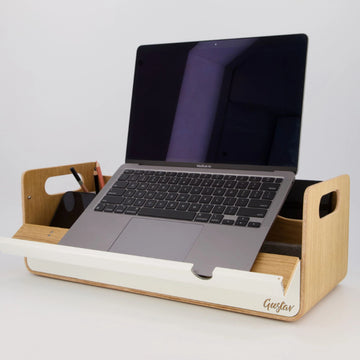
Laptop Stand for Hybrid Work: Why It Matters More Than Ever

Monday morning in the home office, Tuesday in a project zone, Wednesday at a shared desk: anyone moving between locations and work modes quickly realises that a good laptop stand for hybrid work is not a marginal accessory. It often determines whether a workspace is ready in two minutes — or still feels improvised an hour later.
Hybrid work creates different demands than a traditional fixed workstation. The right solution needs to be easy to carry, quick to use, and suitable for visually calm working environments. At the same time, it should support ergonomics, look professional, and fit desk-sharing concepts where personal belongings cannot remain permanently on the desk.
Why a Laptop Stand for Hybrid Work Needs to Do More
A stationary stand may be enough for a dedicated home office. For flexible work models, that is often not enough. Anyone regularly moving between office, meeting rooms, and home needs a product that not only feels good, but genuinely simplifies the working day.
1. Ergonomics
Laptops are mobile, but their form forces the user to look downward. Over longer periods, this often leads to neck tension and collapsed posture. A stand raises the screen and brings it closer to a natural sightline.
It is not a complete ergonomic solution — external keyboard and mouse are usually still recommended — but it is a meaningful step in the right direction.
2. Order and Readiness
In hybrid setups, productivity depends not only on how you work, but how quickly you can begin. A laptop stand gives the device a defined place, structures the desk surface, and makes a temporary workspace feel more controlled.
Especially in open-plan offices, shared desks, or client-facing environments, this is more than an aesthetic detail.
3. Mobility
Many products look elegant in photos, yet prove too heavy, bulky, or awkward in daily use. For hybrid work, the most important factor is rarely maximum functionality. It is the right balance between stability, packability, and ease of use.
What to Look for in a Laptop Stand for Hybrid Work
When choosing a stand, screen height alone should not drive the decision. What matters is how well the product fits into real workflows.
Portability Without Sacrificing Stability
A mobile product should be lightweight, but not fragile. A stand that disappears in a backpack yet wobbles on the desk only solves half the problem.
Strong options feel stable, pack compactly, and remain dependable after repeated setup and breakdown.
This matters particularly in European office environments with rotating desk-sharing zones, smaller desks, or temporary project spaces. The stand should remain secure without occupying unnecessary space — especially when external keyboard, mouse, notebook, or a tech pouch are also on the table.
Ergonomics That Work in Practice
Not every stand lifts the screen to the same height. Some create only a slight tilt, while others raise the device significantly.
What works best depends on usage:
- Short sessions between meetings or touchdown desks: moderate elevation may be enough.
- Several hours of focused work: a higher setup combined with external keyboard and mouse is often the better solution.
This is where the difference becomes clear between a decorative accessory and a genuine productivity tool.
Fast Setup, Clear Use
Hybrid work depends on low friction. A stand that must be unfolded, adjusted, or repositioned every time often gets used less over time.
The best products are intuitive to set up and just as easy to pack away.
That may sound minor, but it is strategically important: in flexible workplaces, products that simplify behaviour are the ones people consistently adopt.
Material Quality and Presence
Function matters, but appearance still counts. Today’s workspace is often also a communication setting — in the office, on video calls, or in client meetings.
A laptop stand should not feel visually noisy or generic.
High-quality materials, precise construction, and restrained design language create confidence. Material choice also affects sustainability and lifespan. Anyone buying for years of use should consider durability, not just short-term price.
For companies, this matters because longevity, resilience, and visual consistency influence total ownership cost.
Common Buying Mistakes in Hybrid Work
Many people buy a laptop stand in isolation — as a single product rather than part of a wider system.
The stand may suit the laptop, but not the bag, desk setup, or actual rhythm of work.
Oversized Solutions
Large, heavy stands may feel reassuringly stable, but often become impractical for mobile use. They end up staying in one place, missing the core purpose of hybrid work.
Too Much Minimalism
Ultra-light models can slide on smooth surfaces or flex under pressure. Lightweight is useful — unstable is not.
Ignoring Input Devices
A higher screen can improve posture, but if the user continues typing on the built-in keyboard, new compromises appear.
Raised laptops without external keyboard and mouse can strain wrists and shoulders in a different way. The decision should never be separated from the wider setup.
Which Type of Stand Suits Which User?
Mobile Professionals
For knowledge workers moving between home office and company workspace several days a week, a portable and quickly packable solution is ideal.
It should fit into a bag or organiser, work on different desk sizes, and make any setup feel calmer immediately.
Workplace Teams, HR, and Facility Managers
For organisations, standardisation often matters most.
A stand should not only work for individuals, but also make sense in rollout scenarios:
- easy to explain
- durable
- visually consistent
- compatible with clean-desk policies
Architects and Office Planners
Design professionals also consider spatial impact.
A good stand should not dominate the desk. It should integrate into contemporary office architecture, complement quality materials, and contribute to a professional visual environment.
This is where ergonomics and design clearly do not need to compete.
The Laptop Stand as Part of a Better Workspace System
A laptop stand delivers the most value when it is not considered alone.
In flexible work models, quality rarely comes from one object. It comes from the combination of:
- stand
- external input devices
- organisation tools
- transport solution
When someone arrives in the morning and creates a full workstation in moments, work feels different.
Less searching. Less cable clutter. Less improvisation.
The desk feels clearer — and often the mind does too.
That is why portable workspace systems are becoming more relevant in many companies: not as a lifestyle idea, but as a practical response to desk sharing and changing work locations.
Brands like Gustav focus on this need because the demand now extends beyond ergonomics alone. People are looking for solutions that combine mobility, order, and quality materiality.
What a Quality Laptop Stand Improves Over Time
The real value of a well-designed stand is not visible in the first five minutes, but after months of regular use.
It reduces the small frictions that accumulate in hybrid work:
- unstable posture
- cluttered desks
- slow setup
- awkward transitions between locations
There is also a psychological benefit.
Anyone who can intentionally and repeatably create their workspace experiences more control in a fragmented working week.
That may sound intangible, but it matters in modern knowledge work.
Good working environments are not created only through square metres or IT budgets. They are also shaped by tools that create clarity.
For companies, the right laptop stand can improve the overall workplace experience.
For individuals, it reduces the compromise between mobility and comfort.
For planners, it becomes a visible building block of functional flexibility.
In the end, the best choice is not the stand with the most features — but the one you genuinely enjoy using every day: at the kitchen table, in a focus zone, at a shared desk, and wherever work happens now.