Which work equipment for hybrid working really counts

Monday morning in the office, Tuesday at the kitchen table, Thursday in the project area with desk sharing - this is exactly where it becomes clear which work equipment for hybrid working really matters. It is not the longest equipment list that wins, but a setup that is mobile, ergonomic and reliable.
Which work equipment for hybrid working really counts
Hybrid working places different demands on equipment than the traditional fixed workplace. Anyone who moves between locations does not simply need more kit, but the right kit. Every piece of equipment should answer three questions: Is it easy to take with you, does it improve working comfort, and does it help keep things organised?
For individuals this means a setup that is ready for use within minutes. For companies it means equipment that supports flexible workplace models without compromising quality or the user experience. Especially in desk-sharing oriented environments, products are in demand that are personal, mobile and easily stowed.
The best selection therefore does not come from individual gadgets, but from functions. Ergonomics, transportability, clarity and material quality are the criteria that make a difference in everyday use.
The basics: working ergonomically everywhere
The most common mistake in hybrid working is surprisingly simple. Many teams move work to different environments without thinking about posture at the workplace. A laptop alone is portable, but rarely ergonomically ideal. Anyone who spends several hours a day at a screen will notice it quickly in their neck, shoulders and concentration.
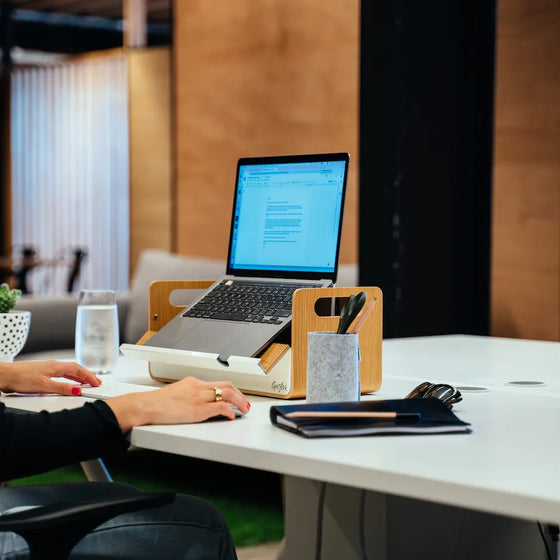
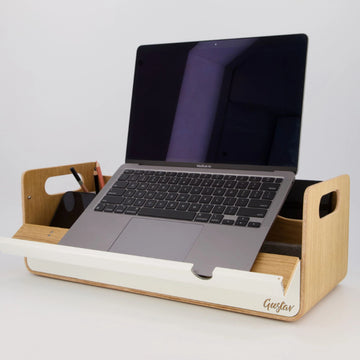
A compact laptop stand is therefore one of the most important pieces of work equipment. It raises the screen to a more comfortable height and also creates more structure on the desk. Particularly useful is a model that is light, stable and quick to assemble and disassemble. In the home office a fixed stand may be sufficient. In changing work environments every detail of weight, pack size and handling counts.
Ergonomics do not stop at the screen. An external keyboard and a mouse or a precise input device make mobile setups significantly more usable. This is especially true when employees regularly move between the office and home. The difference between "it works" and "it is comfortable to work with" often lies precisely here.
For companies it pays to take a differentiated view. Not every role needs the same equipment. Those who travel a lot or frequently change workplaces spontaneously benefit from particularly compact, portable solutions. Those who commute mainly between two fixed locations can equip both sites more permanently.
Order is not a detail but infrastructure
Teams working in a hybrid way rarely lose time because of big obstacles. Far more often it is lost to small frictional losses: the charger is missing, note-taking material is at the other location, adapters are in a different bag, the desk immediately looks cluttered. That is why organisation is a central piece of work equipment - not merely a question of style.
Portable organisers, tech pouches and clearly compartmentalised bags create a standard that makes switching between work locations easier. The advantage is not only in transport. Good organisation reduces the mental load at the start of the working day. Knowing that every item has its place means you set up the workspace faster and work with more focus.
In desk-sharing environments this point becomes even more important. Personal work equipment must be quickly taken from one place to another without the workspace looking like an improvised interim solution. A mobile organiser or a structured carrying system also supports clean-desk policies. That is functional and at the same time looks far more professional.
Design plays a bigger role than often assumed. Work equipment that is well made and creates visual calm noticeably improves use. It helps to set up temporary workplaces consistently and deliberately - instead of starting from scratch every morning.
Which work equipment for hybrid working is missing in everyday use
What is often missing in practice are not spectacular devices, but connecting elements. A desk mat, for example, is often underestimated. It immediately defines a clear working area, protects surfaces and gives mobile setups more stability. Especially on shared tables this creates a workspace that feels more personal and calmer within seconds.
Equally relevant are well thought-out bags or work bags. They do not just carry a laptop and accessories, they keep the entire setup together as a unit. This is crucial for hybrid working. Individual good products help little if they are impractical on the move or cannot be sensibly used together.
Technology yes - but in moderation
Hybrid working is quickly answered with more technology. Additional screens, docks, headsets, adapters, chargers, lamps and accessories can be useful. They can also overload a setup just as quickly. The better question is not: What is technically possible? But: What is used regularly?
A good hybrid setup is pared down, not sparse. Those who have frequent video calls should invest in a high-quality audio setup. Those who write or analyse a lot benefit more from ergonomics and desk organisation. Those who commute between client meetings, the office and home need above all reliability and mobility.
This also has economic relevance. For workplace strategists, facility managers and HR managers standardisation is often more sensible than maximum equipment. Less, but better equipment is often more durable, easier to maintain and actually used. That improves the employee experience and reduces procurement chaos.
Material quality determines everyday suitability
With hybrid work equipment quality shows up faster than at a fixed workplace. Products are carried, packed, placed, reassembled and subjected to continuous use. What looks neat in the online shop can be stretched, scratched or impractical after a few months.
That is why it pays to look at materials, workmanship and construction. High-quality, durable materials are not a luxury but functional. They hold their shape, protect technology and ensure that mobile work equipment still looks professional after many location changes. Especially in design-oriented office environments or at client meetings this is not insignificant.
Sustainability should also be considered concretely. It is not only about the material itself, but whether a product is designed for long-term use. Buying less but better is often the more sustainable decision than short-term, replaceable solutions.
For companies: equipment must fit the workplace strategy
The selection of hybrid work equipment is not an isolated purchasing question. It belongs to the workplace strategy. If a company introduces desk sharing, activity-based working or flexible attendance models, the tools must support this logic.
That means: equipment should be mobile enough for changing settings, consistent enough for simple provisioning and high-quality enough to create acceptance. Employees are more likely to use solutions consistently if they are intuitive, aesthetically pleasing and reliable. Especially in the premium segment it becomes clear that good design does not separate from use but enhances it.
For architects, planners, interior designers and workplace consultants this is an important point. Flexible spaces work better when the personal workspace is not tied to furniture but thought of as a portable system. A set consisting of an organiser, stand, desk mat and tech storage can be more effective than additional fixed infrastructure at every desk.
A design-oriented approach like Gustav's fits precisely with this thinking: work equipment is not seen as loose individual parts but as an integrated mobile workspace system. That supports both user comfort and the visual quality of modern working environments.
How to choose the right work equipment
Instead of immediately collecting products, a short inventory is worthwhile. Where is work actually done - at home, in the office, on the move or in all three contexts? How often is the workplace changed? Which items must be taken every day? And which problems occur regularly - poor posture, cable chaos, lack of structure or awkward transport?
From these answers a clear picture usually emerges. Those who work a lot on the move should first invest in portable ergonomics and good organisation. Those who work in shared-desk environments primarily need solutions for quick assembly and disassembly. Those who spend the whole day on a laptop should prioritise screen height and input comfort.
It is less sensible to answer hybrid working with a long list of accessories. Better is a deliberately curated setup that works every day and adapts to different places without losing quality.
Hybrid working does not improve by having more things, but by having more suitable ones. When equipment brings together mobility, order and ergonomics, a workspace that looks professional everywhere emerges - and feels that way too.