Setting Up Your Work Space In Seconds

Monday, 08:57. The first free desk‑sharing spot has been found, the coffee is already standing beside it, and then the small daily rearrangement begins: laptop out of the bag, charger untangled, mouse searched for, notebook put down, seat height checked. Anyone who wants to set up a workplace in seconds doesn’t need more speed. They need less friction.
That is precisely the difference between an improvised workplace and a well planned set‑up. In hybrid working models, in the home office and in shared office environments it’s not only important whether a desk is available. What matters is how quickly it can become a functional, ergonomic and tidy work area.
Why being able to set up a workplace in seconds is relevant today
Flexible working sounds efficient on paper. In practice it often costs small, recurring minutes. Those who switch daily between locations, meeting rooms, shared desks and their own home lose time mainly in the transitions. Not on the actual work, but in the in‑between.
A set‑up that works in seconds reduces exactly those transitions. This is not a lifestyle detail but a performance issue. When tools are immediately to hand, cables do not lie loose and the screen can be brought to the right height with one movement, the working day starts with better concentration. This applies to individual knowledge workers as much as to teams working in larger hybrid structures.
For companies another aspect comes into play: consistency. Desk sharing only works well if employees do not have to start from scratch every morning. The easier the set‑up, the more likely clean‑desk rules will be accepted, workstations will be left tidy and flexible spaces will actually be used efficiently.
Setting up a workplace in seconds does not mean minimalism at all costs
Speed is often mistaken for sacrifice. A slim set‑up does not mean foregoing comfort or working with only a laptop and charger. It means arranging the right elements so they are mobile, organised and immediately ready for use.
A good mobile workplace usually needs only a few building blocks: a clear organisational structure for the most important tools, a stable solution for a better screen height, space for writing materials and tech, and a transport logic that keeps everything in one place. When these elements are coordinated, what emerges is not a makeshift solution but a complete workstation that can be moved easily.
This is particularly relevant for design‑conscious organisations. A tidy set‑up supports not only productivity but also the visual calm of a space. It looks professional, especially in open‑plan offices, client environments or high‑quality home office interiors.
What slows down a quick set‑up in practice
The biggest brakes are rarely spectacular. Mostly they are five small problems that repeat every day.
First, there is no fixed place for the most important work items. When mouse, cables, adapters, headset and writing implements are transported loosely, every set‑up begins with a search. Second, ergonomics are postponed. The laptop initially stays flat on the table because a separate solution is inconvenient. Often it remains like that.
Third, there are breaks in continuity between locations. What works in the home office does not necessarily fit in the office or the meeting room. Fourth, the transport solution is not designed for work. Many bags carry things but do not organise them. And fifth, a routine is lacking. Even good products help little if the set‑up is not logically arranged.
The crucial thing, therefore, is not only the individual object but the system behind it.
How to set up a workplace in seconds
The quickest set‑up begins before the first move is made. Those who work mobile should think of the workplace as a repeatable process. Not a new one every day, but the same one every day.
1. Treat a set‑up as a unit
It makes sense to define all daily essentials as a fixed kit. These typically include laptop, charger, mouse, notebook, pen, where appropriate a headset and a compact laptop stand. These items should not be spread across different compartments, bags or drawers, but function as a mobile unit.
The advantage is simple: you do not carry individual parts, you carry the workplace itself. That saves time unpacking and even more time packing up.
2. Integrate ergonomics rather than add it on
In many flexible working environments ergonomics fails at the hurdle of portability. If an aid is too big, too heavy or too cumbersome, it gets left behind. That is why mobile working needs solutions that are portable but still bring a noticeable improvement.
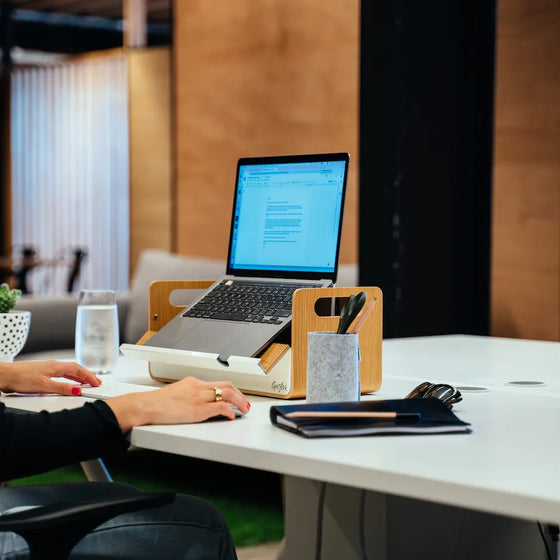
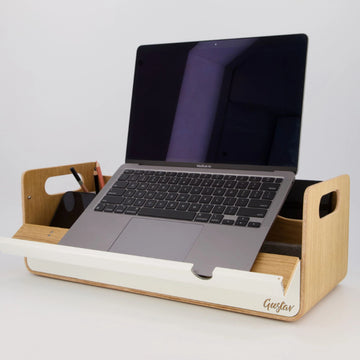
A compact laptop stand is often the decisive difference. It raises the screen, improves posture and signals immediately: this is a place to work, not just to answer a few emails. For longer working days this is not a detail. It helps determine whether mobile work remains professional or becomes a permanent compromise.
3. Keep the desk surface deliberately calm
A quick set‑up is also a visual set‑up. When every object has a clear place, the workplace looks organised straight away. That reduces distraction and supports focus, especially in open offices.
An organised surface does not need over‑staging. The important thing is that only what is in use is visible. Everything else stays stored in an organised way. This fits not only with clean‑desk strategies but also with high‑quality work environments where function and design belong together.
4. Think transport and use together
Many mobile set‑ups are acceptable for transport but impractical on the desk. Or vice versa. Better are solutions that master both: compact on the move, immediately structured at the workstation.
This is exactly where the quality of a well‑thought‑out workspace system becomes apparent. When a bag, an organiser and a stand do not exist side by side by accident but function as a coherent working logic, real time savings are achieved. Gustav follows precisely this approach — not with arbitrary accessories but with mobile tools for a complete office set‑up.
Who benefits most from this approach
Not every work situation requires the same degree of mobility. Someone who works exclusively at a fixed desk needs different solutions from someone who moves between three locations every day. The idea of being able to set up a workplace in seconds is especially powerful where flexibility is not the exception but the norm.
In desk‑sharing offices it eases the start to the day and relieves pressure on shared spaces. In the home office it helps to switch more quickly between living space and working mode. For consultants, creatives, project teams and executives with a high meeting density it ensures that work quality does not depend on the location.
It is also relevant for workplace managers. If employees can easily bring their workplace and take it away in an organised way, the organisational pressure on central spaces decreases. Shared desks stay cleaner, reallocation becomes easier and the quality of use increases.
Quality shows in everyday use, not on the spec sheet
With mobile workspace solutions people often talk first about material, weight or dimensions. That makes sense, but it is not enough. What matters is how a product proves itself in everyday life.
Can it be opened and closed with one movement? Does the set‑up remain stable? Does the surface feel high‑quality with daily use? Does the system still look tidy after months or only in the first few days? Especially in professional environments this durability counts.
That is why it is worth looking at workmanship, material choice and sustainability not only for image reasons. High‑quality, durable products reduce replacement purchases, look good for longer and support a professional user experience. For companies this is as relevant as for individuals who do not want to constantly re‑solve their workplace.
Less set‑up time, more arrival
A good workplace does not begin with technology but with clarity. Those who have to sort, set up and improvise in the morning already start with unnecessary unrest. Those who have everything in the right place are present more quickly.
It sounds small, but it is noticeable in everyday life. A workplace that is ready in seconds creates not only efficiency. It provides a better transition into focused work. That is precisely what makes flexible environments more pleasant, more professional and ultimately more productive.
The real question is therefore not how quickly you can occupy a desk. It is how easily any place can be turned into a workplace that works immediately.