Why the future of desk-sharing offices is being rethought

Monday morning, 08:45. Ten people arrive at the office, nobody is sitting in the same place as last week, and yet the working day is expected to begin in an organised way immediately. This is precisely where the future of desk-sharing offices is decided — not by the number of available workstations, but by the quality of the experience between arriving, setting up and focused work.
Desk sharing is no longer a short-term efficiency lever. For many organisations across Europe it has become the standard for hybrid work. But the next step is more demanding than merely reducing desks. The question is no longer whether workstations are shared, but how shared offices can be designed to feel productive, calm and high-quality.
Why the future of desk-sharing offices is being rethought
The first phase of desk sharing was often driven primarily by space. Fewer fixed seats, higher utilisation, lower costs. The model worked on paper, but in practice often only to a limited extent. Employees searched for a suitable place in the morning, lugged equipment and personal work items around with them and lost time before the actual work even began.
The future therefore does not lie in ever more flexibility at any price, but in better-designed flexibility. A desk-sharing office today must achieve three things at once: it must be efficient, create a consistent working feel and support different modes of work. Those who optimise only space but neglect the daily user experience create friction instead of agility.
This makes a different standard relevant for facilities managers, workplace strategists and planners. Success is measured not only by occupancy rates, but also by set-up time, perceived order, ergonomic quality and employee acceptance. That is a decisive shift.
From the free desk to the curated work environment
In well-functioning desk-sharing environments the desk is no longer the complete workplace. It is just the platform. The actual workplace consists of a system of space, rules, digital infrastructure and mobile tools.
This also changes the role of furniture design. A table alone is not enough. People need a work environment that can be personalised quickly without remaining personalised permanently. That sounds paradoxical, but it is the core of modern shared offices. The space must be neutral enough for changing users and at the same time individual enough to become productive within seconds.
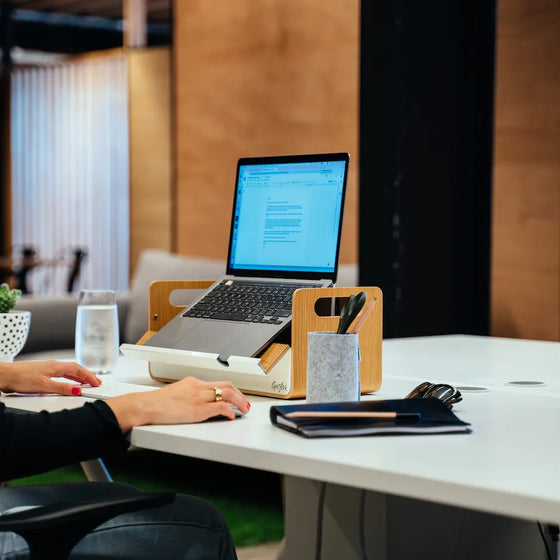
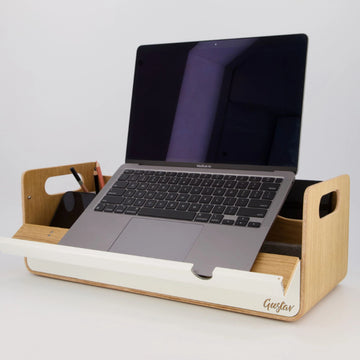
For this reason, portable and clearly organised set-ups are gaining importance. Whoever can transport a laptop, charger, notebook, mouse and personal essentials in an ordered way and place them in one go, starts the day more calmly. That reduces visual clutter, shortens transitions and supports clean-desk standards without appearing sterile.
The next stage is ergonomic
Many desk-sharing concepts do not fail because of the principle, but because of physical reality. Employees accept flexible seats only if they do not have to make ergonomic compromises every day. A beautiful space with good coffee does not replace a reasonable posture at the screen.
The future of desk-sharing offices will therefore become more strongly shaped by ergonomics. Height-adjustable desks, reliably good chairs and easily accessible monitor or laptop solutions are no longer extras. They become basic equipment. Especially in hybrid models, employees rightly expect that the switch between home office and office is not associated with a loss of quality.
Here too, practicality matters. An ergonomic solution is only as good as its actual use. If accessories are stored awkwardly, shared equipment is missing or the set-up takes several minutes, it is often bypassed in everyday life. Good planning therefore means combining ergonomics with simplicity.
Standardisation without uniformity
A common objection to desk sharing is that offices become impersonal. The risk is real. If every place looks the same but none really works well, an atmosphere develops that is correct but generic.
The better answer is not more individualisation in the classical sense, but intelligent standardisation. Workstations should be planned so uniformly that every person finds the same functional prerequisites. At the same time the environment needs materials, organisation systems and details that convey quality. High-quality surfaces, calm colours, tidy cable management and well-thought-out storage create orientation and professionalism.
For architects, designers and office planners this is an exciting point. The quality of a shared office is shown not only in the space logic but in the precision of the details. How is technology stored? Where do personal items go during the day? How quickly can a place be reset? Such questions seem operational, but they are decisive for the user experience.
Mobility becomes the core of the workplace
The classic office workplace was location-bound. The modern workplace is person-bound. This shift has major consequences. Employees move between home, the office, project spaces and meeting rooms. What must remain constant is not the table but the sense of work.
For this reason mobility becomes a strategic issue. Not as an add-on, but as the foundation of a functioning desk-sharing model. Mobile organisational systems, compact work tools and bags or carriers that make the workplace transportable solve a very concrete problem: they create continuity in changing environments.
For organisations this is more than comfort. Helping employees to take their workplace away in an orderly way reduces search times, cable chaos and improvised interim solutions. At the same time the likelihood increases that shared desks are actually used as intended.
In this context, design-oriented, portable workspace solutions fit particularly well with high-quality hybrid offices. They combine order, ergonomics and visual calm — and turn flexibility into a usable quality rather than a daily improvisation.
Technology remains important, but it is not the whole answer
Many organisations start with booking tools, sensors and occupancy data when implementing desk sharing. That makes sense. Without good data it is hard to manage space sensibly. Nevertheless, technology in the coming years will be more of a hygiene factor than a differentiator.
A booking system can show where a space is free. But it cannot ensure that that space is pleasant, orderly and ergonomically convincing. Data help with planning, not with the daily haptics of work. This is a frequent blind spot.
The strongest concepts combine digital clarity with physical quality. Employees need orientation in the system and reliability in the detail. When both are right, a working environment emerges that feels professional without being cumbersome.
What organisations should do differently now
The future of desk-sharing offices will not be decided by radical reinvention, but by better execution. For many organisations this means shifting the focus. Away from the question of how many seats can be saved, towards the question of how flexible work can be organised without friction.
It starts with zoning and usage logic. Not every activity belongs at the same type of workstation. Concentrated work, short touchdown phases, team work and video calls need different settings. Desk sharing works best when it is embedded in a broader activity-based concept.
Equally important are clear standards. Employees must know what to expect at each place and what they should bring themselves. Organisations that define these expectations transparently create more acceptance than those that rely on informal habits.
And finally, it requires investment in things that are often underestimated: high-quality accessories, orderly storage, portable set-ups and materials that withstand daily use. It is precisely here that it becomes apparent whether a concept is merely efficiently planned or truly well thought through.
The success factor is not flexibility alone
The coming years will not abolish desk sharing. They will raise the expectations placed on it. Employees accept flexible offices when they offer clarity, comfort and quality. If these elements are missing, desk sharing is quickly read as a cost-cutting measure — even when the strategic idea behind it makes sense.
For European working environments with high expectations of design, sustainability and user-friendliness this is particularly relevant. The office of the future does not have to be fuller. It has to work better. Calmer. Tidier. More mobile. And more precise in the details that carry daily work.
Those planning desk sharing today should therefore not stop at the floor plan. The real quality is created in the transitions — from arrival to setting up, from switching to working, from shared space to personal focus. It is precisely there that it is decided whether flexibility is merely organised or truly works.
The most helpful question at the end is not how many people can share a desk. It is how well a shared workplace supports each person’s working day.