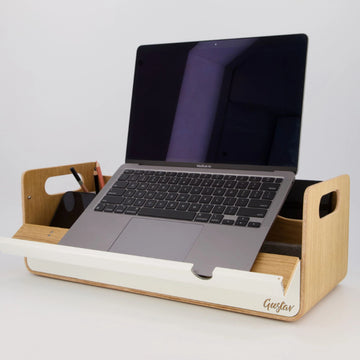
Portable Laptop Stand Review for Hybrid Work

A shared desk at 9am, a meeting room at 11am and the kitchen table after lunch all create the same problem: a laptop screen that sits too low. A portable laptop stand review should begin there, not with a list of features. The right stand helps someone establish a comfortable, organised workstation in seconds, then pack it away without adding another awkward object to their working day.
For hybrid workers, the best choice is rarely the smallest or the tallest product in isolation. It is the one that balances screen height, stability, carrying comfort and visual calm across the places work actually happens. For workplace teams, that balance also affects adoption. Equipment only improves an agile workplace if people want to carry and use it.
What a portable laptop stand should solve
A laptop encourages a downward-looking posture because the display and keyboard are attached. Raising the screen can bring it closer to a more comfortable viewing height, especially when paired with an external keyboard and mouse. That is the most complete ergonomic arrangement for longer focused sessions.
Yet portability changes the brief. A stand that is excellent at a fixed desk but bulky in a bag may stay in a locker. One that folds flat but flexes under a larger laptop can become a distraction in a meeting. The practical question is not simply whether a stand lifts a device. It is whether it creates a dependable work surface wherever the user lands.
For desk-sharing environments, a good stand also gives a temporary desk a sense of order. It defines where the laptop sits, creates room beneath or around it for essentials, and makes it easier to leave the desk clear at the end of the day. That is a modest physical change with a noticeable effect on how a flexible office feels.
Portable laptop stand review criteria that matter
Ergonomics: height is only one part of comfort
Look first at the usable screen height, not a headline measurement. A low tilt can improve the keyboard angle and ventilation, but it will not meaningfully reduce neck flexion for many people. A higher position is more effective for the screen, although it generally calls for a separate keyboard and mouse to keep wrists and shoulders comfortable.
The right range depends on the task. For a short video call or a few emails, a compact lift may be enough. For regular desk-based work, choose a stand that can place the top portion of the screen nearer to eye level while keeping the display stable. Adjustable designs suit varied users and desks; a fixed-height design can be preferable when speed, simplicity and repeatable setup matter more.
Also check the viewing angle. Reflections from overhead lighting and windows can make a technically well-positioned laptop unpleasant to use. A stand should allow enough adjustment to orient the screen clearly without forcing the laptop into an unstable position.
Stability: the quality you notice after the first week
A portable stand must cope with more than a careful showroom test. Consider how it behaves when the laptop is opened with one hand, when a cable pulls slightly from the side, or when someone types without an external keyboard. Wobble is tiring, and a product that needs constant repositioning quickly loses its value.
The footprint matters as much as the material. A broad, well-considered base generally provides more confidence than an ultra-narrow structure, particularly with larger laptops. Non-slip contact points should hold both the stand and the device in place without leaving marks on a shared table. The laptop should rest securely on its supports, with enough of a lip or ledge to prevent gradual sliding.
Weight is a trade-off rather than a flaw. Very light constructions can be easy to carry but may feel less planted. A little more substance can improve stability and longevity, provided the form stays slim enough for a work bag. Test for the laptop sizes used across your team, not only a compact personal device.
Packability: measure the whole working day
When reviewing portability, folded dimensions tell only part of the story. Consider the shape, edges and opening mechanism. Does it slide easily beside a laptop and documents? Can it be set up without hunting for loose parts? Does it sit comfortably in a bag alongside chargers, a notebook and a water bottle?
The most useful stands make the transition from carrying to working feel immediate. That matters for hot desking, where people may have only a few minutes between arriving and joining a call. It matters at home too, where a dining table may need to return to its original purpose at the end of the day.
A product that combines laptop support with a desk organiser can reduce the number of separate items employees need to transport. Gustav Original, for example, is designed as both an ergonomic laptop stand and a portable desk organiser, creating a defined workstation from a single object. This approach suits users who carry a consistent set of essentials and want less loose equipment in transit.
Materials and finish: premium should earn its place
A stand is visible every time work begins, so finish matters. In a client-facing office, a meeting room or a carefully considered home workspace, the product should look intentional rather than temporary. It should also feel pleasant to handle daily, with surfaces and edges that remain composed after repeated packing and unpacking.
Material choice has practical consequences. Wood can bring warmth, stiffness and a more furniture-like presence to a mobile setup. Recycled felt can soften the visual and physical impact of smaller accessories while helping contain cables and stationery. Metal can be slim and precise, although its contact points and hinges need careful design to avoid scratches, noise or cold, impersonal handling.
For organisations, durability is part of responsible specification. Ask how the stand will cope with frequent movement, shared storage and varied desk surfaces. A two-year warranty is a useful indicator that the product is intended for regular use, but everyday construction details remain the clearest test: secure joints, stable contact points and materials selected for repeat handling.
Compatibility: check the desk, not just the laptop
Most buyers remember to check laptop size and weight. Fewer consider the environments around it. A portable stand should work on shallow desks, meeting tables and kitchen tables without consuming the entire surface. If users often connect to monitors, check that charging and display cables can route cleanly without lifting the stand or pulling the laptop off-centre.
Think about the rest of the setup as well. A raised laptop needs space for a keyboard, mouse and notebook. In smaller touchdown spaces, an organiser that keeps chargers, pens and cables contained can be as valuable as an extra adjustment setting. The aim is not to add accessories for their own sake. It is to make a complete workstation possible within the footprint available.
Choosing for individuals and shared workplaces
Individual buyers can select around their own laptop, bag and working habits. If they move between locations daily, speed of setup and folded profile may outweigh fine-grained adjustment. If they spend long periods at one table, screen height and compatibility with input devices should lead the decision.
Workplace planners have a wider brief. A standard should be easy to understand, visually consistent and resilient enough for routine movement. It should support a range of employee needs without making every shared desk look like a temporary equipment store. Pilot a small number across different settings before specifying at scale, then ask users direct questions: did they carry it, use it for calls, pair it with a keyboard, and put it away easily?
This is also where design quality becomes operational. When a portable stand looks considered and feels simple, it is more likely to become part of the workplace rhythm. That helps support clean-desk expectations without making people feel that their personal comfort has been compromised.
The verdict: choose the stand people will carry
The best portable laptop stand is not necessarily the one with the most settings or the lowest packed weight. It is the one that makes a desk feel ready for focused work, whether that desk is assigned, shared or borrowed for an afternoon.
Prioritise stable screen elevation, an intuitive setup, a bag-friendly form and materials that stand up to daily movement. Then consider how the stand works with the rest of the mobile workspace. When every essential has a place, people can arrive, set up and work with less friction - and leave the desk as clear as they found it.