UK Desk Sharing Solutions That Work Better

A shared desk is only flexible when it can feel ready for the person using it. The best UK desk sharing solutions do not begin with a booking app or a bank of identical tables. They begin with the everyday experience of arriving, unpacking, finding a comfortable screen height, keeping personal items contained and leaving the space clear for the next colleague.
For workplace teams, that distinction matters. Desk sharing can reduce underused space and support a wider mix of work settings, but it can also create friction when people carry loose cables, claim drawers, work hunched over laptops or spend the first ten minutes of every day searching for essentials. A well-planned system turns movement between desks into a routine rather than a compromise.
Why desk sharing needs more than a clear desk policy
A clear desk policy is useful, but it is not a complete desk-sharing strategy. Asking people to remove their belongings at the end of the day is straightforward. Giving them a practical way to carry, organise and deploy those belongings is what makes the policy work in practice.
In a conventional assigned-desk office, many small inconveniences disappear into personal storage: a spare charger, notebook, headset, stationery, water bottle and the collection of items that accumulates around a workstation. In a shared environment, every item must either travel with the employee, live in a locker or be provided at the desk. Without a considered system, the result is visual clutter, inconsistent setups and an experience that feels less considered than the office around it.
The goal is not to make every desk identical in personality. It is to create a consistent base that lets each person establish a familiar working position quickly. That means supporting both the physical setup and the small rituals that help people settle into focused work.
What effective UK desk sharing solutions should deliver
The strongest solutions combine workplace planning with objects that work at human scale. Furniture, storage, technology and accessories each have a role. If one is missing, the desk-sharing experience can feel unfinished.
A fast, repeatable setup
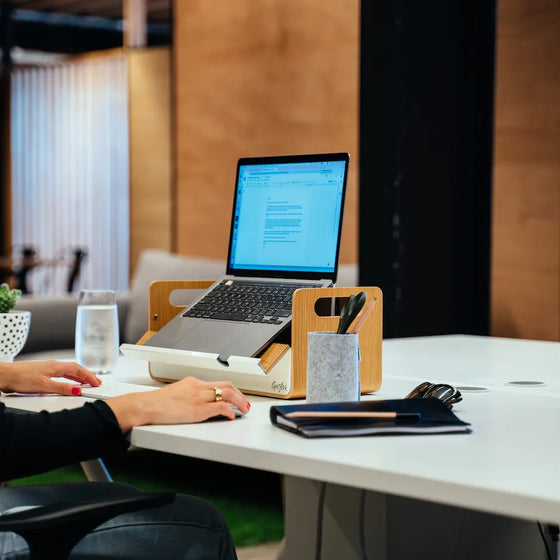
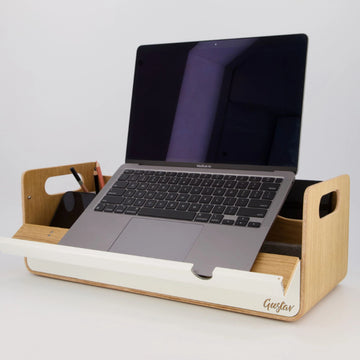
Employees should be able to move from bag to working position in moments, not assemble a temporary office from scattered parts. A portable desk organiser that also raises a laptop, for example, can create immediate structure on any available table. The benefit is not simply tidiness. It is a more predictable start to the day, whether someone is in a neighbourhood desk, project room or client space.
Repeatability also helps workplace teams. When the basic tools are easy to use and return to storage, desks remain ready for the next person without constant intervention from facilities staff.
Better laptop ergonomics
Desk sharing often means working across desks of varying heights and proportions. A laptop placed directly on every surface rarely provides a consistently comfortable viewing position, particularly for longer focus sessions. Portable elevation is therefore a practical part of the desk-sharing kit, not an optional extra.
There is a trade-off to consider. A compact stand is ideal for mobility and short-to-medium laptop work, while longer sessions may also call for an external keyboard and mouse. The right provision depends on the work patterns in each zone. Quiet focus areas may need a fuller ergonomic setup; touchdown spaces may prioritise speed and small footprints.
Contained personal equipment
A desk should not become a temporary dumping ground for technology and personal effects. Cables, chargers, headphones, notebooks and pens need a defined place when they are in use and when they are being carried between settings.
This is where portable organisers, tech pouches and desk-sharing bags earn their place. They reduce the number of loose items employees have to manage, while making it easier to move from locker to desk to meeting room. A bag that opens into an organised workstation is particularly useful where staff carry a laptop, documents and daily essentials through the office.
A calm visual standard
Flexible offices can look untidy quickly, even when they are well designed. The issue is usually not the architecture or furniture. It is the layer of everyday equipment left visible across worktops.
Desk mats and compact organisers establish boundaries for work tools without permanently claiming the desk. Felt organisers can also soften the visual character of shared settings, adding colour and order while keeping stationery and accessories together. This is a small detail with a wider effect: a clearer workspace feels more intentional, more professional and easier to maintain.
Build the system around real work modes
Not every shared desk needs the same equipment. The most effective workplace programmes recognise that people use desks differently across the week.
A quick touchdown desk may require only power access, a clean surface and a portable organiser. A focus desk may need a screen, keyboard, mouse and laptop riser. Collaboration tables need clear cable management and enough open space for documents or shared displays. Home workspaces benefit from the same principle, even when there is no formal booking system: a few portable tools can help a dining table return to being a dining table at the end of the day.
This is why a one-size-fits-all kit can disappoint. Standardisation is valuable when it creates reliability, but it should not erase the requirements of different tasks. Workplace strategists should define a simple baseline, then add equipment according to the purpose of each setting.
A practical baseline might include four elements:
- a carrying solution for daily essentials
- a portable way to raise and organise a laptop
- a compact home for cables, chargers and stationery
- a clear storage point, such as a locker or shared supply area
Make adoption part of the design
Even beautifully specified equipment will be underused if people do not understand how it fits their day. The launch of a desk-sharing environment should show employees where items live, what travels with them and how each desk is meant to be left.
Simple visual guidance is usually more effective than lengthy policy documents. A clean workstation image, a short setup sequence and an obvious home for shared equipment can communicate the expected behaviour without adding bureaucracy. Managers and team leads also shape adoption when they use the system themselves rather than treating it as an administrative requirement for others.
It is worth listening closely after launch. Are employees taking organisers home because lockers are too small? Are cable kits disappearing because the shared supply point is inconvenient? Are people avoiding certain desks because they lack comfortable screen setups? These are design signals, not minor complaints. They reveal where the system does not yet match real work.
Choose products built for movement
Portable workspace tools are often judged only by how they look on a desk. In desk-sharing environments, their performance between desks matters just as much. They need to be easy to carry, quick to open, durable enough for frequent handling and refined enough to suit a considered office interior.
Material choice matters here too. Products made with sustainably grown wood and recycled materials can support a more considered specification while retaining the tactility expected from premium workplace accessories. Quality also has an operational value: items used every day should remain dependable rather than becoming another disposable layer of office equipment.
Gustav approaches this need through award-winning tools designed to help professionals create an organised, ergonomic workspace wherever they work. From a portable organiser and laptop stand to desk-sharing bags and compact tech organisers, the focus is on making the workstation personal without making the desk permanent.
Design for the handover, not just the arrival
A successful shared desk is judged at the moment one person leaves it for another. Can the user pack away quickly? Is the surface clear? Are the essentials contained? Does the next colleague have an inviting, functional place to begin?
When UK desk sharing solutions answer those questions well, they do more than support efficient use of floor space. They create a workplace that respects movement, concentration and the value of a well-made daily setup. Give people the right tools to carry their work with purpose, and every available desk has a better chance of feeling like their own.