12 Best Home Office Organisation Products

A messy desk rarely looks dramatic. It happens quietly - one charging cable left out, a notebook without a home, a laptop balanced too low, a headset draped over a chair. Then the workday starts, and your space is already asking for compromises. The best home office organisation products solve that problem before it turns into visual noise, lost focus and an awkward setup you tolerate for far too long.
For home workers, hybrid teams and anyone moving between rooms, desks or locations, organisation is not just about tidiness. It affects posture, concentration, setup time and how professional your workspace feels. The strongest products do more than store things. They reduce friction, support better habits and help your desk stay calm under daily use.
What makes the best home office organisation products worth buying?
The answer is not volume. More trays, more compartments and more accessories do not automatically create a better workspace. In fact, overfitting a desk with storage can make it feel smaller and more rigid.
The best pieces earn their place in one of three ways. They keep essential items accessible without cluttering the surface. They make switching between tasks or locations easier. Or they improve ergonomic comfort while maintaining visual order. If a product does none of those things, it is probably decoration disguised as organisation.
Material quality matters as well. Home offices are now permanent working environments, not temporary corners of the dining table. Products that use durable materials, age well and look intentional tend to support consistency. Cheap plastic organisers often create the opposite effect - they add compartments, but not calm.
1. A portable desk organiser
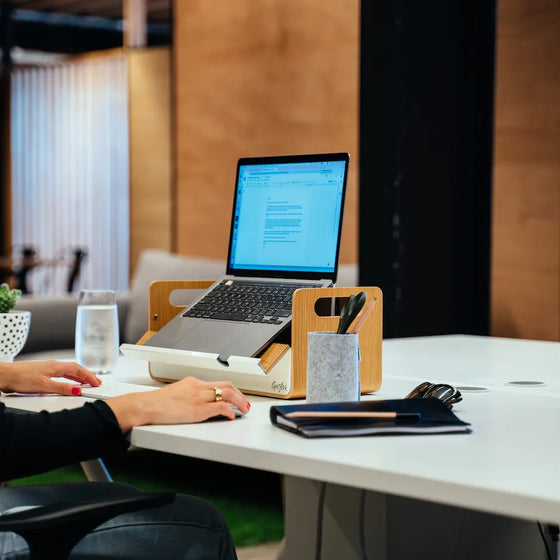
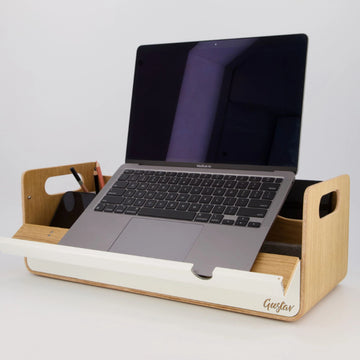
If your workday moves between home, office and shared desks, a portable organiser is often the most effective place to start. It keeps your core tools together - charger, notebook, pen, mouse, headset, adapters - and removes the daily ritual of collecting loose items before and after work.
This is especially valuable in homes where a workspace must be packed away or kept visually clean. Rather than spreading essentials across drawers and bags, a portable organiser creates one defined system. Setup becomes faster, and close-down becomes easier.
The best versions also work as transportable desk infrastructure rather than simple storage. They should feel structured, stable and refined enough to live on a desk, not like a pouch emptied out in public. For hybrid professionals, this category does the work of several smaller products at once.
2. A laptop stand
Organisation is not limited to storage. A laptop stand is one of the most practical products for creating a cleaner and more usable desk because it lifts the screen, frees surface space and defines where the computer belongs.
That vertical separation matters. When the laptop sits flat, cables sprawl, posture suffers and documents compete for the same footprint. Raise the device, and the desk opens up. You gain room for a keyboard, notebook and focused working area beneath the screen line.
There is a trade-off, though. If you use a stand properly, you will usually need an external keyboard and mouse. That adds components. But the net result is still better organisation because each item has a clearer role, and the layout becomes more deliberate.
3. Cable management that hides in plain sight
Few things make a home office look unfinished faster than visible cables. They collect dust, tangle around chair legs and create low-level irritation every time you unplug one thing and disturb three others.
Cable trays, clips, sleeves and weighted holders all help, but the right choice depends on your desk. If your desk is fixed and permanent, under-desk cable routing gives the cleanest result. If your setup changes often, surface-level cable control is more practical.
The mistake is buying cable accessories as an afterthought. Good cable management should be planned around the equipment you actually use every day. Aim for enough control to keep lines tidy and accessible, but not so much containment that charging or swapping devices becomes inconvenient.
4. A desk mat with structure
A desk mat can look like a purely aesthetic purchase, yet it plays a surprisingly useful organisational role. It creates a visual work zone, protects the surface and gives small everyday tools a more intentional home.
Pens, notebooks, phones and keyboards feel less scattered when they sit within a defined area. The desk reads as one composed workspace rather than a collection of unrelated items. In open-plan homes or multi-use rooms, that visual boundary is particularly useful.
Choose carefully, though. An oversized mat can dominate a compact desk, while a poor material can curl, stain or show wear quickly. The best mats support organisation by simplifying the surface, not by becoming another thing to manage.
5. A proper document organiser
Paper has not disappeared. Contracts, sketches, handwritten notes, printed agendas and reference sheets still circulate through many home offices, especially for consultants, planners, designers and managers. Without a system, they end up in unstable stacks that gradually take over the desk.
A slim vertical file organiser or letter tray can solve this neatly. The key is restraint. You do not need a miniature filing cabinet beside your keyboard. You need just enough structure to separate active documents from archived ones and keep current work visible.
If your role involves frequent project switching, a modular document organiser is even better. It supports flow without leaving paper exposed across the full desk width.
6. A drawer insert that prevents hidden chaos
Surface organisation gets attention because it is visible. Drawer organisation matters because it saves time. When pens, chargers, sticky notes and adapters are thrown together, the drawer becomes a storage delay rather than a useful tool.
A well-fitted drawer insert creates fast access and limits duplication. You notice what you already have. You stop buying the same cable twice. You spend less time rummaging.
This is one area where custom fit helps. Generic inserts can slide around or waste space. If your desk has shallow drawers, look for low-profile compartments that separate essentials without overcomplicating the layout.
7. A monitor riser or shelf
For those using an external monitor, a riser can improve both ergonomics and order. It lifts the screen to a better viewing height and creates useful storage beneath for notebooks, a keyboard or small accessories.
Done well, this makes the desk look lighter, not heavier. Done badly, it becomes a bulky platform that traps dust and encourages random storage.
The strongest designs are minimal, stable and proportioned to the desk. Materials matter here too. A refined wood or metal riser tends to integrate more naturally than a flimsy plastic shelf, particularly in premium home office settings where visual quality affects the overall feel of the room.
8. Tech pouches for smaller tools
Not every accessory needs to live on the desk. In fact, some of the best home office organisation products are the ones that keep smaller items off it completely until needed.
A structured tech pouch is ideal for chargers, dongles, earbuds, memory sticks and presentation tools. It keeps these essentials portable, protected and easy to locate. For professionals who work between home and office, it also reduces the risk of leaving one key adapter in the wrong bag.
Soft pouches are fine for light use, but a more structured version tends to hold shape better and feels more suitable for everyday professional movement.
9. A charging station with discipline
Charging hubs can either streamline a workspace or create a nest of wires. The difference comes down to selectivity. A good charging station supports the devices you use daily and keeps power access contained to one area.
It should not become a parking bay for every device you own. If it does, your desk starts serving batteries rather than work.
Wireless charging can help reduce visual clutter, although wired charging still gives more flexibility for some setups. What matters most is keeping cables predictable and preventing chargers from multiplying across the room.
10. Storage that closes fully
Open storage looks tidy only when maintained perfectly. In real working life, closed storage often performs better. A cabinet, lidded box or refined storage container lets you remove low-priority items from view without pretending they do not exist.
This matters in bedrooms, living rooms and shared family spaces where work must coexist with home life. Being able to close away equipment at the end of the day creates a cleaner environment and a clearer mental stop point.
The best closed storage still needs internal order. A beautiful box filled with tangled accessories is only hidden clutter.
11. A work bag that supports desk organisation
The bag is part of the system. If it has no structure, the desk compensates. Items spill out, duplicates accumulate and important tools drift between rooms.
A well-designed work bag with dedicated space for devices, documents and accessories creates continuity between locations. It supports a cleaner desk because fewer things arrive as loose overflow. For hybrid workers, that continuity is not a luxury. It is what makes mobile work feel controlled rather than improvised.
This is where brands such as Gustav have a clear advantage - products are designed as a connected workspace rather than isolated accessories.
12. One modular system instead of six separate fixes
There is a point where buying individual organisers becomes inefficient. If your setup includes mobility, desk sharing or regular reconfiguration, a modular system often makes more sense than a collection of unrelated products.
A coordinated set of organiser, stand, mat and carry solution creates consistency. Materials match, proportions work together and each piece supports the same working style. That does not just look better. It reduces setup decisions and helps people maintain order more naturally.
For home offices that double as hybrid hubs, this joined-up approach is usually the smartest investment. You spend more upfront, but less on replacements, duplicates and workarounds.
How to choose without overbuying
Start with the friction points, not the catalogue. If cables irritate you daily, begin there. If your issue is packing away work each evening, focus on portability and closed storage. If your neck and shoulders are taking the strain, organise around screen height and layout before adding smaller accessories.
It also helps to think in layers. First, fix posture and core tools. Then contain small items. Then refine the surface. Most desks do not need more products. They need fewer, better ones with a clear purpose.
A well-organised home office should feel quiet, capable and ready within seconds. That standard is higher than tidy. It is a workspace that supports the way modern professionals actually work - across locations, across devices and without clutter becoming part of the job.
Choose products that make that rhythm easier, and the desk starts working with you rather than asking to be managed.