Introducing Desk Sharing: A Checklist for Companies

Monday, 8.50 am. The new desk-sharing zone has been open for a week. Three people are standing with laptops under their arms in front of a desk that has held someone else's monitor arm, two charging cables and a jacket since Friday. The booking app says "free"; the desk says otherwise. Two floors up, the team that introduced desk sharing is wondering why acceptance is already slipping after seven days. The answer is almost always the same: a piece of software was bought, an email was sent, and the rest was left to employees. This checklist shows you what needs to be settled before the first shared desk, in the order that works in practice.
Introducing desk sharing does not mean taking desks away
Desk sharing means workstations are no longer assigned but booked daily or chosen freely. The trigger is usually sober: with three or four office days a week, a share of desks sits empty, and floor space costs rent. What often gets lost in the project plan is that for employees, it is not the space budget that changes but their daily routine. They lose a place where their things are allowed to stay. If you do not replace that, you get resistance, however good the app is.
The checklist: eight points before you start
- Set a goal and a metric. Is this about reducing space, increasing collaboration, or both? Set a sharing ratio, for example 0.7 desks per person, and measure actual occupancy after launch. Without a number you cannot later decide whether the ratio is right.
- Collect usage data before you plan. Count for four weeks how many desks are actually occupied, per weekday and per team. A ratio based on management's gut feeling is the most common cause of overcrowded Tuesdays.
- Involve the works council and data protection early. In Germany, desk sharing is generally subject to co-determination under section 87 of the Works Constitution Act (BetrVG) as soon as it regulates conduct in the workplace. Booking data is personal data: hosting, processing agreements and retention periods belong on the agenda from the start. Austria and Switzerland have different rules, but there too, early involvement decides acceptance.
- Check workplace regulations. Workplace health and safety rules apply to shared desks exactly as they do to fixed ones. Height-adjustable desks, monitor arms and lighting have to be right at every bookable desk, not just the nice ones by the window.
- Write the rules down. Booking deadlines, no-show rule, clean desk rule, exceptions for assigned desks (reception, special ergonomic equipment). One page is enough. What matters is that it exists before the first conflict.
- Settle personal storage. This is the point missing from most projects. Where do laptop, charger, mouse, notebook and keyboard live overnight? Lockers alone are not enough; see the next section.
- Choose booking software. Outlook or Microsoft 365 integration, floor plans, occupancy reports, self-service for admins. Compare three to five tools and speak to reference customers. The software matters, but it is point seven, not point one.
- Pilot, not big bang. One zone, 25 to 80 people, six weeks. Weekly feedback, one contact person per team. Only then do you decide on ratio, storage and rollout order for the rest of the site.
Three ways to solve storage, compared
1. Lockers and nothing else
Everyone gets a lockable compartment. That meets the data-protection requirement and is the basis for everything else. What still happens: every morning, people carry laptop, power supply, mouse, keyboard and notebook to the desk one by one, and back again in the evening. After a few weeks, half of it stays on the desk and the clean desk rule is theory.
2. Lockers plus a rucksack
The default solution that emerges when nothing is regulated. It works for commuters who take everything with them anyway. It does not work for anyone who needs a tidy workstation at the desk: a rucksack on the desk is not an organiser, and one under the desk blocks the space for the next day.
3. Lockers plus a personal organiser
All work tools live in one container that travels as a whole from locker to desk. One movement in the morning, one in the evening. In our experience with companies of 50 to 5,000 employees, this is the variant still being followed six months later. It adds €109 to €265 per person, and it assumes the locker compartment is large enough, which you should measure before ordering.
Which option suits you?
Your team mostly works in the building and lockers are in place. Then a light caddy that sits in the compartment and does not stand out on the desk is enough. The Loop Desk Caddy (€109) measures 42 × 20 × 13.5 cm, weighs 900 g and is made from 100% recycled PET felt with an oak-veneer centre section. Laptop, keyboard, notebook, pens; nothing more fits, and that is deliberate.
Your team commutes between office, home and clients. Then the organiser also has to be a bag. The DeskMate Work Bag (€139) has a fold-out organiser panel, a padded compartment for laptops up to 17 inches and stands up on its own. The material is REPREVE® fabric made from recycled PET bottles, water-resistant, 1.2 kg. For commuters it often makes the locker unnecessary.
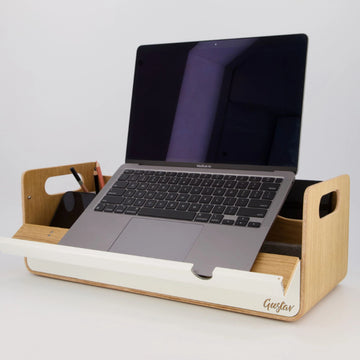
You want an ergonomic laptop stand at every desk without retrofitting monitor arms. Then the Gustav Original (from €245) is the option: organiser and laptop stand in one, handmade in Greece from wood with oak veneer and aluminium, for laptops up to 15 inches (XL up to 17 inches). More expensive, but it solves storage and screen height at the same time.
You are planning this for a whole site. Then have a look at our desk-sharing solutions for businesses, with volume pricing, framework agreements or leasing, and a pilot programme from 25 units.
Who should not introduce desk sharing
To be frank: if your team is in the office four or five days a week, desk sharing saves you no space and only creates friction. The same goes for teams with a lot of paper, specialist hardware or labs; assigned desks are simply more sensible there. And if you have no budget for lockers, even the best organiser does not solve the problem: it needs somewhere to stand overnight. Buy the cabinets first.
For businesses: specification, pilot, rollout
Gustav works with facility and workplace teams introducing desk sharing for 50 to 5,000 employees. We support the specification of per-person storage, supply samples for projects from 50 employees and accompany six-week pilots from 25 units. Purchase, framework agreements and leasing are available. Details are on the business page.
Frequently asked questions
What sharing ratio is realistic?
A commonly cited benchmark is 0.7 desks per person. The right number only comes from your own usage data, though: count for four weeks before you decide, and adjust after the pilot.
Does the works council have to agree?
In Germany, generally yes: rules on the use of workstations and on booking software concern order and conduct in the workplace (section 87(1) BetrVG) and the processing of personal data. Plan the involvement from point 3 of the checklist, not at the end.
How long does the introduction take?
From concept to a completed pilot, allow two to three months. The rollout to the rest of the site is usually faster afterwards, because rules, storage and software have already been tested.
What is the most common problem after launch?
Not the software, but the desk that is not free in the morning. Almost always this comes down to missing or impractical storage. If employees can clear their things in one movement, the clean desk rule holds. If not, it holds for four weeks.