The Future of Hybrid Work Accessories at Work
A shared desk at 9am should not feel like an empty surface that asks employees to rebuild their working day from scratch. Nor should a kitchen table, project room or client site force a compromise on comfort, focus or professional order. The future of hybrid work accessories is about giving people a consistent workspace experience wherever the work happens.
For workplace teams, this is no longer a question of adding more objects to a desk. It is about selecting fewer, better tools that travel well, set up quickly and earn their place through everyday use. The most effective accessories will make flexible work feel considered rather than temporary.
Why the desk is becoming a personal platform
The fixed workstation once held everything an employee needed: monitor, keyboard, files, stationery, photographs and a familiar chair. In hybrid workplaces, that permanence has shifted. The desk may be shared, booked for a few hours or replaced by a home office table. What remains constant is the need for a functional setup.
This changes the role of accessories. They are no longer decorative add-ons or drawer fillers. They become the portable layer between a person and the workspace: the tools that hold essential technology, create visual order and support a more comfortable posture.
That distinction matters in activity-based offices. A clean desk policy can keep a workplace calm and ready for its next user, but it only works when people have a practical way to carry and organise their own essentials. Without it, shared spaces collect loose chargers, notebooks, water bottles and improvised piles of equipment. The result is friction for employees and a less polished environment for visitors.
The future of hybrid work accessories is purposeful
The next generation of work accessories will be defined less by novelty and more by purpose. The best products will solve several connected problems without becoming complicated: portability, organisation, ergonomic support and material quality.
Portable, but not disposable
Mobility has often produced a wave of lightweight accessories that are easy to carry but not designed for daily professional use. That trade-off is starting to look dated. Employees need products that move effortlessly between home, office and meeting room while still feeling stable, durable and appropriate in a premium workplace.
A well-designed organiser or work bag should have a clear role before, during and after the commute. It should protect the essentials, make them easy to find, and avoid turning setup into a ritual of unpacking individual items. When it arrives at a desk, it should help establish order rather than simply sit beside the chair.
For organisations, durability also affects the total value of a workplace accessory. A product made for repeated use is more credible than a short-lived giveaway, particularly when materials and construction are chosen with care. Sustainably grown wood and recycled materials can support this direction when they are combined with thoughtful design and long service life.
Ergonomics that fit real workdays
Laptop work remains a practical reality across offices, homes and temporary work settings. Yet a laptop placed flat on a table encourages a compromised posture, especially over longer sessions. The future is not necessarily a desk filled with permanent equipment. It is a setup that makes ergonomic adjustment available quickly.
Portable laptop stands will become more central to hybrid work, particularly where employees do not have an assigned desk. Raising the screen to a more comfortable height can create a better starting point for focused work, video calls and longer writing sessions. The right solution depends on the task, available peripherals and individual needs, but the principle is straightforward: ergonomics should travel with the employee.
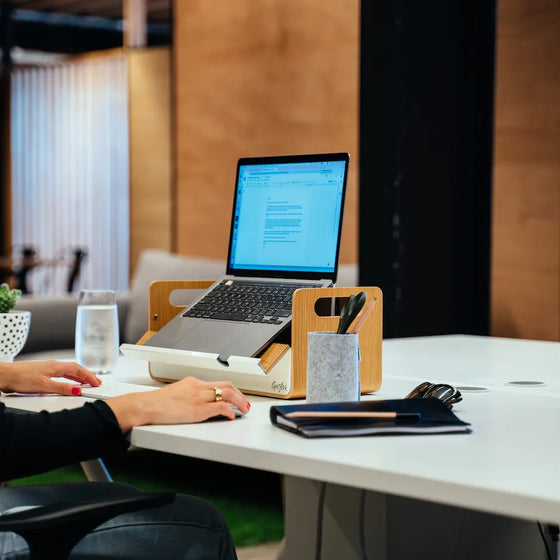
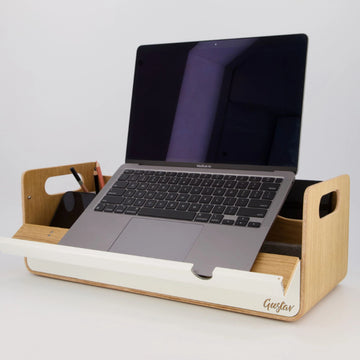
This is where integrated design has an advantage. A desk organiser that also supports a laptop removes an extra item from the bag and reduces setup time. Gustav Original, for example, is designed to turn an ordinary table into an organised, more ergonomic workstation in seconds. The value lies in that transition: from carrying work essentials to working well.
Organisation as a workplace experience
Clutter is rarely just visual. It adds small moments of interruption: looking for a cable before a call, clearing a surface to open a notebook, moving loose items to make space for a colleague. In a shared environment, those interruptions become more frequent because storage is less personal and desks must reset quickly.
Compact organisers will therefore move beyond basic stationery storage. They will create defined places for chargers, cables, pens, headphones and other daily essentials, while helping each employee maintain a recognisable way of working. This is not about making every desk identical. It is about giving people a calm, repeatable structure that can adapt to different settings.
A soft recycled PET felt organiser can bring warmth and colour to a shared desk without creating visual noise. A compact tech organiser can keep small accessories contained in a bag or locker. These are modest interventions, but they make flexible work more intuitive at the moments that matter most: arrival, setup, pack-down and handover.
From individual accessory to workplace system
The strongest workplace strategies will stop treating accessories as isolated purchases. A laptop stand, organiser, desk mat and mobile bag each solve a specific need, but their combined effect is greater when they work as a coherent system.
Consider the employee journey. They may leave a locker, move to a touchdown desk, join a meeting, spend an afternoon in a focus area, then take their equipment home. A workplace system should support that movement with a clear place for documents, technology and personal work tools. It should also make transitions quiet and dignified, rather than a scramble of loose belongings.
For facility managers and office planners, this creates an opportunity to specify accessories alongside furniture and storage rather than after the office is complete. The decision affects desk utilisation, clean desk compliance and employee perception of the workplace. It can also reduce the visual clutter that undermines carefully planned interiors.
There is no universal kit for every organisation. A consultancy with frequent client meetings may prioritise a refined work bag and compact tech organisation. A large desk-sharing office may benefit most from portable organisers that move efficiently between lockers and workstations. Design studios may place greater emphasis on document capacity, material character and a setup that suits creative tools. The right specification begins with observing how people actually move through the day.
What to look for when specifying accessories
A future-ready accessory should make a visible difference within the first minute of use. If it requires too much assembly, takes up excessive space or creates another item to manage, adoption will suffer. Simplicity is not a lack of ambition. It is what allows good design to become part of a daily routine.
Material choice deserves the same attention. In a well-designed workplace, accessories are part of the visual landscape. They should complement the interior, feel good to handle and retain their appearance through regular use. Premium materials and considered construction communicate that flexible work is supported intentionally, not treated as a temporary arrangement.
It is also worth testing how an accessory performs away from the ideal desk. Can it be carried comfortably through an office? Does it fit in a locker? Does it keep cables and small essentials from disappearing into the bottom of a bag? Can a user set up without occupying a neighbouring seat? These practical details separate a concept from a tool people will use every day.
A more human standard for flexible work
Hybrid work accessories will become quieter, more integrated and more personal in the best sense of the word. They will not compete for attention. They will help people arrive, arrange their essentials and begin work with less friction.
For organisations, the goal is not to recreate the old assigned desk in every location. It is to give employees a dependable foundation for good work, wherever they sit. When portability, organisation and ergonomic support are designed together, a shared table can feel less like borrowed space and more like a place that is ready for them.