Personal Desk Storage for Flexible Workspaces

A shared desk at 08:45 can be an empty surface, a tangle of borrowed cables, or a workstation that feels immediately familiar. The difference is rarely more furniture. It is personal desk storage designed around the tools people genuinely use, the places they work and the speed at which they need to settle in.
For hybrid professionals, storage is no longer only about putting things away. It is about carrying a considered working environment between home, the office, meeting rooms and focused spaces. The right system protects essentials, reduces visual noise and gives every item a clear place - without making a desk feel over-equipped.
Personal desk storage is a workplace tool
Traditional desk storage assumes permanence. A pedestal drawer sits beneath one assigned desk; a desk tidy stays where it was placed; spare supplies accumulate because there is room to leave them. That model is less useful when people choose a different desk each day or move between work settings.
Personal desk storage should do three jobs at once. It should contain the daily essentials, make them easy to find, and create a clean set-up that can be packed away without thought. When these functions work together, the desk becomes calmer and the transition between locations becomes less disruptive.
This matters for individual users, but it also matters for workplace teams. A clear-desk policy only works when employees have a practical way to store and transport what they need. Asking people to clear their desk without providing a considered alternative simply shifts clutter to lockers, cupboards and meeting rooms.
Storage is not the same as capacity
The largest organiser is not automatically the most useful. Excess capacity often invites unnecessary items: old notebooks, duplicate chargers, loose paperwork and stationery that belongs to the wider office supply point. A better approach is to choose enough space for the repeatable workday, plus a small margin for variation.
Think in terms of access rather than volume. Your laptop charger should not sit beneath a pile of papers. A pen, headset and access pass should not require emptying an entire bag. Good storage makes the most frequently used items the easiest to reach.
Decide what belongs in your daily kit
Before choosing an organiser or work bag, separate what travels every day from what can stay at home, in a locker or in a shared supply area. This prevents a mobile set-up becoming a heavy, overfilled carry-all.
A useful personal kit usually has four categories:
- Core technology: laptop, charger, cable, mouse, headphones and any adapters required for your regular workstations.
- Working tools: notebook, pen, reading glasses, access card and small items that support focused work.
- Personal essentials: medication, reusable bottle, keys and other items that should remain close rather than being left at a shared desk.
- Set-up pieces: a laptop stand, desk organiser or desk mat that creates a consistent working position and visual order.
Choose storage for the way work moves
There is no single best format because flexible work has different rhythms. The key is matching the product to the distance and frequency of movement.
For desk sharing: use an organiser that sets up fast
In a desk-sharing environment, the best organiser is one that moves from bag to desk in a single action. It should keep smaller items visible and contained, rather than scattering them across the work surface. A compact organiser also makes the end-of-day reset simple: gather, close or lift, and move on.
Materials matter here. Soft recycled PET felt can protect everyday accessories while bringing warmth and colour to a clean, contemporary workspace. Structured compartments are useful for pens, cables and headphones, provided they do not force every user into an overly fixed arrangement.
For home and office: create a consistent landing zone
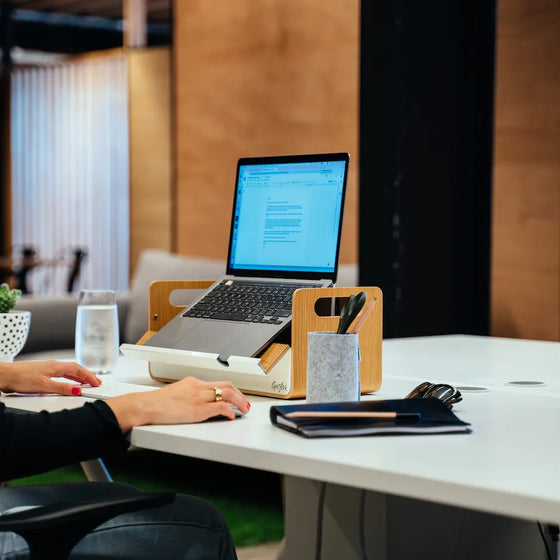
When someone alternates between a home office and a workplace, a portable organiser can act as a familiar landing zone in both locations. The desk may change, but the position of the daily tools does not. That small consistency reduces the friction of beginning work and makes it easier to leave the surface clear afterwards.
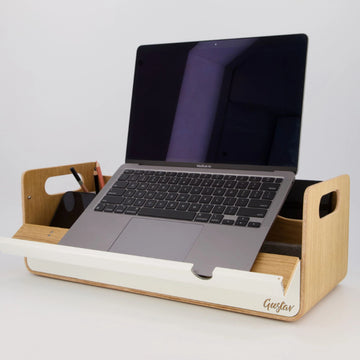
A laptop stand can form part of this system rather than sitting apart from it. Raising the screen to a more comfortable height supports a more ergonomic set-up, while the organiser holds the accessories that tend to gather around a laptop: charger, mouse, notebook and cables. The result is a workstation with purpose, not a collection of objects.
For constant movement: let the bag become the workstation
For employees moving from locker to desk, desk to meeting room and office to home, a work bag needs to do more than transport equipment. It should organise the journey and support the set-up at the destination.
A bag that opens into a structured workstation can be particularly effective for this rhythm. It keeps documents upright, protects technology and separates personal belongings from work tools. The trade-off is size: the more it carries, the more it can weigh. Choose enough room for a normal working day, not every possible scenario.
Design details that make storage work harder
Premium personal desk storage earns its place through details that are easy to overlook until they are missing. A stable base prevents an organiser sliding across a smooth tabletop. A clear internal layout stops cables becoming a knot. Materials should feel considered enough for a client-facing office, while being durable enough for regular commuting.
Look for proportion as well. Storage should sit comfortably beside a laptop without dominating the desk. In compact offices and home workspaces, a low, horizontal organiser often maintains a cleaner sightline than a tall container. Where desks are shared, it should also pack away efficiently, leaving no permanent footprint.
Sustainability deserves the same practical scrutiny. Materials such as sustainably grown wood and recycled fabrics can support a more considered choice, but longevity is equally important. A well-made organiser that remains useful through changing devices, roles and workplaces is preferable to a short-lived solution that needs replacing after a season.
Build a set-up that is easy to reset
The most effective storage system is one people will use when they are busy. That means the reset must be intuitive. At the start of the day, place the organiser first, then set up the laptop, power and input devices around it. At the end, reverse the sequence and return each item to its designated compartment.
Avoid treating the desk as temporary storage for everything that arrives during the day. Papers should either be actioned, filed in a document sleeve or returned to the relevant shared area. Cables should return to the organiser once charging is finished. This is not about creating an overly controlled desk. It is about preserving enough clear space to work comfortably and leave the next user a ready surface.
For workplace planners, consistency helps adoption. Providing a small number of well-designed, portable storage formats is often more effective than filling every shared desk with generic accessories. People need choice for their individual tools, but they also benefit from a recognisable system that supports the organisation's workspace standards.
Gustav's approach reflects this balance: portable organisers, ergonomic laptop support and mobile workstation bags designed to help people create a complete office set-up wherever they work. The aim is not to make a flexible desk feel temporary. It is to make it feel ready.
Make space for the work that matters
A well-organised desk does not need to look empty or impersonal. It should show only what supports the task at hand, with the rest protected, contained and ready to move. Start with the items you reach for every day, give each one a deliberate home, and let your personal desk storage make every new surface feel like a place where good work can begin.