Desk Sharing: How to Plan It Right and Use It More Effectively

Desk sharing sounds efficient. In reality, it often breaks down at the same points: no space for personal work essentials, inconsistent ergonomics, and cluttered desks despite clean-desk policies. This is exactly where desk sharing either becomes a modern workplace model — or just a way to save space while creating frustration.
What Desk Sharing Really Means in Everyday Work
Desk sharing doesn’t simply mean multiple people using the same desk. It means the workspace becomes temporary. Employees arrive, set up, work productively, and leave the desk completely clear again. This transition must be fast, intuitive, and reliable.
For companies, the appeal is obvious. Office space can be used more efficiently, hybrid work models become easier to manage, and workplaces can be planned based on actual usage instead of fixed assignments. For users, however, the experience is more nuanced. Without thoughtful equipment, the workspace feels improvised every single day.
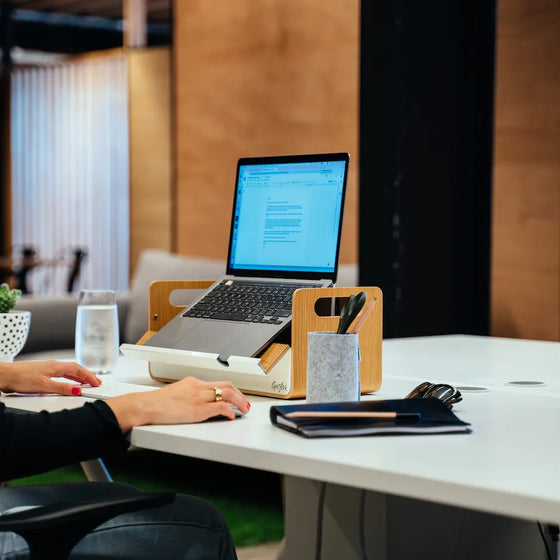
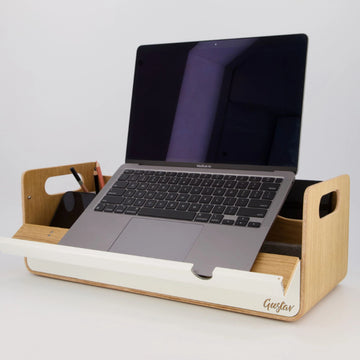
That’s why desk sharing is not just a booking model. It’s a workplace design challenge. If you want flexible usage, you also need flexible workspace tools — especially solutions that support workplace mobility and allow employees to carry their full setup in a structured way, such as a mobile workspace toolbox: https://gustavconcept.com/workplace-mobility
Why Desk Sharing Often Fails in Small Everyday Moments
The biggest problems rarely occur at a strategic level. They happen at 8:45 a.m. Someone searches for a free desk, carries a laptop, charger, mouse, notebook, and headset across the office, and ends up at a desk that is technically available — but not ready for work.
When personal essentials don’t have a defined place, friction increases. When monitor height, laptop position, or working posture can’t be quickly adjusted, ergonomics suffer. If employees must improvise every day, acceptance drops — even when space utilization looks great on paper.
Desk sharing therefore requires more than booking tools and policies. It needs a physical infrastructure that supports mobility without sacrificing quality. The workspace must work in seconds, not after ten minutes of cable sorting. This is where mobile desk organizers and structured desk sharing setups become essential, helping employees move between shared desks without losing consistency: https://gustavconcept.com/desk-sharing
Desk Sharing Needs Mobile Organization
In traditional offices, the fixed desk quietly stores routines, accessories, and personal organization. Desk sharing removes that function. The question becomes: how do you transport a complete workspace in a compact and professional way?
The best answer isn’t more storage in the office — it’s a portable workspace system. When employees keep their essentials in a mobile desk organizer, tech pouch, or structured workspace toolbox, search times shrink and desks stay clean. It’s not just tidier — it’s faster. A well-designed mobile workspace toolbox keeps everything in one place and allows users to instantly transform any shared desk into a productive setup: https://gustavconcept.com/mobile-workspace-toolbox
For organizations, this directly improves shared desk usability. A clean desk is only half the solution. The real goal is enabling employees to transform it into a productive workspace instantly.
Ergonomics Is Not Optional in Desk Sharing
A common planning mistake: desk sharing is treated as a functional model, not an ergonomic one. But in changing environments, a quickly achievable working posture is critical. If you sit at a different desk every day, you need tools that deliver consistent quality independent of the furniture.
A portable laptop stand, defined positioning for input devices, and a clean working surface make a measurable difference. They create consistency in an intentionally flexible environment. This improves comfort, reduces visual noise, and supports focused work. Ergonomic desk sharing tools that travel with the user — rather than staying at the desk — make this possible in hybrid workplaces: https://gustavconcept.com/ergonomic-desk-sharing
For workplace leaders, this is essential. Acceptance doesn’t come from rules — it comes from a professional user experience. Employees don’t compare desk sharing to space efficiency metrics. They compare it to their expectation of good work.
What Defines a Good Desk Sharing Setup
A strong desk sharing setup is lightweight, complete, and ready in seconds. It bundles the items needed every day without complicating transitions between office, home office, and mobile work. Typically this includes a laptop, charging accessories, mouse, headset, writing tools, and small personal work essentials. A structured desk sharing setup ensures each item has a defined place and can be deployed immediately: https://gustavconcept.com/desk-sharing-setup
Once these elements have a fixed mobile place, desk sharing becomes a routine instead of a daily reset.
Visual consistency is equally important. Flexible workspaces quickly feel chaotic when each desk is used differently. Structured, design-driven solutions create calm. They support both individual users and the overall workspace experience. In hybrid offices, consistent workspace tools help maintain a clean-desk policy without sacrificing usability: https://gustavconcept.com/hybrid-workspace
This matters especially in high-quality office environments. Architects, workplace strategists, facility teams, and HR leaders now think beyond desks per square meter. They think in employee experience, brand perception, and workspace usability. Desk sharing must support those goals.
Where Desk Sharing Works Best
Desk sharing works best where attendance fluctuates, teams work hybrid, and offices are shared resources. It is particularly effective in knowledge-based environments with established mobility routines and a culture of ownership. Flexible office concepts that combine shared desks with mobile personal setups create the highest acceptance: https://gustavconcept.com/flexible-office
It is less suitable where work requires highly personalized setups, confidential physical documents, or permanently installed equipment. Not every team needs the same level of flexibility — and not every task benefits from fully unassigned desks.
The most effective workplace strategies are often hybrid: shared desks where mobility is high, combined with defined zones for focus work, collaboration, and specialized tasks.
Desk Sharing Succeeds When It Becomes Effortless
When employees set up in seconds, when desks are truly clear at the end of the day, and when the office remains calm despite changing users — desk sharing fulfills its promise. Not as a compromise, but as a modern workplace model.
This is where well-designed workspace tools make the difference. They turn flexibility into something tangible, reduce friction, and give mobile work routines a clear structure. Portable workspace organizers designed specifically for desk sharing environments help standardize quality across changing desks: https://gustavconcept.com/workplace-toolbox
Gustav approaches desk sharing not just as an office strategy, but as a daily setup — precise, portable, and ready for the next workspace.