7 Workplace Wellbeing Design Trends

A quiet room with no booking friction gets used. A shared desk with no storage does not. That gap says a great deal about workplace wellbeing design trends: the best ideas are not the ones that look impressive on a plan, but the ones people adopt without effort.
For workplace strategists, architects and facilities teams, wellbeing has moved beyond feature lists. It is now measured in how easily a space supports concentration, movement, comfort and a sense of control. In hybrid settings especially, where people move between home, office and shared desks, design has to work harder. It must reduce setup time, lower visual noise and help people feel settled quickly.
The most relevant shift is simple. Wellbeing design is becoming less about amenities and more about everyday working conditions. That changes what gets prioritised.
Workplace wellbeing design trends are becoming more practical
For a period, workplace wellbeing was often expressed through standout gestures: a lounge area, a statement planting scheme, a social hub. Those elements still have value, but they do not solve the daily friction of modern work. If someone spends the first ten minutes of the morning searching for a charger, adjusting a screen height or clearing a previous user’s clutter, the space is already underperforming.
That is why current workplace wellbeing design trends lean towards usable comfort. The focus is shifting to what supports people hour by hour: better ergonomic access, calmer desk areas, more intuitive zoning and mobile tools that make shared environments feel consistent.
There is a design lesson in that. Wellbeing is rarely delivered by one big intervention. More often, it comes from a series of small decisions that remove strain.
1. Calm is replacing visual excess
A calmer workspace is not an aesthetic luxury. It helps reduce cognitive load. In busy offices, too many materials, colours, signals and objects can make the environment feel restless before work has even begun.
The stronger schemes now tend to use restraint well. Surfaces are cleaner. Storage is better integrated. Desk areas are designed to support only the tools people actually need. This does not mean sterile or characterless. It means every object has a purpose, and the overall environment feels composed rather than crowded.
For shared workplaces, this matters even more. When no one fully owns the desk, visual order becomes part of the experience. Portable organisers, contained carry systems and well-defined landing spaces help users establish immediate structure without adding bulk.
2. Portable ergonomics are moving to the centre
Hybrid work has exposed a basic problem: ergonomic support often disappears as soon as people leave a fixed workstation. A beautifully specified office means little if employees split their week across touchdown areas, home setups and temporary desks.
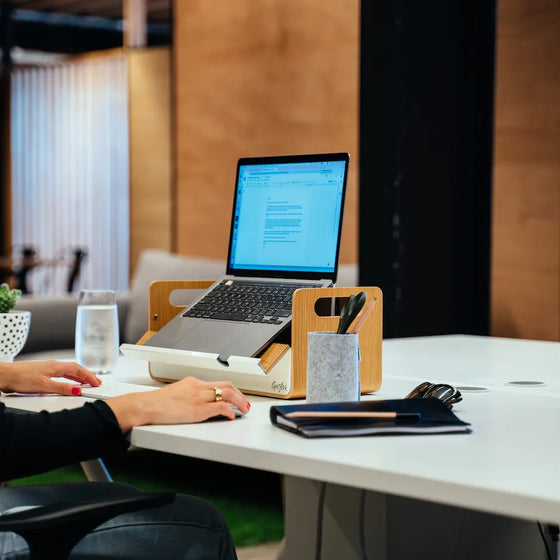
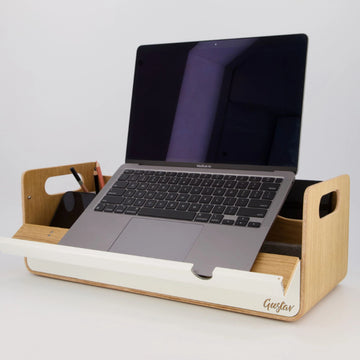
One of the most useful workplace wellbeing design trends is the rise of portable ergonomics. Instead of assuming comfort is built into one permanent location, organisations are looking at tools people can carry and use anywhere. A laptop stand, a desk mat, a compact organiser or a structured tech pouch may sound modest, but together they create continuity. They help transform an anonymous desk into a functional setup in seconds.
This is especially relevant in desk-sharing environments. If users can recreate a familiar working position quickly, the office feels easier to navigate. That sense of consistency supports both physical comfort and mental ease.
There is a trade-off, of course. Portable solutions are not a substitute for proper workplace standards. Seating, lighting and desk height still matter. But in flexible settings, portability fills the gap between a well-designed base environment and the reality of movement.
3. Personal control is becoming a wellbeing metric
People do better in spaces they can adjust. That principle is shaping everything from task lighting and acoustic choice to the way desks are equipped. The aim is not endless customisation. It is giving users enough control to work comfortably without effort.
In practice, this often means smaller interventions with high impact. A user can choose a quieter area for focused work. They can set up their screen at a better height. They can keep essentials organised and within reach rather than spread loosely across a borrowed desk. These moments of control add up.
For designers and workplace teams, this requires a different mindset. Instead of asking whether a workplace offers wellbeing features, it is often more useful to ask whether the space lets people fine-tune their environment throughout the day.
The best workplace wellbeing design trends support movement between modes
Work is no longer organised around one task in one place. Most teams switch constantly between focused work, online meetings, project discussion and informal catch-ups. Wellbeing design now has to support those changes smoothly.
4. Zoning is getting sharper, not softer
Open-plan environments are not disappearing, but they are being refined. The strongest layouts now create clearer distinctions between high-focus areas, collaborative zones and transitional spaces. This improves comfort because people spend less energy negotiating what kind of behaviour is expected where.
Sharp zoning also helps with acoustics, which remain one of the biggest stress points in shared offices. A space does not need to be silent to feel comfortable, but it does need to align sound levels with task type. When the setting matches the work, people feel less drained.
The design challenge is avoiding rigid separation. Offices still need flow. That is why successful zoning often uses furniture, materials and layout cues rather than heavy barriers. The result feels intuitive rather than over-managed.
5. Setup speed is now part of employee experience
This trend gets overlooked because it feels operational rather than architectural. Yet in hybrid offices, setup speed has a direct effect on how a workplace feels. If arriving at a desk is slow, awkward or cluttered, the office creates friction before meaningful work starts.
That is why wellbeing design increasingly overlaps with organisation design. People need a straightforward way to carry, place and access the tools they use every day. Products that support instant setup are not just accessories. In many environments, they are part of the workplace system.
For employers, the benefit is broader than convenience. Faster setup supports clean desk policies, makes desk-sharing more acceptable and helps maintain a tidy visual standard across the office. For employees, it creates a more settled start to the day.
Gustav has built much of its product thinking around this reality: the modern workspace needs to be portable, organised and ready to perform across locations.
6. Domestic comfort is being translated, not copied
After years of home working, employees are less tolerant of offices that feel purely functional. But the answer is not to make every workplace look like a living room. That approach can dilute purpose and create new practical issues.
The better direction is translation. Offices are borrowing the qualities people value at home - warmth, material tactility, softer visual rhythm, less institutional formality - while keeping professional performance intact. Natural materials, considered textures and more restrained palettes can all support this shift.
For premium workplace environments, this is where design quality matters. Wellbeing is influenced by what people touch and handle every day, not only by the overall concept. A workspace can feel more grounded when the objects within it are durable, refined and made to be used repeatedly, rather than treated as disposable office stock.
7. Sustainability and longevity are part of comfort
Wellbeing and sustainability are increasingly linked, though the connection should be handled carefully. People respond well to environments that feel responsibly made and built to last. Cheap, temporary solutions often create clutter, inconsistency and replacement cycles that are noticeable at user level.
This does not mean every project needs to make grand environmental claims. It means design teams are paying more attention to longevity, repairability, material quality and whether products can adapt to changing workplace models over time.
In practical terms, a well-considered accessory or workspace tool that supports daily use for years can contribute more to wellbeing than a trend-led feature that dates quickly. Durability creates trust. It also supports a calmer visual environment because fewer elements feel provisional.
What these trends mean for workplace decision-makers
The direction is clear. Workplace wellbeing design trends are becoming more grounded, more mobile and more closely tied to daily behaviour. They reward offices that are easy to use, not just attractive to present.
For workplace leaders, that means asking slightly tougher questions during planning. Where does friction appear in the first five minutes of the day? What happens when someone moves from one desk to another? Can people create a healthy, organised setup without relying on fixed personal storage? Does the space support focus and collaboration with equal clarity?
Those questions often reveal that wellbeing lives in the details. Not every improvement requires a major refit. Sometimes the most effective move is to support better desk-sharing, clearer zoning or more consistent portable ergonomics across the workplace.
A well-designed office should not ask people to adapt to chaos with good humour. It should help them arrive, settle and work well with as little resistance as possible.
Design your own wellbeing workspace.
Gustav creates award-winning desk organisers and work bags designed for focus, flow and flexibility. Sustainably made from 100% recycled water bottles. Designed to move with you between home, office and anywhere in between.
⭐⭐⭐⭐⭐ Red Dot Design Award winner · Trusted by 5,000+ professionals
Explore the Collection →Free EU shipping from €90 · 30-day returns