9 Flexible Office Storage Ideas That Work

The problem usually shows up at 9:07 on a Monday. Someone claims a desk, opens a laptop, then realises the charger is in a locker on another floor, the notebook is in a tote bag, and the headset has vanished into a shared drawer. Flexible office storage ideas matter because hybrid work only feels efficient when the essentials are easy to carry, easy to store, and easy to find.
In a fixed office, storage can be generous and static. In a flexible workplace, it needs to move with the user, support clean desk expectations, and still look considered within the wider interior. That changes the brief. The best storage is no longer the biggest cabinet or the deepest pedestal. It is the system that keeps work tools accessible without making the space feel heavy, cluttered, or over-furnished.
What flexible office storage ideas need to solve
Storage in agile environments has a different job from storage in traditional assigned offices. It needs to support movement between settings, from focus desk to meeting room to home office, without creating friction. It also needs to reduce visual noise. A workspace can be well equipped and still feel calm, but only if every item has a clear place.
There is also a practical balance to strike between personal ownership and shared use. People still need a reliable home for their daily tools, but the office footprint cannot be built around permanent individual storage at every desk. That is why the most effective approaches combine mobile personal organisation with selective shared storage points.
1. Portable desk organisers instead of fixed desk clutter
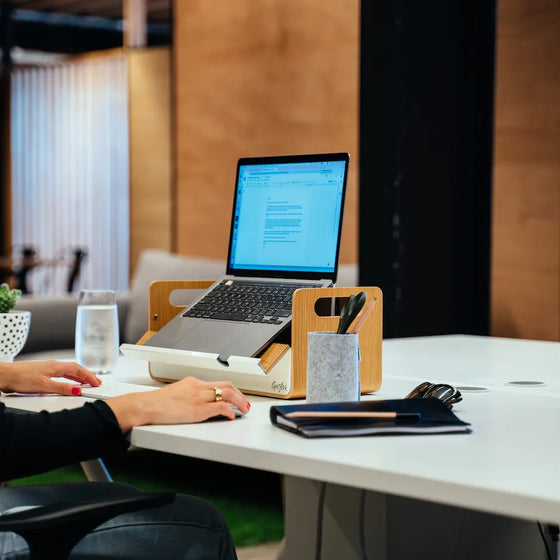
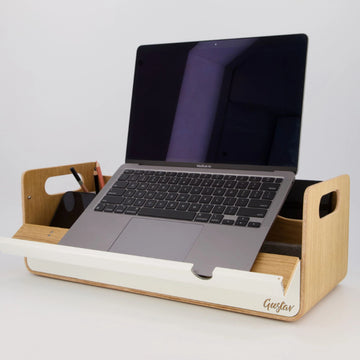
If desks are shared, personal tools should travel as one kit rather than as loose items. A portable desk organiser gives each user a compact base for the objects they use every day - notebook, pens, charger, mouse, cables, and small tech accessories - while keeping the desktop clear when the workday ends.
This is one of the strongest flexible office storage ideas because it reduces setup time immediately. Users arrive, place the organiser, and work. When they leave, the desk returns to a clean state in seconds. For facility teams and workplace strategists, that means less reliance on under-desk storage and fewer abandoned items across the floor.
The design detail matters here. A portable organiser should look appropriate in a premium workplace, feel durable enough for daily movement, and support a consistent routine rather than becoming another container for random clutter.
2. Personal lockers sized for real hybrid use
Lockers still have a role, but they work best when they are planned around actual user behaviour. Many offices install lockers that are either too small for a work bag and outerwear or so large that they consume valuable floor area. The more effective option is a right-sized locker strategy tied to what people genuinely store during the day.
For most hybrid teams, that means room for a bag, a laptop accessory kit, perhaps a headset, and a few personal items. If larger project materials are common, separate team storage may be more efficient than simply enlarging every locker. It depends on the work profile.
Lockers should support the flow of arrival and departure, not interrupt it. Positioning near entrances or touchdown zones often works better than hiding them deep within the office plan.
3. Shared storage hubs for team equipment
Not everything should travel with the individual. Teams often need shared items such as presentation tools, stationery refills, adapters, whiteboard materials, and print supplies. Instead of scattering these across cupboards and desk drawers, create storage hubs that serve a clear zone or function.
This approach helps flexible workplaces feel more intentional. People know where to go for shared resources, and desks remain dedicated to active work rather than becoming general storage surfaces. It also makes stock management simpler for office teams.
The trade-off is accessibility versus neatness. If hubs are too hidden, users revert to keeping backup supplies at the desk. If they are too exposed, they can quickly look messy. Closed storage with a well-planned internal layout usually gives the best result.
4. Vertical storage that frees the floor
In offices where footprint is under pressure, vertical storage often performs better than adding more low-level units. Wall-mounted shelving, tall cabinets, and slim storage towers can hold a surprising amount while preserving movement around desks and collaboration areas.
This matters particularly in smaller offices and project spaces where circulation must remain clear. Vertical solutions can also help define zones without introducing bulky partitions. For architects and designers, that creates more flexibility within the plan.
The caution is visual weight. Tall storage can dominate a room if materials, proportions, and placement are not carefully considered. In design-led workplaces, fewer pieces with a stronger purpose usually work better than multiple mismatched units.
5. Cable and device storage that prevents surface creep
A large share of office clutter is not paper. It is cables, chargers, adapters, headphones, and small devices that accumulate around temporary workstations. If they are not given a defined storage solution, they spread quickly across desks, meeting tables, and window ledges.
Dedicated tech pouches, cable organisers, and device trays are simple additions, but they make flexible work much more usable. They also support faster transitions between locations. A person moving from home to office to client site should not need to repack five loose accessories each time.
For shared settings, central charging lockers or controlled charging shelves can also be useful, especially where teams rotate heavily through the office. The key is to separate active charging from general desktop storage, so technology remains tidy rather than becoming part of the visual background clutter.
Flexible office storage ideas for cleaner desk sharing
Desk sharing only works well when the storage model is clear. If users are unsure what belongs on the desk, what should be stored centrally, and what should leave with them, clutter returns very quickly.
A simple framework helps. Daily essentials should be portable. Shared supplies should live in local team hubs. Personal non-daily items should go in lockers. Archive material should be removed from the desk area entirely. Once those categories are defined, storage decisions become much easier.
This is where premium workspace accessories can add genuine value. Products designed for portability and instant setup make flexible policies feel less like restriction and more like considered workplace design.
6. Modular storage that can adapt with the office
Flexible work patterns change. Teams grow, project needs shift, and spaces are reconfigured. Storage should be able to move with that reality rather than locking the office into one arrangement.
Modular systems are useful because they can scale up, re-stack, or change function without requiring a full refit. A storage unit that works beside touchdown desks today may need to support a collaboration area next quarter. That kind of adaptability is commercially sensible and operationally practical.
There is a limit, though. Highly modular systems can become visually inconsistent if they are expanded without discipline. The best schemes keep a tight material palette and clear logic, so the office still feels resolved.
7. Storage built into the work kit
One of the most effective shifts in hybrid office planning is moving some storage away from furniture and into the user toolkit itself. Work bags, laptop stands with integrated organisation, compact organisers, and protective pouches reduce reliance on the desk as the primary storage location.
This approach suits mobile professionals especially well. Consultants, designers, managers, and knowledge workers moving between locations benefit from having a complete, repeatable setup they can carry. It supports consistency, protects equipment, and reduces the need for duplicate accessories across home and office.
For employers, it can also improve the overall desk-sharing experience. When users bring a coherent kit rather than a collection of loose items, each desk stays more orderly and setup feels more natural.
8. Hidden paper storage, not paper-heavy desks
Even digitally mature offices still handle paper. The issue is not eliminating it entirely but storing it deliberately. Open piles of documents make a space feel unmanaged very quickly, especially in otherwise minimal interiors.
Where paper is still needed, keep it in closed storage near the point of use and avoid assigning large paper capacity to individual desks. Project files, printed drafts, and reference material can be held in labelled cabinets or team credenzas while active desktops remain focused on immediate tasks.
This is one area where policy and product need to work together. Without a clear filing routine, even the best storage furniture will struggle.
9. Storage that supports the feel of the workplace
The best storage solutions do more than contain objects. They shape how the office feels. A calm, professional environment depends on restraint, consistency, and materials that suit the space.
That is why flexible office storage ideas should be considered as part of the overall workplace experience, not as an afterthought. High-quality finishes, well-resolved details, and durable materials contribute to both performance and perception. In premium workplaces, storage should not look temporary simply because the work style is flexible.
For organisations across Europe refining hybrid environments, this is often the difference between a workplace that feels improvised and one that feels ready. Gustav approaches this challenge through portable, design-led tools that help people create an organised workspace anywhere, without adding friction to the office itself.
The smartest storage choice is rarely the one that holds the most. It is the one that makes movement easier, clutter less visible, and the working day more composed.