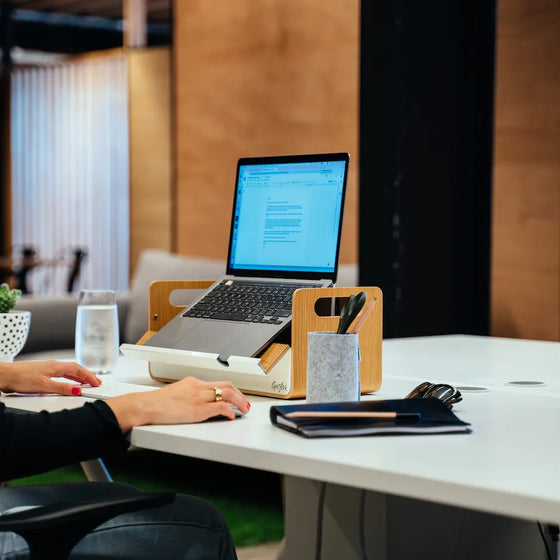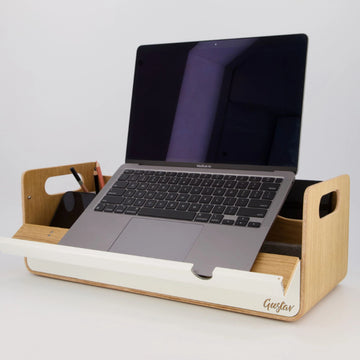
What a Hot Desk Organiser Should Do

A shared desk tells you a lot in the first 30 seconds. If someone can arrive, place their essentials, raise their screen, clear the visual noise and start work without fuss, the setup is doing its job. That is where a hot desk organiser matters. In hybrid offices and desk-sharing environments, it is not just a storage item. It is a compact system for creating order, comfort and consistency wherever work happens.
The difference is easy to spot. A basic caddy moves objects from one place to another. A well-designed organiser supports the full rhythm of flexible work - carrying, setting up, working, packing away and moving on. For employees, that means less friction. For workplace teams, it means cleaner desks, easier resets and a more professional environment across the office.
Why a hot desk organiser matters now
Desk sharing has changed what people need from the workplace. The desk is no longer a fixed personal zone with drawers full of cables, notebooks and chargers. It is a temporary workstation that needs to perform well for different people across the day. That puts pressure on every accessory placed on it.
A hot desk organiser has to solve several problems at once. It needs to keep essentials together, reduce setup time and support a clean desk policy without feeling clinical or disposable. It also has to work across different settings - a corporate office one day, a home office the next, a project room after lunch.
This is why design quality matters more than it used to. In a fixed setup, people can compensate for poor organisation over time. In a flexible setup, every small inconvenience repeats daily. A cable with no place to go, a laptop at the wrong height, a notebook buried under loose accessories - these become recurring points of friction.
What a hot desk organiser should actually include
The strongest organisers are not defined by how much they hold, but by how clearly they support the working day. Capacity matters, but only when it is paired with structure.
Storage that reflects real work tools
Most professionals carry the same core items between locations: laptop, charger, phone, notebook, pens, earbuds and a few personal tools. Some also carry a mouse, keyboard, headset or adapter. A useful organiser accounts for these objects without becoming bulky.
That means separate spaces for different item types, not one large compartment where everything collides. Soft structure can work well for flexibility, but too little organisation slows people down. If users have to empty half the organiser to find one cable, the product is adding effort rather than removing it.
Fast setup and fast pack-down
Speed is one of the most overlooked criteria. In a hot desking environment, people should be able to go from bag to working desk in moments. The reverse matters too. At the end of the day, desks need to be cleared quickly and completely.
An organiser should open intuitively, place neatly on the desk and keep items visible while working. If it needs constant rearranging or spreads objects across the surface, it undermines the calm it is meant to create.
Support for ergonomics
Not every organiser needs to become a full ergonomic tool, but the best ones recognise that desk comfort is part of desk organisation. If a product can help position a laptop more effectively, reduce awkward reaching or create a more stable setup, it adds value beyond storage.
This is especially relevant in shared offices, where monitor arms, risers and accessories may vary from desk to desk. A portable organiser that contributes to a more consistent setup helps users work more comfortably across changing environments.
The trade-off between portability and presence
There is always a balance to strike. A hot desk organiser needs to be portable enough to move with ease, but substantial enough to feel considered on the desk. Too light, and it can feel temporary or flimsy. Too large, and it becomes another item people resent carrying.
This is where materials and construction make a visible difference. Premium materials tend to hold their shape better, age more gracefully and bring a sense of permanence to flexible work. That matters because hot desking can easily feel improvised if every object looks generic or short-lived.
For design-conscious workplaces, the organiser also has a visual role. It should contribute to a calmer desk landscape, not add noise. Clean lines, tactile finishes and restrained detailing help shared workspaces feel intentional rather than patched together.
What workplace teams should look for
For individual users, the question is often simple: does it make my working day easier? For workplace strategists, facilities teams and office planners, the criteria are broader.
A hot desk organiser should support adoption of desk-sharing without making users feel stripped of ownership. That distinction matters. People do not need permanently assigned desks to want a sense of control over their setup. A portable organiser restores some of that control in a flexible format.
It can also reduce the operational mess that often follows hybrid working. Shared desks stay clearer when personal equipment has a defined place before, during and after use. Lost chargers, abandoned stationery and cable sprawl become less common when storage is built into the routine.
There is also a cultural signal in the products an organisation chooses. Low-grade accessories tell employees that flexibility is about compromise. Well-made tools suggest the opposite - that mobility, organisation and comfort are part of a better workplace standard.
Hot desk organiser design for different users
The right solution depends on how people work.
For knowledge workers and everyday hybrid use
A compact organiser with space for core tools is often enough. The focus should be easy transport, quick access and a footprint that sits neatly on smaller desks. If someone moves regularly between home and office, weight and simplicity matter.
For creatives and project-based teams
The organiser may need to hold a little more - sketch tools, adapters, reference materials or specialist tech. Here, flexibility inside the organiser becomes more important. Rigid layouts can be limiting if the contents change from day to day.
For office-wide rollout
Consistency becomes the priority. Products should be intuitive for first-time users, durable enough for repeated handling and visually aligned with the workspace. An organiser that looks refined in a boardroom but awkward in an open-plan area is not as versatile as it seems.
Materials are part of the experience
People notice materials more than many workplace briefs acknowledge. The texture of a handle, the stability of a base, the finish of a surface - these shape how a product feels to use every day.
In premium workplaces, this is not a cosmetic detail. Material quality influences trust, longevity and perceived value. An organiser made with care feels less like office equipment and more like a personal working tool. That increases the chance that people will actually use it consistently.
There is a practical side too. Durable materials cope better with commuting, desk moves and repeated packing. They retain their form, protect contents more effectively and keep the overall setup looking composed over time.
A better desk-sharing experience starts with the small tools
Large workplace decisions often focus on layouts, occupancy and policy. Those are important, but the everyday experience of flexible work is shaped by smaller objects. The things people touch first and use repeatedly tend to define whether a workspace feels easy or awkward.
A hot desk organiser sits right in that space. It supports the transition between locations, protects the essentials people rely on and helps each desk feel ready within moments. When designed well, it reduces clutter without stripping away character. It gives structure without adding weight. And it turns hot desking from a compromise into a cleaner, more composed way of working.
For brands like Gustav, that is the real opportunity in workspace accessories. Not to add more to the desk, but to make every desk work better. Choose an organiser that respects movement, supports comfort and brings order at first touch. People will feel the difference before they have even opened their laptop.