A Guide to Agile Office Storage That Works

A guide to agile office storage begins at the moment someone arrives at a shared desk with a laptop, charger, notebook and water bottle in hand. If those essentials have nowhere clear to go, the desk becomes cluttered before work has even started. The result is a slower set-up, an inconsistent employee experience and a clean-desk policy that feels difficult to follow.
Agile storage is not simply about adding more lockers or cupboards. It is about giving every work item an appropriate place across the working day: in transit, at the desk, in a team area and in longer-term storage. When that system is considered as one, people can move between work settings without carrying clutter or sacrificing comfort.
A guide to agile office storage starts with movement
Traditional office storage assumed that each employee had a fixed desk, a pedestal drawer and a predictable collection of paper. Agile workplaces operate differently. People may begin at a touchdown desk, move to a project table, take a call in a focus room and finish work at home. Storage needs to support that movement rather than interrupt it.
Start by observing the routes people take through the office. Where do they enter? How far is the nearest locker? Are desks close to meeting rooms, or do people regularly carry their equipment between floors? The answers shape the right storage mix far better than a generic ratio of lockers to desks.
A workplace with short, frequent moves benefits from compact personal organisers and accessible short-stay storage. A larger campus with staff travelling between zones may need more generous lockers, bag storage and collection points. There is no single perfect layout. The useful question is whether employees can carry what they need, store what they do not and set up again without friction.
Separate personal ownership from shared resources
Agile storage works best when personal belongings, work tools and shared supplies are treated differently. A coat, medication or private documents require secure personal storage. A monitor adaptor, marker pens or spare keyboard should be easy for teams to find and return. Archive boxes and infrequently used equipment belong away from daily workstations.
When these categories blur, lockers become overfilled, shared cupboards become untidy and desks become informal storage units. Define what belongs in each place, then make that decision visible through placement, labelling and simple internal guidance.
For daily use, the ideal personal storage solution holds the essentials rather than everything someone owns. This encourages purposeful packing and keeps the journey from locker to desk light. It also prevents valuable desk space being consumed by oversized bags, loose cables and stacks of papers.
Build agile office storage in four layers
A practical storage plan usually combines four distinct layers. Each supports a different duration and type of work.
1. Personal carry storage
This is the mobile layer: the equipment people take with them between home, desk, meeting room and locker. It should protect a laptop and documents, contain cables and stationery, and make essentials quick to reach. A structured work bag or portable desk organiser is more effective than a loose tote because it maintains order while moving.
This layer matters most in desk-sharing environments. Employees should not need to unpack a collection of small pouches just to find an adaptor or pen. A well-designed organiser lets them arrive with one contained workspace, then set up with confidence.
2. Immediate desk storage
The desk itself should hold only the tools needed for the current task. Think laptop, charger, headphones, notebook and a small amount of stationery. Compact organisers, cable storage and document holders keep these objects visible without spreading them across the work surface.
Immediate desk storage needs to be portable or easily cleared. Fixed desk accessories can suit assigned workstations, but they often create problems where desks must be reset for the next user. The better choice is a system that helps someone create a familiar workstation in seconds, then leave no trace when they move on.
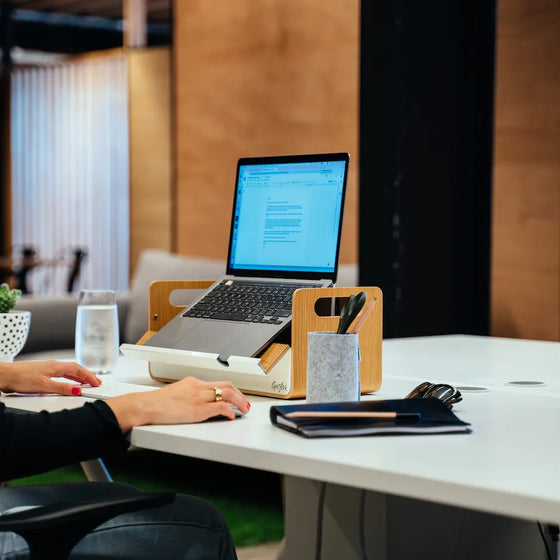
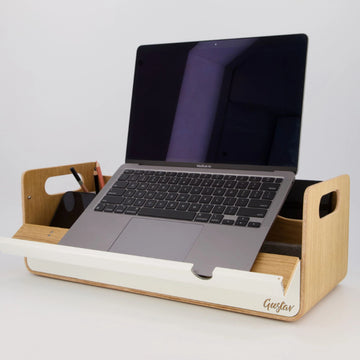
Gustav Original, for example, combines a portable organiser with an ergonomic laptop stand, helping users establish a more comfortable desk position without relying on permanent desk equipment. That combination is particularly useful where workstation consistency matters but desk allocation changes every day.
3. Neighbourhood storage
Neighbourhood storage sits close to the work area and supports shared activity. It may include lockers, team cupboards, print stations, supply points and charging facilities. This is where office planners need to balance access with visual calm.
Place frequently used items near the people who need them, but avoid turning every collaboration area into a supply depot. A small, clearly organised resource point near project desks is often more useful than a large central cupboard that requires a walk across the floor. For teams working with physical samples, documents or specialist equipment, dedicated project storage may be necessary. The trade-off is footprint, so it should be reviewed as projects change rather than becoming permanent clutter.
4. Long-term and archive storage
Items used monthly or less should not compete with daily work tools. Archive materials, spare devices, event equipment and bulk supplies need a separate home, ideally outside the main working neighbourhood. This preserves valuable office space for focused work, collaboration and informal exchange.
Before adding capacity, audit what is already being stored. Many offices retain outdated stationery, unused peripherals and documents that no longer need to occupy premium floor space. Reducing this volume can be as valuable as purchasing new storage furniture.
Make clean-desk policies practical
A clean-desk policy only succeeds when it respects the reality of work. Asking people to clear a desk without providing a logical place for their belongings simply shifts clutter into cupboards, meeting rooms and corridors.
Give people a clear reset sequence at the end of a desk session: pack personal tools, return shared equipment, remove food and cups, and leave the surface ready for the next person. The process should take moments, not feel like an administrative task. Portable organisers help because they turn packing away into one contained action rather than a search for multiple loose items.
Consistency also matters. If one office zone provides lockers, charging and desk accessories while another does not, employees will naturally gravitate towards the better-equipped area. Set a baseline for every neighbourhood, then add specialised storage where the work requires it.
Design for ergonomics as well as order
Storage decisions affect posture. When a laptop stand, external keyboard or charger is difficult to carry, people are more likely to work directly from a laptop at an unsuitable height. When cables and adaptors are scattered, desks become harder to arrange safely and comfortably.
A mobile workstation should therefore accommodate the tools that support a healthy set-up, not merely the devices themselves. Consider where users will place a laptop at eye level, where charging cables sit, and how a bag or organiser can be kept off the main work surface. The aim is a desk that feels calm and usable within minutes.
Material choice has a role here, too. In visible desk-sharing environments, storage becomes part of the workplace experience. Durable finishes, recycled PET felt organisers and sustainably grown wood can bring warmth and order to a flexible office, while standing up to repeated daily use. Premium materials are worthwhile where they improve longevity, touchpoints and the overall impression of the space.
Test the system before scaling it
The most effective agile office storage plans are tested with real users. Pilot a small work zone and ask employees to use it across a typical week. Observe what ends up on desks, what is left in lockers and which items travel between settings. These patterns reveal gaps that floor plans cannot.
Pay particular attention to peak moments: the morning arrival, the period before meetings and the end-of-day reset. If queues form at lockers or people leave bags under desks, the issue may be capacity, location or the design of the personal carry solution. Adjusting these details early is simpler than retrofitting an entire office.
A well-planned storage system should fade into the background. People should be able to arrive, arrange their tools, work comfortably and move on without spending thought on where anything belongs. That is the real measure of an agile workplace: not empty desks, but a space that is ready for its next user.