A Guide to Flexible Workplace Setup

A flexible office only works when people can settle in quickly and work well straight away. That is where a clear guide to flexible workplace setup becomes useful. The challenge is not simply giving people a desk to use. It is creating a system that supports movement, reduces clutter, protects focus and still feels considered in every location.
For workplace leaders, designers and hybrid teams, the real test is consistency. If one day starts at a shared desk, the next at home and the third in a project room, employees should not have to rebuild their working habits from scratch each time. A strong setup gives them a dependable foundation, wherever work happens.
What a flexible workplace setup needs to achieve
The phrase can sound broad, but in practice the brief is precise. A flexible setup should let people carry what matters, arrange it in seconds and work with the same sense of order across different spaces. It should also support the wider office strategy - whether that means desk sharing, activity-based working or a tighter clean desk policy.
That creates a balancing act. The setup must be compact enough to move easily, but complete enough to support a full working day. It should feel personal without becoming territorial. It needs to improve ergonomics without filling the desk with equipment that nobody wants to pack away.
This is why poorly planned flexible workplaces often create friction. The office may look efficient on paper, yet the user experience feels fragmented. Cables wander, peripherals go missing, lockers fill with random items and desks lose their sense of calm. Flexibility without structure usually becomes visual noise.
A guide to flexible workplace setup starts with behaviour
Before choosing products or furniture, look at how people actually work. Not every role needs the same setup, and not every workspace should solve for the same task. A designer moving between focus work and reviews needs something different from a consultant who mainly works from a laptop, and both differ from a team member who spends most of the day in calls.
Start by mapping the core work modes. Focus work, collaboration, video meetings, touchdown use and home-based tasks all place different demands on the desk. Once those patterns are clear, it becomes easier to define what should stay fixed in the environment and what should travel with the individual.
This is often where organisations overcorrect. Some try to provide every accessory at every desk, which increases cost and clutter. Others strip everything back too far, leaving employees to improvise with poor posture and scattered essentials. The better option sits between the two: provide the right shared infrastructure, then equip people with a personal setup that moves with them.
Build around three layers: base, mobile and personal
The most effective flexible workplaces are built in layers. First comes the base environment. That includes the desk, chair, screen, power access and lighting. These elements should be reliable and consistent across the office, because inconsistency slows people down and makes each workstation feel like a negotiation.
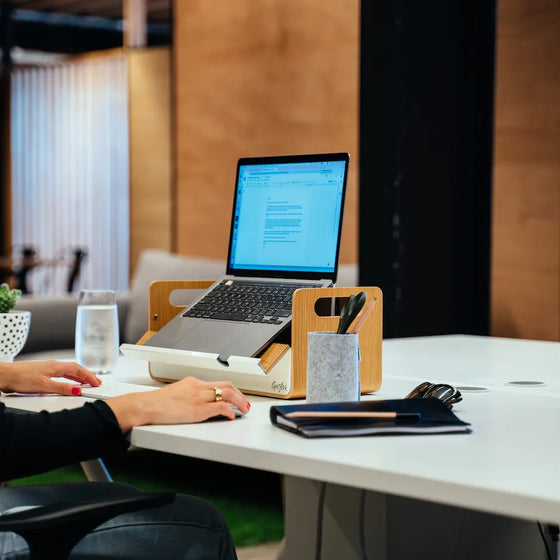
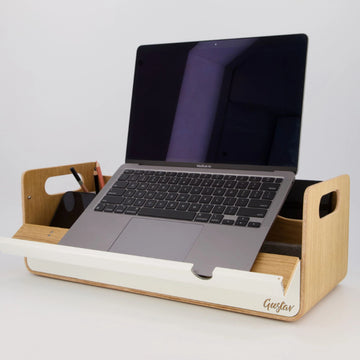
The second layer is the mobile working kit. This usually includes the items people need every day but cannot rely on finding in perfect condition at every desk - laptop stand, mouse, keyboard, charger, notebook, headset and cable organisation. Keeping these tools together in a portable format cuts setup time dramatically and supports cleaner desks at the end of the day.
The third layer is personal comfort and routine. This is less about decoration and more about repeatability. When someone can place their devices in the same arrangement each morning, they regain a sense of control. That matters in shared environments, where the desk itself may change daily.
A design-led portable organiser or work bag often sits at the centre of this system because it bridges storage and setup. Instead of carrying loose objects from desk to desk, users move one considered kit that contains everything they need. The benefit is practical, but also visual. Order tends to improve behaviour.
Ergonomics cannot be an afterthought
Many flexible work strategies promise agility but fail on posture. If employees are moving constantly, they need setup tools that make ergonomic adjustment simple rather than optional. Otherwise the laptop stays flat on the desk, the shoulders lift, and comfort declines by mid-morning.
A laptop stand is one of the clearest examples. It creates a better viewing height without demanding a permanent workstation footprint. Pair it with a compact keyboard and mouse, and the user can establish a more natural posture almost anywhere. That does not replace the need for a good chair and suitable desk height, but it closes an important gap.
There is, however, a trade-off. The more complete the mobile setup, the more there is to carry. That is why material choice, weight and packing logic matter. Premium lightweight components, durable construction and a format that stores accessories neatly are not luxury details here. They are what make the setup realistic for everyday use.
Design for speed, not just storage
A common mistake in flexible office planning is to focus on where things are kept rather than how quickly they can be used. Storage matters, but setup speed matters more. If employees need several minutes to unpack, connect devices and sort cables each time they change location, the system is already underperforming.
The goal should be near-instant setup. Open the bag or organiser, place the essentials, connect power and start work. That sounds simple, but achieving it requires discipline in product selection. Fewer, better tools usually outperform a larger collection of mediocre ones.
This is also where desk mats, pouches and organisers become more than accessories. They define placement, protect surfaces and reduce small daily interruptions. A well-designed desk mat can quickly frame a temporary workstation and create a sense of visual order. A dedicated tech pouch prevents the low-grade frustration of hunting for adapters and charging cables.
The office and home setup should speak the same language
Hybrid work has exposed an awkward truth: many employees move between highly considered office spaces and improvised home setups. That mismatch can undermine both wellbeing and performance. A flexible workplace setup should therefore extend beyond the office itself.
The best approach is not to duplicate an entire corporate workstation at home. For many organisations, that is unnecessary and expensive. Instead, create a shared standard for key tools and working principles. If an employee uses the same portable stand, organiser and accessory kit in both places, they gain continuity without needing to replicate every piece of furniture.
For employers, this also makes support easier. Equipment becomes simpler to specify, easier to replace and more consistent to manage. For users, it reduces the mental reset between locations. Familiar tools shorten transition time.
Why material quality matters in flexible environments
When products move daily, quality becomes visible very quickly. Hinges loosen, fabrics fray, surfaces mark and cheap finishes age badly. In a flexible workplace, accessories are handled, packed, unpacked and transported far more often than traditional desk items. Durability is not a secondary concern. It is central to cost, appearance and user trust.
That is one reason many organisations are moving towards fewer, better workplace tools. Well-made products built from durable, responsibly sourced materials tend to last longer, look better in shared environments and support a more refined employee experience. For design-conscious businesses, this matters as much as pure function. The workspace communicates standards.
Gustav’s approach sits naturally in this space because portability, craftsmanship and sustainable materials are built into the product logic rather than added as marketing language. For flexible workplaces, that alignment makes practical sense.
A guide to flexible workplace setup for managers and specifiers
If you are planning at team or organisational level, think beyond procurement. The setup should support behaviour, policy and space planning together. A portable workspace kit works best when paired with clear desk-sharing etiquette, reliable booking systems and storage that is easy to access but does not dominate the floorplate.
It is also worth piloting before scaling. Test a setup with different user groups and look at what actually happens over several weeks. Do people carry the kit daily? Do they leave items behind? Are desks clearer at the end of the day? Does setup time fall? Small observations often reveal more than workshop feedback alone.
Architects and workplace strategists should pay particular attention to visual consistency. In open-plan environments, a coordinated ecosystem of tools can make a noticeable difference to the overall feel of the office. When desks look orderly even as users change, flexibility feels intentional rather than temporary.
The strongest flexible workplaces do not ask people to tolerate compromise. They give them a portable, ergonomic and well-organised way to work that feels credible in every setting. If the setup is calm, quick and durable, people notice. And when work can begin without friction, the space starts to do what it was designed to do.