Home Office Ergonomics That Actually Work

By 3 pm, most home office problems stop looking like design problems and start feeling physical. Tight shoulders, a hot laptop, a chair that seemed fine at 9 am and a desk surface slowly disappearing under cables, notebooks and chargers. That is where home office ergonomics stops being a nice extra and becomes a performance issue.
For hybrid teams and focused professionals, the goal is not to create a picture-perfect workspace that only works in one room. It is to build a setup that supports posture, movement and concentration without adding visual noise or daily friction. Good ergonomics should feel calm, quick to use and easy to maintain.
What home office ergonomics really means
Ergonomics is often reduced to chair height and screen position. Those matter, but they are only part of the picture. A well-considered home office setup supports the way work actually happens - switching between laptop and notebook, taking video calls, reading, typing, charging devices and packing everything away when the day ends.
That is why the best ergonomic decisions are rarely about a single product. They come from how the whole workspace works together. Desk height influences shoulder tension. Screen height affects the neck. Storage affects whether the desk stays usable. Portability matters if your work moves between home, office and shared spaces.
There is also no universal perfect setup. Someone spending eight hours on detailed spreadsheet work needs something different from a creative professional sketching, presenting and moving between rooms. Home office ergonomics is less about copying a standard and more about removing strain from your own work pattern.
Start with posture, not products
The simplest way to assess a workspace is to sit down and notice what your body is compensating for. If your chin tips down for hours, your screen is too low. If your shoulders lift while typing, the desk or chair is working against you. If you perch forward rather than sit back, your chair is not giving enough support or your screen is pulling you out of position.
A neutral posture is a useful reference point. Feet grounded, knees roughly level with hips, shoulders relaxed, elbows close to the body and wrists fairly straight. Your gaze should land near the top third of the screen rather than dropping steeply towards the desk.
That sounds straightforward, but laptops complicate it immediately. The screen is too low for the neck and the keyboard is too high to raise without creating another problem. If you work on a laptop for long periods, that compromise catches up quickly.
The laptop dilemma
A laptop is excellent for mobility and poor as a fixed workstation. Used flat on a desk all day, it encourages a rounded neck and inward shoulders. Raised on its own, it improves the viewing angle but makes typing awkward unless paired with separate input devices.
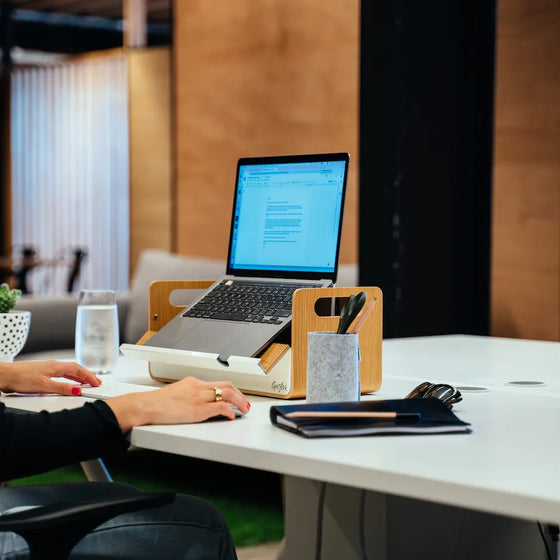
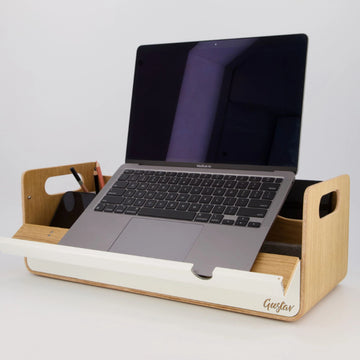
This is one of the clearest it depends moments in ergonomic planning. If your laptop use is short and intermittent, a simple adjustment may be enough. If it is your main device for daily work, elevating the screen is usually the turning point. A stable stand creates a more natural line of sight, and a separate keyboard and mouse let the arms return to a more comfortable working position.
That small shift often changes more than posture. It creates visual order, clears desk space underneath and makes the setup feel more intentional. For hybrid professionals, it also keeps the transition between locations consistent.
The desk should support focus, not collect friction
A surprising amount of ergonomic strain starts with clutter. Not because clutter is visually unpleasant, although it can be, but because it changes how you use the desk. You twist to reach chargers, angle your mouse around objects, balance documents on the edge of the surface and gradually work in a narrower, less natural zone.
A clean desk is not about minimalism for its own sake. It is about preserving a usable working area where your keyboard, mouse, notebook and screen can sit in the right relationship to each other. That is especially important in smaller homes, multi-use rooms and desk-sharing routines where everything must be easy to set up and easy to clear away.
Storage, then, is an ergonomic tool. When essentials have a defined place, setup becomes faster and the working posture becomes more repeatable. Portable organisers, tech pouches and structured desk systems help reduce the small daily inconsistencies that make one day feel fine and the next feel oddly uncomfortable.
Why repeatability matters
One overlooked principle in home office ergonomics is repeatability. The body copes better when the setup is consistent. If Monday is spent at a dining table, Tuesday at a proper desk and Wednesday half on the sofa, discomfort is not surprising.
For people working across home and office, the most effective setups make it easy to recreate the same essentials everywhere - screen at a better height, tools close to hand, fewer loose accessories and a clear surface. That is where design and ergonomics genuinely meet. A workspace that is organised and portable is easier to use well.
Seating matters, but not in isolation
Chairs attract most of the ergonomic attention, often with good reason. A poor chair can create pressure points, encourage slumping and make long sessions tiring. But an expensive chair will not fix a low screen, a crowded desk or a laptop used in the wrong position.
What matters most is adjustability and fit. You should be able to sit back with support through the lower back, keep feet on the floor or on a footrest, and avoid feeling pushed forward by the seat edge. Armrests can help or hinder depending on their height and whether they stop you getting close enough to the desk.
If you do not have a task chair, there are still useful improvements. A firm cushion can alter seat height slightly, a footrest can stabilise the lower body and a separate screen riser can prevent the neck from doing all the compensating work. Ergonomic progress is often incremental rather than all-or-nothing.
Movement is part of the setup
Even a well-designed workstation becomes uncomfortable if it encourages stillness for too long. The body is not asking for perfect posture held for eight hours. It is asking for variation.
That changes how home office ergonomics should be approached. The right setup supports micro-movements, easy posture shifts and regular breaks without disrupting work. Keep water away from the keyboard so you stand up occasionally. Place the printer or storage slightly out of reach rather than beside the chair. Take calls standing when possible. Alternate between focused screen work and tasks that change your eye line and arm position.
Sit-stand desks can be useful, but they are not automatically the answer. Some people use them brilliantly, others raise them twice in the first week and then forget. The better question is whether your setup makes movement easy enough to happen naturally.
Light, materials and visual calm
Ergonomics is not only mechanical. Light quality, glare and visual distraction also shape physical comfort. If you lean forward to see the screen because of reflections, that is an ergonomic problem. If poor lighting causes eye strain and headaches, performance drops even when the chair is technically correct.
Natural light is ideal when it can be managed without screen glare. Task lighting helps in darker rooms, particularly in winter. Matte surfaces, considered cable management and fewer reflective distractions all support a calmer visual field.
Materials play a role too. A workspace made from durable, tactile materials tends to invite better daily habits because it feels worth maintaining. This is where premium design earns its place. Thoughtful craftsmanship is not decoration. It can make a workstation easier to use, easier to reset and more pleasant to return to every morning.
Build for the way work moves now
The traditional idea of ergonomics assumed one desk, one chair and one fixed routine. That is no longer how many professionals work. Home office, shared office, project room, client site and travel often sit within the same week.
So the most relevant ergonomic question is no longer What is the perfect desk setup? It is How quickly can I create a good one wherever I am working today?
That is why portability deserves a place in the conversation. Lightweight stands, organised carry systems and desk accessories that support instant setup are not just convenient. They help preserve comfort and concentration across changing environments. Gustav has built much of its thinking around that reality - your office should not depend entirely on one room.
A better setup should feel simpler
If home office ergonomics is working, you notice it less. Your shoulders settle. The desk stays clear enough to think. Tools are where they should be. You spend less time adjusting, searching and compensating, and more time getting through meaningful work with less strain.
That is the real standard to aim for - not a showroom workspace, but one that supports better work every day, wherever that work happens.