How to Organise a Hot Desk Well

A hot desk usually looks fine at 9:00 and chaotic by 11:30. A charger appears from nowhere, someone borrows a chair from another zone, and by mid-afternoon the clean-desk policy exists mostly in theory. That is why knowing how to organise a hot desk matters. It is not only about tidiness. It is about speed, comfort, consistency and how professional a shared workplace feels to the people using it.
In a flexible office, the desk cannot depend on one person’s habits. It has to work for many people, across different tasks, with minimal friction. The best hot desk setups are easy to claim, easy to adjust and easy to clear. They reduce visual noise, support posture and keep the essentials close without letting personal equipment spread across the surface.
What a well-organised hot desk needs to do
A good hot desk has a different job from a permanent workstation. It is not there to hold your entire working life. It is there to support a focused working session, then reset quickly for the next person.
That changes the standard for organisation. The goal is not storage for storage’s sake. The goal is temporary order. Everything on the desk should earn its place by improving work in the moment - not by simply being available.
For most users, that means five things: a clear work zone, access to power, a comfortable screen height, space for writing or a notebook, and a simple way to keep daily tools together. If one of those is missing, people compensate by improvising. That is when desks start to look cluttered and inconsistent.
For workplace teams, this is also where employee experience meets operations. If hot desks are difficult to use, people waste time settling in. If they are too bare, staff bring in ad hoc accessories that create more mess than the office intended to avoid.
How to organise a hot desk without overfilling it
The easiest mistake is treating the desk like a mini storage unit. In practice, the more objects a shared desk holds, the harder it is to keep usable. A better approach is to organise by activity.
Start with the primary work surface. Leave enough open space for a laptop, documents and forearms to rest comfortably. This sounds obvious, but many hot desks are undermined by fixed organisers, oversized screens or cable arrangements that eat into the working area. A desk-sharing environment works best when the centre of the desk stays visually and physically open.
Then think in layers. The surface should support active work. The accessories should support fast setup. Anything not used daily should live off-desk, either in a locker, bag or shared storage point nearby.
Portable organisation is often more effective than static organisation here. A compact organiser, pouch or tray that moves with the user keeps essentials together without turning each desk into a personal territory. It also makes the desk easier to reset at the end of the day.
Build around a portable core kit
The cleanest hot desk is often the one that arrives organised. Rather than relying on each desk to provide every tool, many hybrid workers benefit from carrying a small core kit that creates a complete setup anywhere.
This kit should be disciplined. A laptop stand, compact keyboard and mouse, charger, notebook, pen and headphones will cover most needs. If the user often joins calls, add a foldable webcam or headset. If they work between home, office and third spaces, the kit should pack and unpack in seconds.
This is where design matters. Accessories that nest together, pack flat or have a defined place inside a bag are easier to live with than loose items. They also reduce the small but constant mental load of checking whether everything has been packed away. Premium workspace tools earn their value here - not as decoration, but as a reliable system for repeat use.
For organisations, there is a trade-off. Standardised desk equipment gives consistency, while personal portable kits give flexibility. Many offices need a mix of both. Shared desks can provide the basics, while users carry the items that affect comfort and workflow most directly.
Set up for ergonomics in under a minute
An organised desk that feels uncomfortable by lunchtime is not well organised. Ergonomics is part of order because poor setup leads to sprawl. People start stacking books under laptops, dragging in spare chairs or moving equipment from neighbouring desks.
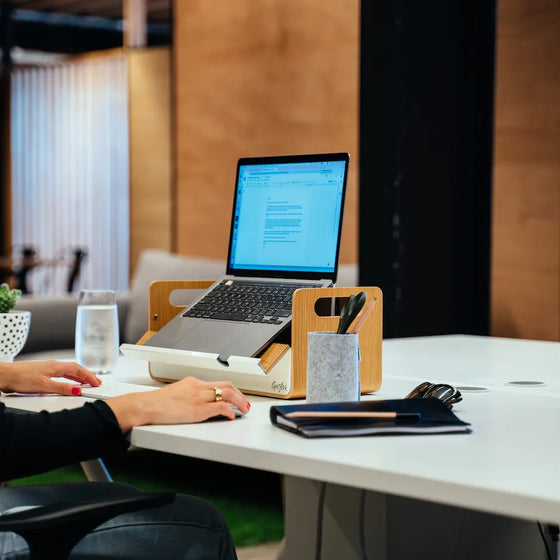
The key adjustment is screen height. If staff work primarily on laptops, a lightweight stand makes a significant difference. It brings the screen closer to eye level and encourages a more neutral posture. Pair that with a separate keyboard and mouse, and the desk becomes more usable for longer sessions.
Chair height and monitor distance matter too, but these depend on what the office provides. In shared environments, the most practical ergonomic tools are usually the portable ones. They travel with the user and deliver a familiar setup wherever they sit.
If a hot desk is intended for short touchdown work only, the setup can be simpler. If people are expected to spend half or full days there, the desk should support proper posture without workarounds. That distinction is worth making early, especially for office planners and facilities teams.
Keep cables under control
Cables are where most hot desks lose their sense of calm. One charging cable may be necessary. Three tangled leads, a dock, and an extension block on the surface are usually a sign that the setup has not been designed with real use in mind.
The simplest solution is to reduce what needs plugging in. Fewer devices mean fewer cables. After that, route power to the edge or underside of the desk where possible and keep only the active lead accessible on the surface.
For individual users, a small tech pouch helps keep chargers, adapters and cables from spreading across the desk. For organisations, integrated power access and cable management should be considered part of the furniture brief, not a later fix. Shared desks feel more premium when power is available without visual clutter.
There is also a hygiene factor. Loose cables collect dust, interfere with cleaning and make end-of-day resets slower. In offices with a strong clean-desk policy, cable discipline is often what separates a policy that works from one that is constantly ignored.
Give every item a temporary home
People are more likely to keep a hot desk organised if each object has an obvious place while it is in use. Without that, small items drift. Pens end up beside monitors, earbuds get left behind, access cards disappear under notebooks.
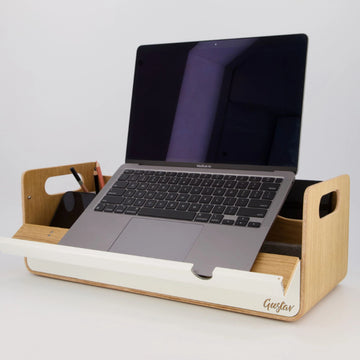
This does not require complicated storage. In fact, minimal systems usually work better. A desk mat can define the work zone. A slim organiser can hold the tools in active use. A bag or portable caddy can act as the base for everything else.
The principle is simple: if an item comes out, it should return to the same place before the user leaves. That habit is easier to maintain when the setup has been designed as a repeatable routine rather than a collection of loose objects.
This is one reason design-led accessories suit desk-sharing environments so well. When products are made to work together - visually and functionally - people tend to maintain order more naturally. Gustav approaches this as a complete workspace system rather than a series of separate add-ons.
Create rules that feel usable, not punitive
Hot desking often fails because workplace rules are written for compliance rather than behaviour. Telling employees to keep desks clear is reasonable. Expecting them to do that without enough storage, the right accessories or a quick setup routine is not.
A more effective standard is practical and visible. Keep the desk surface clear apart from current work. Remove all personal items at the end of the session. Store daily tools in a portable organiser or bag. Leave cables unplugged and the chair reset.
For managers and workplace strategists, the lesson is straightforward. If you want orderly desks, provide the conditions for order. That may mean lockers, better shared equipment, or guidance on what employees should carry in a mobile work kit. It may also mean accepting that different roles need different levels of setup. A designer, consultant and finance manager may all use the same desk, but not in the same way.
The best hot desk feels ready, not empty
There is a difference between a sparse desk and a prepared one. A sparse desk feels temporary in the wrong way - under-equipped, impersonal and slightly inconvenient. A prepared desk feels calm, functional and easy to start using.
That is the balance to aim for when deciding how to organise a hot desk. Keep the surface clear, but not stripped. Make setup fast, but not makeshift. Support mobility, but do not force people to rebuild their workspace from scratch every day.
When the desk works this way, the whole office works better. Shared space feels intentional. Transitions are quicker. Clutter drops without endless policing. And people can focus on their work rather than on where they left their charger.
The most useful hot desk is not the one with the fewest objects. It is the one where everything has a purpose, and nothing gets in the way.