How to Pack Daily Work Essentials for Any Desk

A shared desk should not mean starting from zero. Yet many professionals still arrive with a laptop under one arm, a loose charger in a pocket and the rest of their working day scattered across several bags. The result is predictable: a cluttered surface, a rushed setup and small but persistent friction before the first task begins.
Learning how to pack daily work essentials is less about carrying more and more about carrying with purpose. The right system protects the tools you rely on, keeps them easy to reach and helps you create a familiar workspace wherever you sit. For hybrid workers, desk-sharing teams and home-office professionals, that consistency is a practical advantage.
Start with the workday, not the bag
Before choosing a bag, pouch or organiser, look at the sequence of your day. Do you move from a locker to a desk, then into meeting rooms? Do you travel between home and office? Are paper documents still part of your work, or is your setup almost entirely digital? A good packing system follows these realities rather than forcing every item into one oversized compartment.
Think in three layers: the tools needed to work, the items that make the workspace comfortable, and the personal essentials that must travel with you. Your laptop, charger and work phone belong to the first layer. A laptop stand, mouse, headphones and notebook may belong to the second. Keys, wallet, medication and water bottle sit in the third.
This distinction matters because each layer needs a different level of access. Your laptop should be protected but immediately available. A cable you use once at the end of the day can sit deeper in the bag. When everything has a defined place, packing becomes a repeatable routine rather than a daily search.
Build a considered daily work kit
Your core kit should be compact enough to carry comfortably and complete enough to avoid borrowing, improvising or returning home for something essential. For most knowledge workers, it begins with a laptop, charging cable, phone, headphones, notebook and pen. The details then depend on the work itself.
If you spend long stretches reading, writing or working across multiple windows, an ergonomic laptop stand and a separate keyboard or mouse may earn their place. If you regularly host client meetings, add a presentation adapter, a slim document folder and a reliable charging option. Designers, architects and consultants may need a stylus, samples or printed plans. The principle stays the same: pack for your actual work, not every possible scenario.
There is a trade-off between readiness and weight. Carrying duplicates of every cable and peripheral feels prepared, but it can make a daily commute unnecessarily heavy. Start by identifying the items you use at least four days a week. These form your non-negotiable kit. Everything else should be selected according to the diary.
Keep technology contained
Loose cables create visual noise and practical problems. They tangle around pens, catch on zips and are difficult to find when a meeting is about to start. A compact tech organiser gives chargers, adapters, cables and smaller accessories a fixed home. It also makes the end-of-day check faster: if the organiser is closed and back in the bag, the essentials are together.
Roll cables loosely rather than tightly around a power brick. Tight winding can place strain on the cable over time, while a soft loop is easier to retrieve. Store charging cables separately from food, liquids and pens without caps. Small decisions like these protect the equipment that keeps your day moving.
Protect the items you touch most
Laptop protection is not only about the journey between locations. It also matters when you place your bag below a shared desk, beside a meeting-room chair or in a locker. Use a dedicated padded area for the laptop, ideally positioned close to your back so the load sits more comfortably when walking.
Place heavier items low and close to the body. A water bottle, power supply or bulky notebook can otherwise pull the bag out of balance. Keep the screen, phone and glasses away from hard-edged accessories. A purposeful layout reduces the chance that packing itself becomes the source of wear.
How to pack daily work essentials in zones
The most effective bags and organisers make their contents visible at a glance. Rather than filling empty space, create zones based on how often you use each item.
The first zone is for immediate access: access card, phone, headphones, pen and notebook. These are the items you may need while commuting, entering the office or moving to a meeting. The second is your working zone: laptop, stand, mouse, keyboard and charger. The third is for occasional items, such as adapters, paper documents, spare batteries or a cleaning cloth.
This approach is particularly useful in desk-sharing environments. You can arrive at a desk, take out the working zone and set up without emptying your entire bag across the surface. When it is time to move, everything returns to the same place in seconds. The desk stays clear, and so does your attention.
For people who work with paper, use one slim, defined section for active documents. Avoid folding papers around the laptop or placing them loose at the bottom of the bag. Review this section at the end of each week. Documents that have been completed should be filed elsewhere, not carried indefinitely from desk to desk.
Make setup part of the packing system
A well-packed bag should support a better workstation, not simply transport equipment. The goal is to turn an ordinary table into a place where you can work comfortably and with focus.
Start by positioning the laptop at a more comfortable viewing height where possible, then connect the accessories you use most. Keep your notebook and pen within reach, place your phone out of the main visual field and leave clear space beside the keyboard for active work. This is not about creating a perfect desk. It is about reducing the small distractions that build up across a day.
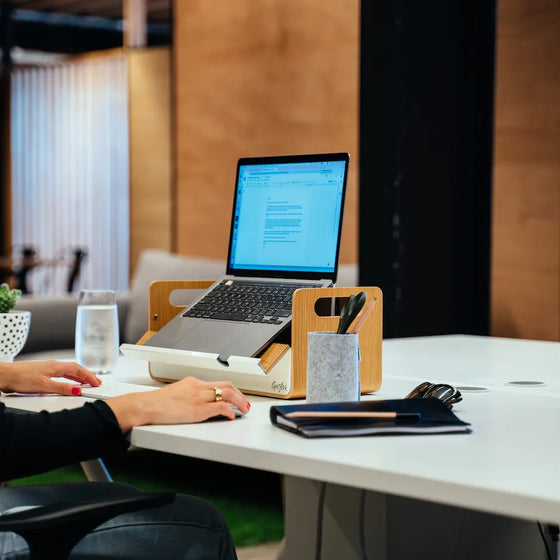
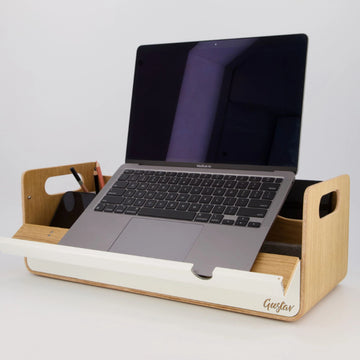
A portable desk organiser and laptop stand can be especially useful here because it combines storage with setup. Gustav Original, for example, is designed to carry essential desk tools and create an elevated laptop position quickly. For employees moving between lockers, desks and meeting rooms, a portable desk-sharing bag can play a similar role by keeping the full kit structured from door to desk.
The best choice depends on the way you move. A compact organiser suits a light, laptop-led setup. A larger work bag is more appropriate when you need to carry documents, a bottle and multiple devices. In either case, the key measure is simple: can you set up and pack away without creating a pile?
Keep the kit calm, clean and current
Daily packing works best when it is maintained, not constantly reinvented. Take two minutes at the end of the day to return each item to its place, remove rubbish and check that essential technology is present. This is particularly useful before travel days or office days with several meetings.
Once a week, review what is living in your bag. Retire duplicate pens, outdated papers, empty snack wrappers and cables for devices you no longer use. A work bag can quietly become storage if it is never edited. Keeping it light is not an aesthetic exercise; it makes moving through the day easier.
Material quality also plays a role. Organisers made with considered, durable materials hold their shape, protect their contents and continue to look appropriate in professional settings. Recycled PET felt, sustainably grown wood and well-finished textiles can bring warmth and structure to a setup without adding unnecessary visual clutter.
A mobile workspace should still feel like yours
The purpose of packing well is not to turn every journey into a logistics exercise. It is to remove the friction between arriving and doing good work. When the laptop, tools and personal essentials have a place, a shared desk or kitchen table can feel composed within minutes.
Choose fewer, better items. Give each one a clear role. Then let your daily work kit do what it should: carry your office with you, without carrying the clutter.