How to Set Up a Shared Desk Well

A shared desk succeeds or fails in the first two minutes of use. If someone sits down and has to hunt for a charger, adjust a chair from scratch, wipe away yesterday’s clutter and guess where to place their laptop, the setup is already working against them. Knowing how to set up a shared desk is less about adding more equipment and more about removing friction.
The best shared desks feel neutral but not cold, efficient but not temporary. They support fast setup, consistent ergonomics and a clean visual standard that makes the whole workplace feel more intentional. Whether you are planning a desk-sharing office or improving a hybrid team’s day-to-day experience, the aim is simple: make every desk ready to work, every time.
Start with the desk's real job
Before choosing accessories or setting rules, define what the shared desk needs to support. A touchdown space for one-hour visits needs a different setup from a desk used for full working days. A workstation used by designers or consultants may need room for sketching, dual-screen work or regular video calls. A general admin desk may need less equipment but higher turnover and faster resets.
This matters because over-equipping a shared desk creates clutter, while under-equipping it pushes users to improvise. In practice, the most effective desks support a core set of tasks well and rely on portable tools for individual preferences. That balance keeps the desk consistent without making it feel stripped back.
How to set up a shared desk for fast use
A good shared desk should be understandable at a glance. Users should know where to sit, where to power up, where to place personal tools and how to leave the space for the next person. If the setup requires explanation every morning, it is too complicated.
Start with the essentials fixed in place. The monitor, if provided, should be centred and aligned. Power access should be obvious and easy to reach. Cable routing should be controlled so wires do not spread across the surface. The chair should be fully adjustable and in good condition. Lighting should be even, with no dependence on one person’s preferred lamp angle or brightness.
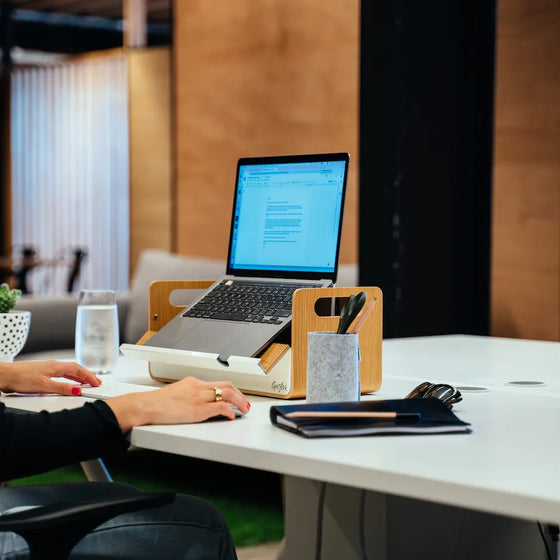
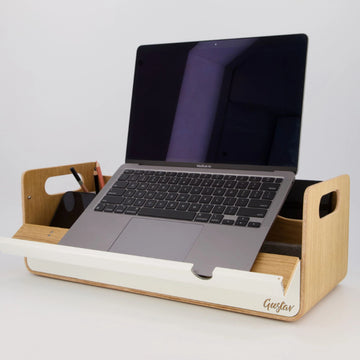
Then keep the surface clear. Shared desks work best when the permanent setup is limited to what every user genuinely needs. Anything highly personal or role-specific should live in a portable organiser, tech pouch or work bag rather than on the desktop itself. This is where design matters. A portable workspace system lets users arrive with their own tools, create a familiar setup in seconds and leave without residue.
Build in ergonomics without making it personal
Ergonomics at a shared desk can be tricky because bodies and preferences differ. One user wants a higher screen, another prefers a lower chair, and someone else works partly on paper. The answer is not to fix everything permanently. It is to make adjustment easy and obvious.
The chair is the first priority. If users cannot quickly adjust seat height, back support and arm position, discomfort arrives early. The monitor is next. If a screen is included, it should be placed at a height that suits the widest possible range of users, with enough flexibility to adapt where needed. If many people work from laptops, a portable laptop stand becomes one of the most useful additions to a shared desk setup. It raises the screen, improves posture and helps standardise comfort across locations.
Keyboard and mouse placement also matter. A desk that looks tidy but forces awkward arm angles is not well designed. Leave enough clear depth on the work surface so users can sit close to the desk and work with relaxed shoulders. If the desk is too shallow or crowded by fixed items, people end up compensating with poor posture.
There is always a trade-off here. The more fixed equipment you provide, the easier the desk is for some users but the harder it becomes to keep adaptable. In many hybrid offices, a lighter permanent setup paired with portable ergonomic tools gives better results.
Storage should move with the person, not stay on the desk
One of the fastest ways to ruin desk sharing is to let personal storage spread into shared space. Notebooks in drawers, chargers left behind, loose stationery and half-used paperwork all create hesitation for the next user. A shared desk should not feel occupied when nobody is there.
That is why mobile storage often works better than desk-based storage. If people can carry their daily essentials in a compact organiser or bag, they can create consistency without claiming territory. The desk remains clear, while the user still has immediate access to the tools they rely on.
For workplace planners, this is also more scalable. Instead of trying to predict every individual need at every desk, you create a universal base layer and let personal equipment travel. It is cleaner, easier to manage and better aligned with flexible working patterns.
Create a visual standard people will actually follow
Clean desk policies often fail because they are written as rules rather than designed into the workspace. If people have nowhere sensible to put their items, they will leave them on the desk. If the cable management is poor, cables will stay visible. If there is no obvious place for temporary belongings, clutter becomes the default.
A better approach is to make the desired behaviour the easiest behaviour. Keep the desk surface open. Give users a clear area for laptop, keyboard and notebook. Keep accessories restrained and purposeful. Use materials and finishes that look calm and professional, because people are more likely to respect a space that feels considered.
This is especially relevant in client-facing offices, design studios and premium workplace environments, where the desk is part of the brand experience. A well-set shared desk communicates order, care and competence before any meeting begins.
Set rules lightly, but make them precise
Even the best physical setup needs a few shared norms. The key is to keep them practical. People do not need a long policy document. They need a small set of standards that support everyday use.
At minimum, users should know how to leave the desk when they finish: remove personal items, disconnect and take devices, wipe the surface if needed, return adjustable elements to a neutral position and report faults quickly. That last point is often missed. In shared environments, small defects spread frustration fast because dozens of people encounter the same issue.
If desks are booked, the booking system should match the physical layout clearly. Confusion around desk ownership can undo an otherwise strong setup. Names, zones or desk codes should be easy to read but visually discreet.
How to set up a shared desk for different work modes
Not every shared desk should look identical. Consistency matters, but so does fit. Quiet focus desks, collaboration benches and occasional touchdown spaces each need a slightly different emphasis.
For focused work, prioritise visual calm, ergonomic support and acoustic consideration. For collaborative zones, keep technology access simple and provide enough shared surface area to avoid crowding. For short-stay desks, speed matters most - power, a clear surface and a comfortable chair may be enough.
This is where many offices over-standardise. Uniformity can simplify procurement and maintenance, but it can also flatten the user experience. A better model is consistent principles with role-appropriate variation. The desk should always feel part of one system, yet still support the work happening there.
Keep maintenance visible and ongoing
A shared desk is never finished. It needs periodic review because usage patterns change. Teams grow, devices change, and what worked for occasional hybrid use may not work when occupancy rises.
Watch for signs of friction. Are people bringing in their own stands because the desk setup is too low? Are chargers disappearing? Are certain desks constantly left messy while others stay clear? These are not minor annoyances. They are design signals.
Reviewing the setup every few months often reveals simple improvements - a better cable route, more logical storage nearby, more portable support tools, or clearer reset expectations. Premium workplace performance usually comes from these small details being handled properly, not from adding complexity.
For organisations that want shared desks to feel genuinely professional, portable workspace accessories can make a meaningful difference. They allow each user to carry a consistent setup from home to office to project space, while preserving the clarity of the desk itself. That combination of mobility and order is what modern desk sharing actually needs.
A shared desk should never feel borrowed. When it is set up well, it feels ready - calm to look at, quick to use and easy to leave better than you found it.