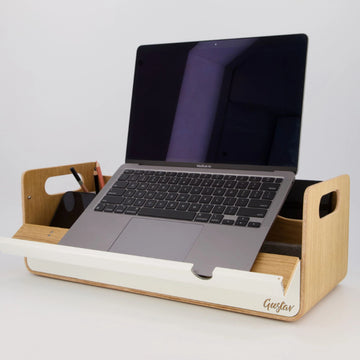
Laptop Stand vs Monitor Arm: Which Fits?

A desk can look perfectly equipped and still feel wrong after two hours of focused work. Usually, the issue is not the laptop, the chair or even the room. It is the screen position. That is why the laptop stand vs monitor arm question matters more than it first appears, especially in hybrid setups, shared desks and home offices where space, posture and speed of setup all have to work together.
Both tools solve a real problem, but they solve different versions of it. A laptop stand raises your device, improves viewing height and keeps your setup portable. A monitor arm frees up desk space, gives you broad screen adjustability and creates a more fixed workstation. The better choice depends less on specs and more on how you actually work.
Laptop stand vs monitor arm: the real difference
The simplest distinction is this: a laptop stand supports the device you carry, while a monitor arm supports a separate display that usually stays on the desk. That difference shapes everything else.
A laptop stand is built for mobility and speed. You place it on the desk, raise the screen, connect a keyboard and mouse if needed, and your workstation is ready in seconds. For professionals moving between home, office and touchdown spaces, that simplicity is hard to beat.
A monitor arm belongs to a more permanent setup. It attaches to the desk and holds an external monitor in a floating position. You gain precise control over height, tilt and distance, and you remove the monitor base from the work surface. In a dedicated workstation, that can feel cleaner and more intentional.
Neither option is automatically better. One is flexible in the sense of mobility. The other is flexible in the sense of screen positioning.
When a laptop stand makes more sense
If your workday moves, your equipment needs to move with it. This is where a laptop stand has a clear advantage.
For hybrid workers, consultants, designers and knowledge workers shifting between locations, a stand supports consistency. You carry one compact tool and create a familiar setup wherever you open your laptop. That matters in desk-sharing environments, where the quality of a workstation often depends on how quickly a person can make it their own without adding clutter.
A laptop stand also suits clean desk policies. It is easy to store, easy to transport and easy to reset at the end of the day. In offices designed around activity-based working, that portability supports the broader workplace strategy rather than fighting against it.
There is also a visual benefit. A well-designed stand creates order without demanding much space. On a smaller desk, that can be enough to improve both posture and focus. The setup feels lighter, calmer and more deliberate.
The trade-off is straightforward. A stand raises the laptop screen, but the screen itself is still limited by the size of the laptop. If you spend long hours reviewing detailed layouts, analysing spreadsheets or working across several windows at once, you may still want a larger display.
When a monitor arm is the better choice
A monitor arm earns its place in setups where the desk is stable and the screen is central to the work.
If you use an external monitor every day, especially a larger one, an arm gives you a level of ergonomic adjustment that a standard monitor base usually cannot. You can bring the screen closer, lift it higher, angle it more precisely and reclaim valuable desk depth. That can make a measurable difference in comfort over a full working day.
For planners, analysts, architects, finance teams and anyone working with large documents or detailed visuals, an external monitor is often not a luxury. It is the primary workspace. In that case, the arm improves the performance of the monitor rather than simply tidying the desk.
Monitor arms also support shared environments in a different way. In a hot-desking office with fixed screens on each workstation, an arm allows each user to reposition the monitor quickly. That helps accommodate different body heights and working preferences without replacing the whole desk setup.
Still, there are limits. A monitor arm is less portable, requires installation and depends on desk compatibility. Not every desk can take a clamp, and not every workplace wants visible mechanical hardware. In some interiors, particularly where calm materiality and minimal visual noise matter, the wrong arm can feel overly technical.
Ergonomics: which one actually supports better posture?
This is where the answer becomes more nuanced.
A monitor arm usually offers superior ergonomic range because it allows more exact placement of a larger screen. You can position the display so the top sits roughly at or just below eye level, while adjusting depth to reduce neck strain and visual fatigue. For long, desk-based sessions, that is a strong argument.
A laptop stand improves laptop ergonomics significantly, but only when paired properly. Once the laptop is raised to a better viewing height, the built-in keyboard and trackpad become awkward to use for long periods. So the stand works best with a separate keyboard and mouse. Without them, posture often improves in one area and worsens in another.
That does not make the stand a weaker ergonomic tool. It simply means the full setup matters. In flexible work, the best ergonomic solution is often the one people will actually use every day, not the one that looks most impressive on paper.
Space, clutter and visual calm
For many modern workplaces, the question is not just comfort. It is how the desk performs as an environment.
A monitor arm clears the desk surface by lifting the screen off its base. That creates more usable area underneath and can make a workstation look more spacious. In compact offices, that is valuable.
A laptop stand, however, can create a different kind of order. It supports a self-contained setup with fewer fixed elements. You are not committing the desk to one user or one display. For shared offices, training rooms or multi-purpose spaces, that can be the more intelligent approach.
There is also the issue of reset. A stand can be packed away. An arm stays in place. If your workplace needs to shift between individual work, collaboration and touchdown use, fixed hardware can sometimes reduce flexibility rather than improve it.
Cost and long-term value
A basic comparison on price alone is misleading.
Laptop stands are typically more accessible, and the investment is easier to justify across mobile teams because each person can own one and use it everywhere. The value comes from consistency, portability and reduced friction between locations.
Monitor arms often cost more, especially when quality, finish and durability matter. They may also involve additional spending on external monitors, cable management and installation. But in dedicated workstations, the return can be strong because the setup supports comfort and performance every day.
For business buyers, the real question is scale. Are you equipping people or desks? If you are equipping people who move, stands make sense. If you are equipping fixed workstations designed around external displays, arms often make more sense.
Which setup works best for hybrid and desk-sharing environments?
In most flexible workplaces, the answer leans towards the laptop stand.
That is not because monitor arms are less capable. It is because hybrid work rewards portability, fast setup and personal ownership of tools. A stand aligns with that pattern. It helps users create a familiar workstation anywhere, without depending on one assigned desk.
This is particularly relevant in European offices where desk sharing, smaller footprints and clean desk expectations are now standard rather than experimental. A portable setup supports employee experience while keeping the environment ordered.
That is also why design matters. A workspace accessory used every day should not feel like a compromise between ergonomics and aesthetics. It should support both. Gustav approaches this with products designed for mobility, organisation and calm visual presence, which is often exactly what flexible workstations need.
So, laptop stand or monitor arm?
Choose a laptop stand if your work moves across locations, your desk is shared, or you want an ergonomic upgrade that travels with you. It is the more adaptable choice for hybrid professionals and organisations building around flexibility.
Choose a monitor arm if your workstation is fixed, your external monitor is central to your work, and precise screen adjustment matters more than portability. It is the stronger option for dedicated desks where performance and posture over long sessions are the priority.
Some users will benefit from both - a laptop stand for mobile days and a monitor arm in a permanent home office setup. But if you are choosing just one, start with the reality of your work pattern, not the appeal of the hardware.
The best workspace tool is rarely the one with the longest feature list. It is the one that makes good work feel easier the moment you sit down.