Mobile Workspace Accessories That Work Hard

A laptop balanced on a café table is not a workspace. Neither is a hot desk with one power socket, no monitor riser and nowhere sensible to keep your charger. Mobile workspace accessories exist for the gap between those two realities - when work needs to move, but standards should not slip.
For hybrid teams, desk-sharing offices and home setups that change by the day, the right tools do more than add convenience. They create consistency. They reduce setup friction, support posture, contain clutter and make flexible work feel intentional rather than improvised. That matters to individual users, but it matters just as much to the people planning workplaces at scale.
Why mobile work needs better tools
Flexible work promised freedom. In practice, it often introduced variation - different desks, different heights, different storage, different levels of readiness. One day starts in a quiet home office, the next in a shared project room, the next at a touchdown desk between meetings. Without a portable system, every move asks the user to rebuild their setup from scratch.
That rebuilding comes at a cost. Time is lost finding cables, unpacking devices and adjusting to poor ergonomics. Desks gather visual noise. Clean desk policies become harder to maintain because the essentials are no longer contained. Even the experience of work suffers - people feel temporary, unsettled and less in control of their day.
Well-designed accessories solve this by turning mobility into a repeatable routine. Instead of carrying separate objects that do not work together, the user carries a coordinated set of tools that supports organisation, comfort and speed. The difference is subtle but significant. A better setup changes how quickly someone can begin, how comfortably they can work and how calmly they can leave the space for the next person.
The mobile workspace accessories that matter most
Not every accessory earns its place in a portable setup. The useful ones are the pieces that improve more than one part of the workday.
Portable organisers
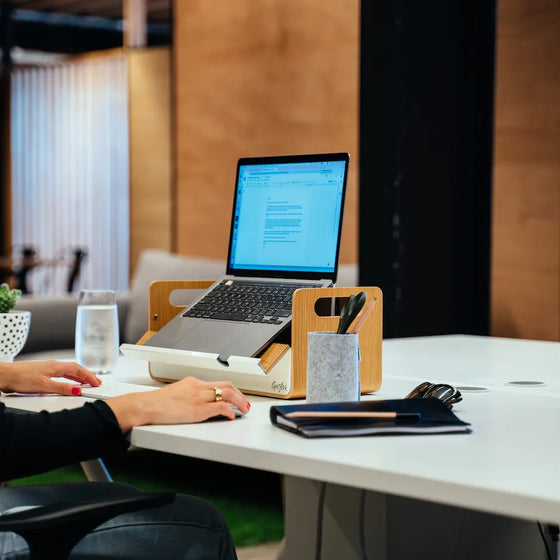
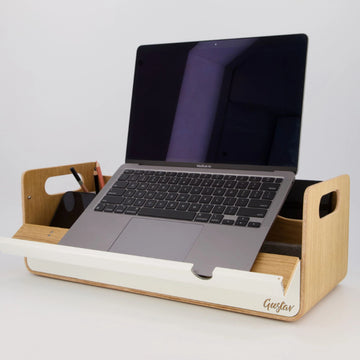
A portable organiser is usually the foundation. It gives every essential item a place - laptop, notebook, pens, charger, mouse, cable set and smaller personal tools. For desk-sharing environments, this is especially valuable because it lets the user arrive, place one object on the desk and begin working immediately.
The best organisers are structured rather than floppy, compact rather than oversized, and refined enough to move between home, office and client settings without looking purely utilitarian. This is where premium construction matters. Better materials hold shape, wear well and maintain a professional appearance over time.
Laptop stands and ergonomic risers
A laptop on a flat desk is one of the most common compromises in mobile work. It is also one of the easiest to improve. A portable stand raises the screen, supports a more natural viewing angle and makes short or medium-length sessions far more comfortable.
There is a trade-off here. The most compact stands are excellent for travel but may offer fewer height options. Larger models can feel more stable and ergonomic, but they take up more room in the bag. The right choice depends on whether mobility or adjustability is the higher priority.
Tech pouches and cable management
Cable clutter is small until it is everywhere. A dedicated pouch for chargers, adapters, earphones and power accessories prevents the low-level disruption that comes from untangling gear at every new location.
In shared offices, this matters beyond personal convenience. Loose accessories make desks look unfinished and create friction at the end of the day, when spaces need to be cleared quickly. Good cable organisation supports both individual efficiency and workplace discipline.
Desk mats and surface organisers
A desk mat may seem optional, but in flexible environments it serves several functions at once. It defines a personal work zone, protects the desk surface and gives a temporary workstation a more composed, professional feel. On unfamiliar desks, that sense of order is useful.
Surface organisers work in a similar way. They reduce visual noise and keep frequently used objects in place, which is especially helpful in open-plan settings where concentration is already under pressure.
Work bags designed around setup, not just storage
A standard bag carries items. A well-considered work bag supports the setup itself. That means internal structure, quick access, protected compartments and enough shape to move smoothly from transport to desk.
This is one of the most overlooked parts of a mobile system. If the bag makes items hard to reach, the setup slows down. If it collapses into a pile of loose gear, organisation disappears before the working day has even begun.
What separates useful accessories from disposable ones
The market is crowded with accessories made to solve isolated problems. A foldable stand here, a pouch there, a mat added almost as an afterthought. The better question is whether the pieces work together as a system.
That systems view is what sets apart truly effective mobile workspace accessories. They should support four things at once: portability, organisation, ergonomics and visual calm. If one comes at the expense of all the others, the result often feels compromised.
Material quality is part of that equation. For professionals and organisations investing in flexible work, accessories are not short-term gadgets. They are everyday tools, handled constantly, moved frequently and expected to look credible in a wide range of settings. Sustainably grown wood, recycled textiles and durable finishes do more than elevate aesthetics - they support longevity and reduce the cycle of cheap replacement.
Craftsmanship also influences behaviour. People are more likely to care for and consistently use accessories that feel considered. When an object is stable, intuitive and well made, it becomes part of the routine rather than another item to tolerate.
Mobile workspace accessories in shared office strategy
For workplace leaders, accessories are not just personal productivity tools. They are infrastructure for flexible work.
Desk sharing only works when employees can move through the office without losing efficiency or comfort. If every desk requires a fresh hunt for supplies, or every team member adapts differently to incomplete setups, the policy starts to feel like a cost-saving exercise rather than an improvement to workplace experience.
Portable workspace systems help close that gap. They allow staff to carry their essentials, set up quickly and leave no residue behind. That supports cleaner desks, faster desk turnover and a more consistent user experience across different zones.
For architects, designers and office planners, there is also a visual benefit. Mobile accessories that are refined, compact and materially coherent align far better with contemporary workplace design than an accumulation of ad hoc personal items. In other words, better tools support both function and fit-out intent.
Choosing the right setup for real working patterns
The ideal combination depends on how mobile the user really is. Someone travelling daily between home and office needs a lighter, more integrated kit than someone moving within one headquarters between focus rooms, meeting areas and shared desks.
For highly mobile users, compactness matters. A slim organiser, stable laptop stand and dedicated tech pouch will often cover the essentials. For office-based desk sharers, the emphasis may shift towards storage, desktop order and the speed of daily setup. For creative professionals or consultants who present often, visual polish and material quality can carry more weight because the tools are part of the professional impression.
At an organisational level, standardisation can help, but only to a point. Giving everyone the same kit creates consistency and simplifies procurement. Yet different roles have different needs. The strongest workplace strategies leave room for role-specific variation within a clear design and performance standard.
This is where brands such as Gustav sit in a useful position - not simply offering accessories as standalone products, but framing them as part of a coherent mobile workspace system designed for hybrid work, desk sharing and elevated daily use.
A better setup changes behaviour
People often talk about accessories as if they are optional finishing touches. In reality, they shape how work happens. They influence whether someone starts the day calmly or scrambles for cables. They affect whether a shared desk feels usable in seconds or awkward for half an hour. They determine whether flexible work looks clean and deliberate or temporary and improvised.
That is why the best mobile workspace accessories are not about adding more to carry. They are about carrying better. When each piece has a purpose, moves easily and earns its place, mobility stops feeling like compromise and starts feeling properly designed.
The useful question is not whether your team needs accessories. It is whether the current setup helps people work well wherever they land. If the answer is no, the fix is often smaller, smarter and more durable than expected.