10 Office Accessories for Architects

An architect’s desk rarely stays still for long. One hour it holds trace, material samples and a sketchbook. The next, it is supporting a laptop, review notes and a quick meeting with clients or consultants. That is exactly why the right office accessories for architects matter - not as decoration, but as tools that keep creative work precise, organised and easy to move between settings.
For architects working across studio desks, home offices and shared workplaces, accessories need to do more than look good. They should reduce visual noise, protect focus and support a setup that can adapt without losing quality. A polished workspace is valuable, but a useful one is what carries the day.
What architects actually need from office accessories
Architecture work sits at an unusual intersection. It is highly creative, but it is also deeply technical. That means accessories have to support concentration, drawing, digital production and presentation without creating clutter.
A generic desk setup often misses this balance. Standard office accessories can feel too corporate for design work or too casual for technical tasks. Architects usually need products that are clean in form, durable in daily use and practical enough for changing workflows.
The best choices usually serve at least one of three purposes. They improve ergonomics during long design sessions, create order around tools and tech, or make it easier to move between workstations. When an accessory only adds visual interest, it tends to earn less desk space over time.
Office accessories for architects that earn their place
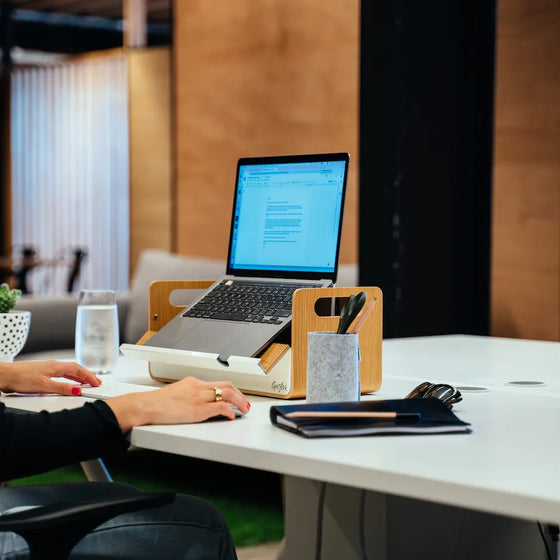
A laptop stand for healthier working angles
Many architects spend a large part of the day switching between CAD software, email, mark-ups and video calls. A laptop stand is one of the simplest upgrades because it lifts the screen to a more comfortable height and creates a clearer working posture.
This matters even more in hybrid setups where a permanent monitor is not always available. In a studio with hot desks, or at home where the dining table occasionally becomes the office, a portable stand helps create a consistent setup in seconds. The trade-off is that it usually works best with an external keyboard and mouse, so it should be considered part of a wider ergonomic system rather than a standalone fix.
A desk organiser that controls small-format chaos
Architects accumulate small essentials quickly: pens, scale rulers, sticky notes, charging cables, memory cards and adapters. Left loose, these items create friction all day. A good desk organiser restores order without turning the workspace into storage furniture.
The key is restraint. Too many compartments can be as distracting as none at all. A compact organiser with a clear layout is often the better choice, especially in shared offices where employees need to set up and pack down efficiently. Premium materials also make a difference here. Accessories handled every day should feel solid, not disposable.
A desk mat that defines the workspace
A desk mat is often overlooked because it seems optional. In practice, it can be one of the most useful accessories on the desk. It creates a visual boundary for work, softens the feel of hard surfaces and gives everyday objects a more intentional place.
For architects, that matters because the desk often becomes a changing project surface. A mat helps unify laptop, notebook, mouse and writing tools into one calm zone. It can also protect the desk from repeated movement of samples or equipment. The best versions avoid excess thickness and visual fuss. They should support the work, not compete with it.
Ergonomic accessories for architects in hybrid work
A portable keyboard and mouse
If a laptop stand raises the screen, a separate keyboard and mouse complete the setup. For architects moving between office locations, this is often more realistic than expecting every desk to offer the same ergonomic standard.
There is an obvious portability trade-off. Added peripherals mean more to carry. Yet the gain in comfort and control is usually worth it, particularly for long technical sessions. Compact models are often the right answer - enough travel and accuracy to feel reliable, without adding unnecessary bulk to the work bag.
A task light with focused illumination
Not every architect spends the day reading paper drawings under a lamp, but good lighting still matters. Screen work, sketching, note-taking and material review all benefit from clearer, more directed light, especially in winter months or in home office corners not designed for professional use.
The right task light should improve visibility without flooding the desk. Adjustable brightness is useful, but so is a simple footprint. On a crowded desk, oversized lighting quickly feels intrusive. If the office already has strong ambient lighting, this accessory may be less urgent. In lower-light spaces, it can make a noticeable difference to eye comfort and concentration.
Accessories that support movement between desks
A tech pouch for cables, chargers and adapters
Few things undermine a mobile workflow faster than hunting for a USB-C adapter five minutes before a presentation. A structured tech pouch keeps cables, chargers, pens and small devices together so the essentials move as one unit.
For architects, this is especially useful because the toolset is rarely limited to a laptop alone. Mobile phones, tablets, styluses, storage devices and connectors all need a home. The best pouches are easy to open, easy to scan and compact enough to slip into a larger bag. Overdesigned interiors can be surprisingly frustrating in real use.
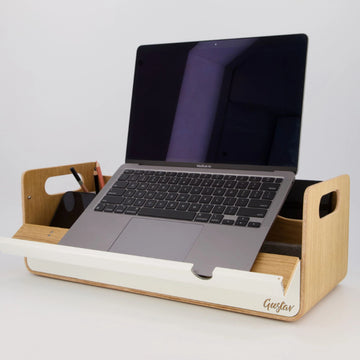
A portable desk organiser for desk-sharing environments
In flexible workplaces, permanence is no longer guaranteed. Architects may work from a studio bench one day, a touchdown desk the next and home on Friday. In that context, a portable organiser is less of an accessory and more of a workflow tool.
It allows the user to carry their core setup, place it on the desk and start immediately. That reduces setup time, supports clean desk policies and creates a sense of continuity across locations. For firms adopting activity-based working, this type of accessory has strategic value as well as individual appeal. Gustav has built a strong case for this category by treating portability and order as part of one system rather than separate problems.
Design quality still matters
Architects notice proportion, finish and material quality. That does not mean every accessory needs to be expressive or sculptural. It means poorly considered products stand out quickly.
The best office accessories for architects tend to share a few qualities. They use materials that age well, forms that stay quiet on the desk and details that feel deliberate. Sustainably sourced wood, recycled textiles and durable construction are not just brand signals. They suggest a product made to stay in service rather than be replaced at the first sign of wear.
That matters for another reason too. In design-led workplaces, accessories contribute to the wider atmosphere of the office. A cluttered collection of mismatched plastic tools can make even a well-designed space feel unresolved. A more coherent set of accessories supports the calm, professional environment many studios are trying to create.
How to choose office accessories for architects without overfilling the desk
A better desk is not built by adding more objects. It is built by removing friction. That usually means choosing accessories according to how the work is done rather than how the desk should look in a photograph.
Start with the problems that repeat. If posture collapses by midday, prioritise a laptop stand and keyboard. If cables and stationery spread across the desk, add a compact organiser or tech pouch. If every move between office and home creates disruption, focus on portability first.
It is also worth considering the type of architecture work involved. A concept-focused designer who sketches constantly may benefit more from a desk mat and task light. A project architect spending long hours in BIM software may feel the strongest gains from ergonomic accessories. There is no single perfect set because workflows vary across roles, teams and stages of a project.
The stronger approach is to build a compact system where each item has a clear purpose. When accessories are chosen this way, the desk feels lighter, not fuller.
A well-equipped workspace should not draw attention to itself. It should simply make the day run better - from first sketch to final review, and from one desk to the next.