What Is Desk Hoteling and How Does It Work?

Monday morning in a hybrid office often starts with the same small friction point - where do I sit, and will this desk actually work for the way I work? That is exactly why the question what is desk hoteling matters. It is not just another workplace term. It is a practical operating model that shapes how people move through the office, how space is used, and whether flexible work feels efficient or chaotic.
What is desk hoteling?
Desk hoteling is a workplace system where employees reserve a desk in advance for a specific day or time period, rather than having a permanently assigned workstation. The idea is simple: desks are shared, but not on a first-come, first-served basis. People book the space they need, use it for the scheduled period, then clear it for the next person.
The hotel analogy is useful because the desk is treated much like a room booking. You do not own it. You use it when needed. Then it becomes available again. In most organisations, bookings are managed through workplace software, though some smaller teams still rely on internal calendars or manual systems.
For employers, this makes office capacity more adaptable. For employees, it can support hybrid work without forcing everyone back into fixed seating patterns that no longer match how often they are actually on site.
How desk hoteling differs from hot desking
Desk hoteling and hot desking are often used interchangeably, but they are not quite the same.
With hot desking, employees choose from available desks when they arrive. There is usually no prior reservation. That can work in fast-moving environments, but it also creates uncertainty. Staff may struggle to sit near their team, find the right equipment, or secure a suitable setup during busy periods.
Desk hoteling adds structure. Because desks are booked ahead of time, teams can plan around attendance, managers can understand demand, and employees have more confidence that a workspace will be ready when they arrive. In design terms, it is the more intentional version of shared seating.
That distinction matters. A flexible office should still feel calm, usable and well considered. Hoteling tends to deliver that better than a purely informal desk-sharing model.
Why companies use desk hoteling
The rise of hybrid work changed the maths of office space. In many organisations, assigned desks were sitting empty for much of the week while occupancy patterns shifted daily. Desk hoteling emerged as a more efficient response.
At a property level, it helps businesses use square metreage more intelligently. If a team is only in the office two or three days a week, there is often little value in maintaining a dedicated desk for every individual. Hoteling allows the workplace to flex with actual demand rather than old assumptions.
But cost reduction is only part of the picture. For many workplace leaders, the stronger argument is experience. A well-run hoteling system can support collaboration days, project-based seating, quiet work zones and better visibility over how space is used. It can also reinforce clean desk policies, which are increasingly relevant in shared offices where order, hygiene and security all matter.
For designers and facilities teams, hoteling creates clearer planning data. You can see which areas are popular, which settings are underused, and where the office needs better ergonomic support or more storage. That kind of feedback is valuable when refining a workplace over time.
What a desk hoteling setup usually includes
The most effective hoteling environments are built around more than booking software. The desk reservation system is only one layer. The physical experience matters just as much.
Typically, a desk hoteling setup includes shared workstations, digital booking tools, clear zoning, and a clean desk standard between users. In stronger implementations, it also includes lockers or personal storage, consistent monitor and power access, and portable accessories that help employees recreate a familiar setup quickly.
This is where many offices either succeed or fall short. If employees arrive at a booked desk and still need to hunt for a charger, adjust poor screen height, or manage cables and personal items with nowhere to place them, the model starts to feel inefficient. A flexible workplace needs a reliable baseline. Booking a desk should remove uncertainty, not shift it elsewhere.
The benefits of desk hoteling
When desk hoteling is properly planned, it can improve both workplace efficiency and day-to-day usability.
One clear benefit is space optimisation. Offices can support fluctuating attendance without carrying large areas of underused desks. That is especially relevant for organisations balancing headcount growth with pressure on real estate costs.
Another is flexibility. Teams can book spaces that suit the work they are doing that day, whether that means sitting together for a workshop, choosing a quieter zone for concentrated work, or selecting a desk close to meeting rooms.
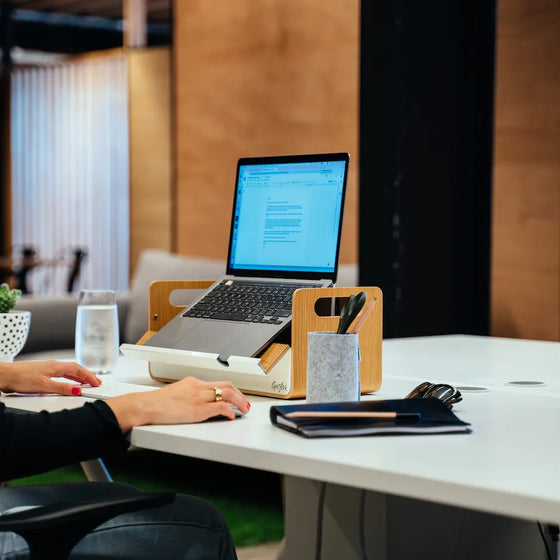
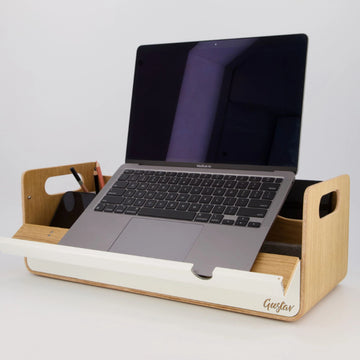
There is also a consistency benefit when the system is supported by the right physical tools. Portable desk organisers, laptop stands, mats and pouches can help employees move between desks while maintaining a familiar, professional setup. In desk-sharing environments, mobility is not a luxury. It is what turns movement into continuity.
From a cultural perspective, desk hoteling can encourage a more active use of the office. People come in with greater purpose. The workplace becomes less about assigned territory and more about access to the right setting for the task.
The trade-offs to consider
Desk hoteling is not automatically better. It works well in some environments and poorly in others.
The most common challenge is the loss of personal ownership. Some employees value a dedicated desk because it gives them a sense of routine and belonging. Removing that can create friction, particularly if the wider office experience feels impersonal or inconsistent.
There is also a behavioural risk. If booking rules are unclear, people may reserve desks they do not use, occupy spaces without booking them, or leave workstations untidy for the next colleague. That quickly erodes trust in the system.
Ergonomics can be another weak point. Shared desks need to accommodate different users, but standardised furniture alone does not solve that. People still need an easy way to adjust their setup, position screens correctly, and keep essentials organised. If they cannot do that in seconds, hoteling starts to feel like compromise dressed up as flexibility.
For some roles, the model simply may not fit. Teams handling sensitive materials, specialist equipment or high-frequency office attendance may still need dedicated stations. The right answer depends on the work, not just the occupancy spreadsheet.
How to make desk hoteling work in practice
A successful system starts with clarity. Employees need to know how to book, when to cancel, what each desk includes, and what condition it should be left in. Without that, even attractive office design cannot compensate.
The next priority is consistency. Shared desks should offer a dependable foundation every time: power, display access, good lighting, comfortable seating and enough surface order to work immediately. This is where compact, portable workspace tools become particularly useful. They reduce setup time, minimise clutter and help individuals carry their preferred work essentials from place to place without turning each morning into a reset.
It also helps to think in layers. Not every desk needs to be identical, but every desk should be legible. People should understand which spaces are for focused work, which are for touchdown use, and which are intended for team collaboration. Hoteling works best when choice is deliberate rather than random.
Storage deserves more attention than it usually gets. If employees are expected to clear desks at the end of the day, they need somewhere practical for documents, devices and personal items. Otherwise, clutter migrates from the desktop to the wider office.
Finally, measure what is happening. Booking data, occupancy reviews and employee feedback all reveal whether the system is supporting work or merely enforcing policy. Often the issue is not desk hoteling itself, but a gap between the intended experience and the real one.
What is desk hoteling best suited for?
Desk hoteling is usually best suited to hybrid organisations where office attendance varies by day, and where employees do not need permanent access to the same workstation. It often works well for knowledge workers, consultants, sales teams, project groups and cross-functional departments that split time between home, client sites and the office.
It can also suit design-led workplaces that want to maintain a clean, uncluttered environment without sacrificing functionality. In those settings, the combination of shared desks and well-designed mobile accessories is particularly effective. The workspace stays visually calm, while individuals still have what they need to work comfortably.
Where it is less suitable is in environments with highly fixed routines, limited digital adoption, or poor change management. If the office culture is not ready for shared use, the system can feel imposed rather than useful.
The real question behind desk hoteling
When people ask what is desk hoteling, they are often asking something slightly deeper: can a shared office still feel professional, personal and productive? The answer is yes, but only if flexibility is designed properly.
A desk booking platform may define the process, but the everyday experience comes down to details - how quickly someone can settle in, how easily they can work ergonomically, and whether the space feels considered rather than temporary. That is why the strongest desk hoteling environments combine policy, planning and physical tools in equal measure.
For workplace leaders, the goal is not simply to fit more people into fewer desks. It is to create a system people will actually want to use. When shared workstations are organised, comfortable and ready to perform, flexible working stops feeling improvised and starts feeling intentional. That is where desk hoteling becomes genuinely valuable.