Why Use a Laptop Riser at a Flexible Desk?

A laptop is designed to travel. It is not always designed to sit at the right height on every desk you use. That is why use a laptop riser is a practical question for anyone moving between home, shared desks and office touch-down spaces. A well-designed riser gives the screen a more considered position, creates space around the keyboard and helps a temporary workstation feel deliberate from the first minute.
For hybrid teams, this is not a minor desk accessory. It is part of creating a consistent working experience wherever the day happens.
Why use a laptop riser for better screen height?
When a laptop sits directly on a desk, its screen usually sits below a comfortable viewing level. This often encourages users to angle their head downwards for long periods, particularly during focused work, video calls and reading-heavy tasks. A laptop riser raises the display closer to eye level, supporting a more upright and natural working position.
The right height depends on the individual, the chair, the desk and the laptop itself. There is no single setting that suits everyone. The aim is simple: place the top portion of the screen nearer to your natural line of sight, without forcing you to lift your shoulders or crane your neck.
A riser is especially useful when working from dining tables, hotel desks or shared office benches, where furniture is rarely adjusted for one person. Instead of accepting an awkward setup, you can make a meaningful improvement in seconds.
A raised screen works best with an external keyboard
There is an important trade-off. Raising a laptop also raises its built-in keyboard and trackpad. For occasional email or short tasks, this may be perfectly workable. For longer sessions, an external keyboard and mouse allow you to keep the display elevated while positioning your hands at a more comfortable desk height.
This two-part arrangement is often the most effective setup for regular laptop work. The riser supports the screen; the separate input devices support a more relaxed arm and wrist position. It also gives you greater freedom to place each element where it works best, rather than accepting the fixed geometry of a laptop.
A clearer desk supports clearer work
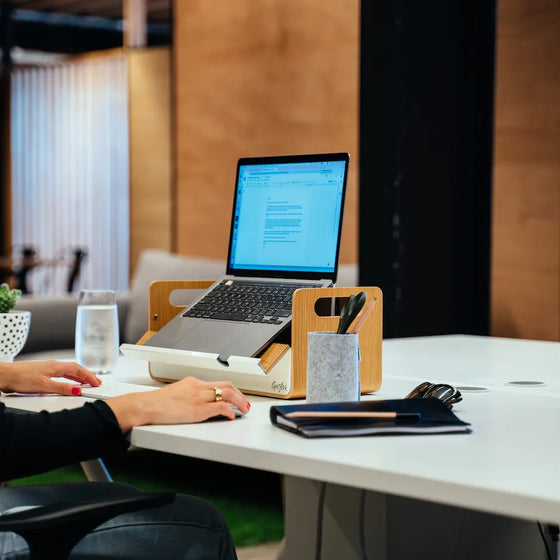
The most visible benefit of a laptop riser is height. The quieter benefit is order. Raising the device creates usable space beneath it for a notebook, keyboard, charging cable or the small essentials that otherwise spread across a desk.
That matters in workplaces built around desk sharing and clean-desk policies. A temporary desk can quickly become cluttered with adapters, headphones, documents and personal devices. A riser gives the laptop a defined footprint and helps establish visual structure around it. The result is a workspace that feels calmer, even when the available surface is limited.
For home offices, the same principle helps a work area sit more comfortably within a living space. A considered arrangement can make it easier to set up for work in the morning and restore the table when the day is done. Good organisation is not about adding more objects. It is about giving the essential ones a clear role.
Why use a laptop riser in a desk-sharing office?
In a dedicated office, people can gradually refine their setup over time. In a desk-sharing environment, that luxury disappears. Each workstation needs to work for different people, different tasks and different devices throughout the week.
A portable laptop riser brings a degree of personal adjustment to a shared setting without changing the furniture itself. Employees can arrive, place their laptop at a suitable height, connect the tools they need and begin work with less compromise. At the end of the day, the setup can be packed away just as quickly.
For workplace planners and facilities teams, this offers a practical way to support varied users without filling every desk with permanent accessories. It keeps shared surfaces adaptable and visually clean, while giving people a tangible tool for shaping their own work position.
There is also an employee-experience benefit. Flexible working should not mean starting from zero every time someone changes location. A familiar, portable setup creates continuity between home, office and client site. The desk may change, but the working ritual remains recognisable.
Portability matters as much as ergonomics
A riser that stays in a drawer solves only part of the problem. For hybrid work, it needs to be light enough to carry, slim enough to store and durable enough to use repeatedly. The best design removes friction from the daily transition between locations.
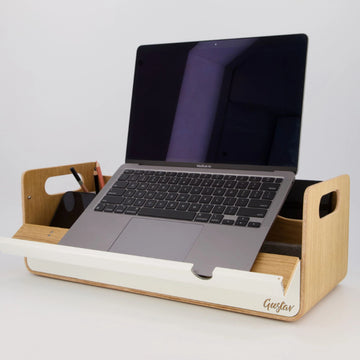
Look for a form that packs flat and opens without complicated assembly. Stability is equally important. The laptop should feel secure while you type, join calls or adjust the screen angle, and the feet should help protect the desk surface from slipping or marking.
Material choice also shapes the experience. Premium materials can make a practical object feel at home in both a carefully designed office and a domestic setting. Sustainably grown wood and recycled materials, used thoughtfully, bring warmth and purpose to an object that is handled every day. Durability matters here too: a mobile accessory should be made for the routine of commuting, moving between rooms and setting up repeatedly.
Better video calls begin with camera position
Laptop risers also improve how people appear on screen. With a laptop placed low on the desk, the camera often points upwards, producing an unflattering angle and making eye contact feel less natural. Raising the device brings the camera closer to face height, creating a more composed presence in meetings.
This is valuable for client conversations, interviews, workshops and internal collaboration alike. It does not replace good lighting or a quiet room, but it gives the call a more professional starting point. In a hybrid workplace, where a large part of interaction happens through a screen, small details of setup carry real weight.
If you use an external monitor for most desk-based work, a laptop riser can still have a role. It can position the laptop as a second display for chat, notes or video calls, while keeping the main screen centred in front of you. The right arrangement depends on the task, but a riser gives you more options.
Choosing the right laptop riser
Not every riser is suited to every working pattern. A fixed stand may be ideal for a permanent home office, where screen height can remain consistent. A foldable or portable design is usually better for desk sharing, commuting and work across several locations.
Consider the size and weight of your laptop, the space available in your bag and whether you normally use a separate keyboard and mouse. Check how quickly the riser can be deployed, whether it offers a stable angle and how it sits alongside your other essentials. A product that looks elegant but is inconvenient to carry will soon be left behind.
For organisations, consistency is worth considering as well. Providing a coherent set of portable workspace tools can help employees create an effective desk setup with less guesswork. It also supports a more intentional visual language across shared spaces - functional, uncluttered and ready for the next person.
A small object with a wider workplace role
A laptop riser will not solve every ergonomic challenge. Chair height, desk depth, screen glare, lighting and the length of time spent in one position all matter. But it is one of the simplest ways to improve the relationship between a person, a laptop and a temporary desk.
Gustav approaches this kind of object as part of a complete mobile workspace: tools that carry easily, organise quickly and make any suitable surface feel more prepared for focused work. The value is not in raising a device for its own sake. It is in making the everyday act of setting up feel more comfortable, composed and repeatable.
Choose a riser that suits the way you actually work, then let it become part of the routine: unpack, raise the screen, clear the surface and make the desk yours.