How to Create Ergonomic Portability

A laptop on a shared desk can look efficient right up until hour two. Your shoulders rise, your neck folds forward, cables spill across the surface, and the promise of flexible work starts to feel physically expensive. That is usually the moment people ask how to create ergonomic portability - not as a design trend, but as a practical requirement for working well across home, office and in-between.
Ergonomic portability means building a setup that moves easily without forcing you to compromise on posture, comfort or focus. It is not about carrying less at any cost. It is about carrying the right tools in a format that lets you set up quickly, work properly and leave the space as clean as you found it.
What ergonomic portability actually means
Portability on its own is easy. A laptop and charger in a tote bag are portable. Ergonomics on its own is also easy if you never move - a fixed desk, monitor arm and full-size peripherals solve most problems. The challenge is combining both.
To create ergonomic portability, you need a system rather than a collection of objects. Each item should earn its place by improving either posture, organisation or speed of setup. Ideally, it does all three. If one accessory adds bulk without making work more comfortable, it is not helping. If another improves comfort but takes too long to unpack and arrange in a shared office, people will eventually stop using it.
That balance matters in hybrid workplaces, desk-sharing environments and home offices where the workspace changes regularly. The best portable setup feels consistent even when the desk is not.
Start with posture, not products
The most useful way to approach how to create ergonomic portability is to work backwards from the body. A mobile setup should support a neutral viewing angle, reduce wrist strain and help you avoid the rounded posture that laptop-only working often creates.
For most people, the first issue is screen height. A laptop places the display too low and the keyboard too high to be ideal for long sessions. You can tolerate that for a train journey or a quick meeting. You should not build your full workday around it.
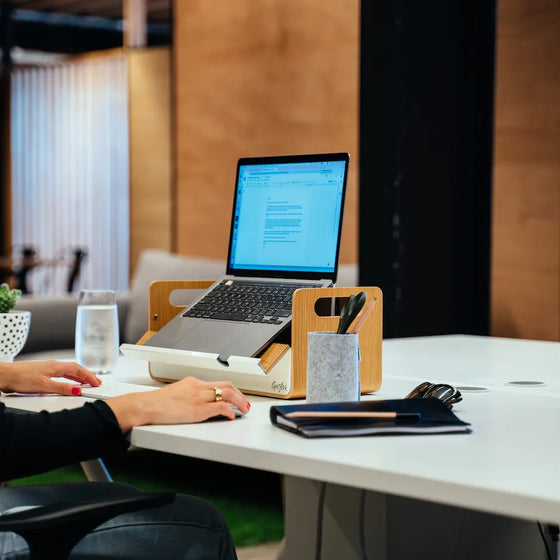
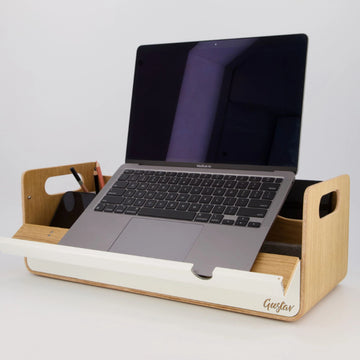
That is why a portable laptop stand often becomes the anchor of an ergonomic setup. It lifts the screen to a more comfortable height, which encourages a more upright posture. But there is a trade-off. Once the laptop is raised, you need an external keyboard and mouse to work properly. True ergonomic portability is rarely one item. It is a coordinated set.
If your work is highly mobile and you move several times a day, a lighter stand with a slim keyboard may be the right compromise. If you typically commute once and stay put for the day, you can justify a slightly more substantial setup with better support. The right answer depends on how often you move, how long you work in each location and how sensitive you are to physical strain.
How to create ergonomic portability with a portable system
A portable workspace works best when it is arranged as one repeatable kit. That usually includes a laptop stand, compact keyboard, mouse, charger, and a way to store cables and small essentials without clutter. In many cases, a desk mat or organiser also plays an important role because it defines your working zone and speeds up setup.
This matters more than it may seem. In a desk-sharing office, friction kills good habits. If it takes ten minutes to unpack, untangle and position everything, people will skip steps. They will work directly from the laptop, balance accessories awkwardly, or spread across the desk in a way that feels temporary and inefficient.
A well-designed portable system reduces those decisions. Items have a fixed place. The setup sequence is obvious. The desk feels intentional within seconds. That is where ergonomic portability becomes valuable not just for individuals, but for workplace teams trying to support consistent employee experience across flexible environments.
Choose tools that travel as well as they work
Portable accessories should feel stable in use and compact in transit. That sounds straightforward, but many products do one well and fail at the other. Some fold down neatly but wobble when typing. Others are excellent on the desk and frustrating in a bag.
Look closely at the transitions. How quickly does the stand open? Does the keyboard fit naturally with the organiser or pouch you use? Can cables be packed without creating a tangled bundle? Do materials feel durable enough for daily movement between locations?
Premium materials and thoughtful construction are not just aesthetic decisions here. They affect daily handling, longevity and the overall calm of the setup. A portable workspace should not feel improvised. It should feel as considered as a fixed one.
Build around your most common work mode
Not every mobile worker needs the same kit. A consultant moving between client sites has different needs from an architect in a studio hot-desking three days a week. A home-office user may want a setup that stores away cleanly at the end of the day, while a facilities team may need solutions that support clean desk policies across an entire floor.
The simplest approach is to define your main work mode. If you mostly do focused desk work, prioritise support and comfort. If you spend much of the day in meetings, reduce weight and optimise for fast transitions. If your setup needs to move between home and office, focus on a system that can be packed once and used consistently in both places.
This is where many people overcomplicate things. They try to prepare for every possible scenario and end up carrying too much. Ergonomic portability is better when it is edited.
Organisation is part of ergonomics
People often treat ergonomics as posture alone, but physical comfort is shaped by how the workspace functions. Reaching across clutter, searching for adapters, or constantly shifting items to make room for a notebook adds friction and strain over time.
A portable organiser, tech pouch or structured work bag can make a surprising difference. When tools are easy to access and return, setup becomes faster and the desk stays clearer. That supports better positioning of the essentials you use most.
A desk mat can also contribute more than many expect. In flexible offices, it creates visual order and defines a personal work zone on changing surfaces. Practically, it helps align keyboard, mouse and notebook placement, which supports more consistent movement throughout the day. The effect is subtle, but in agile environments subtle improvements often matter most because they are repeated every day.
Design for short setup time
If you are serious about how to create ergonomic portability, aim for a setup that takes under two minutes from bag to ready. That threshold matters because it keeps the system realistic on busy mornings and between meetings.
To get there, reduce loose items. Group accessories together. Avoid duplicate cables for devices you rarely use. Keep your most important ergonomic components immediately accessible rather than buried at the bottom of a bag.
For workplace decision-makers, this principle scales. Employees are more likely to adopt portable ergonomic tools when the kit is intuitive, compact and easy to store. Good workplace design is not only about what performs well on paper. It is about what people will genuinely use every day.
Support movement without normalising discomfort
There is a difference between a mobile workspace and a compromised one. Portability should support movement, not excuse poor physical conditions. If a setup leaves people leaning forward for hours or working from unsuitable surfaces day after day, mobility has been prioritised at the expense of wellbeing.
That is why the most effective portable solutions combine compact form with proper support. A raised screen, external input devices, organised essentials and a stable work surface create a setup that travels without feeling temporary. For employers, this is also part of creating a flexible office that feels credible. Staff can adapt to different desks and locations more confidently when the tools themselves are well resolved.
In design-led workplaces across Europe, this has become increasingly relevant. Flexible work is no longer a temporary adjustment. It is an operating model. Portable ergonomics should be treated with the same seriousness as fixed workstation planning.
Keep refining the system
The best portable setup is rarely perfect on day one. It improves through use. You notice that one cable is too long, the bag pocket is in the wrong place, or the keyboard is compact enough to carry but not pleasant enough to use for six hours. Those details matter.
Refinement is part of the process. Remove what you never use. Upgrade the items that directly affect posture and workflow. Pay attention to how the setup feels at the end of the day, not just how it looks when packed.
A well-made portable workspace should leave you with two impressions. First, it should feel easy to carry. Second, once opened, it should feel like a proper place to work. That is the standard worth aiming for.
When you create ergonomic portability well, mobility stops feeling like a compromise. It becomes a more deliberate, more comfortable way to work wherever the desk happens to be.